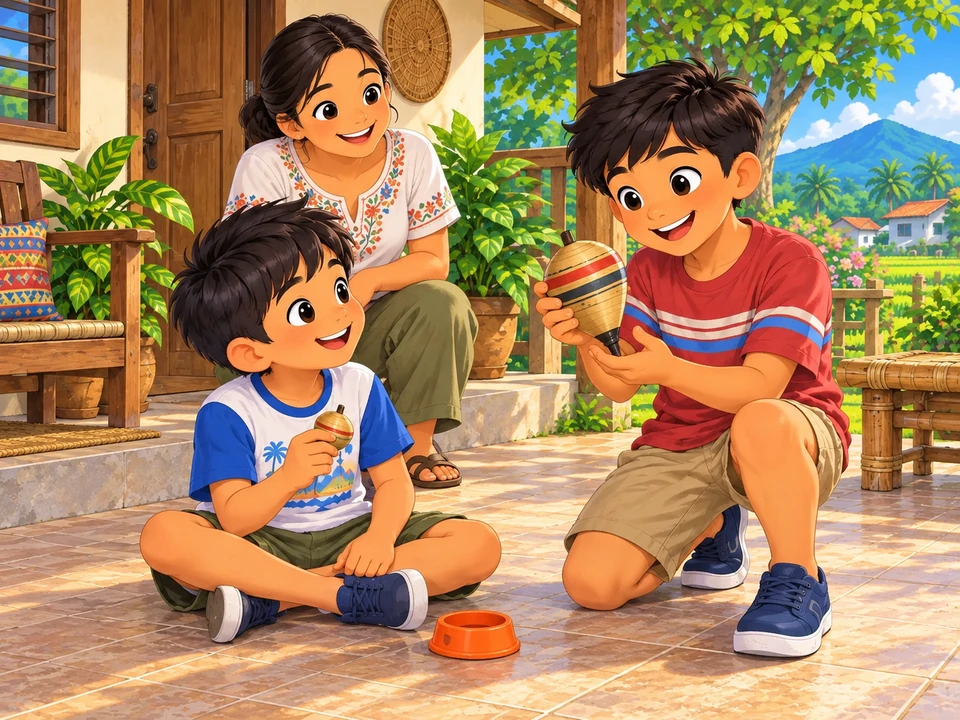
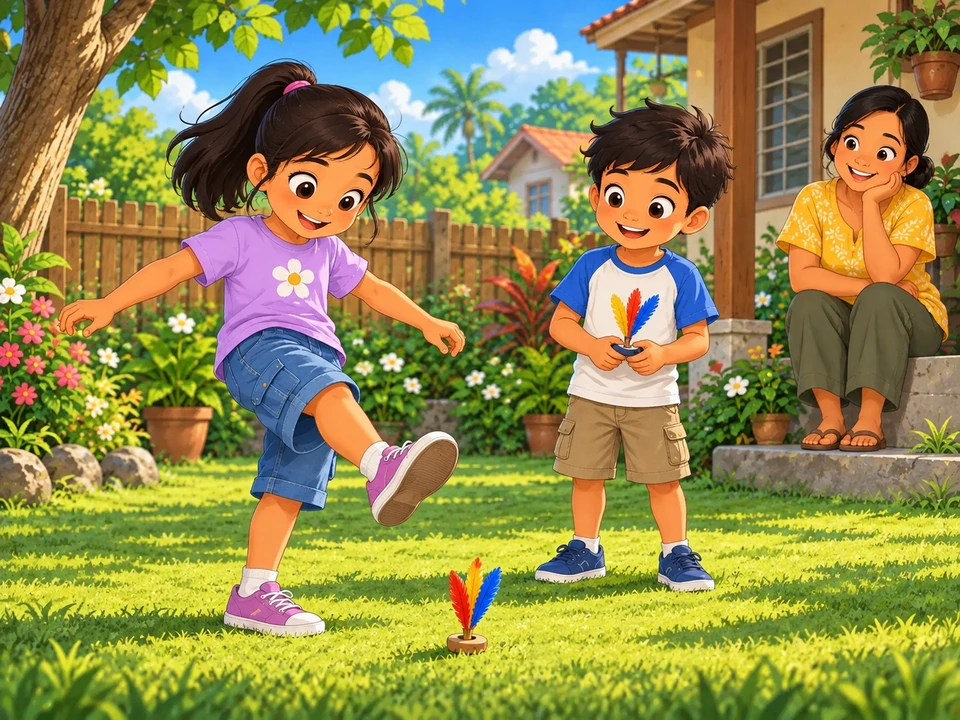
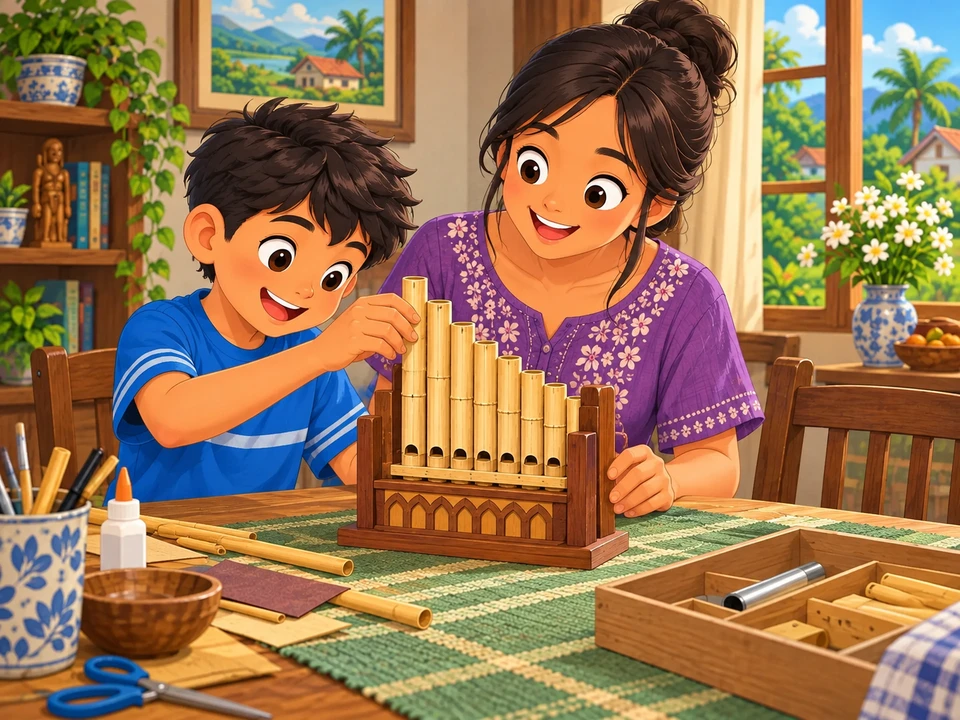
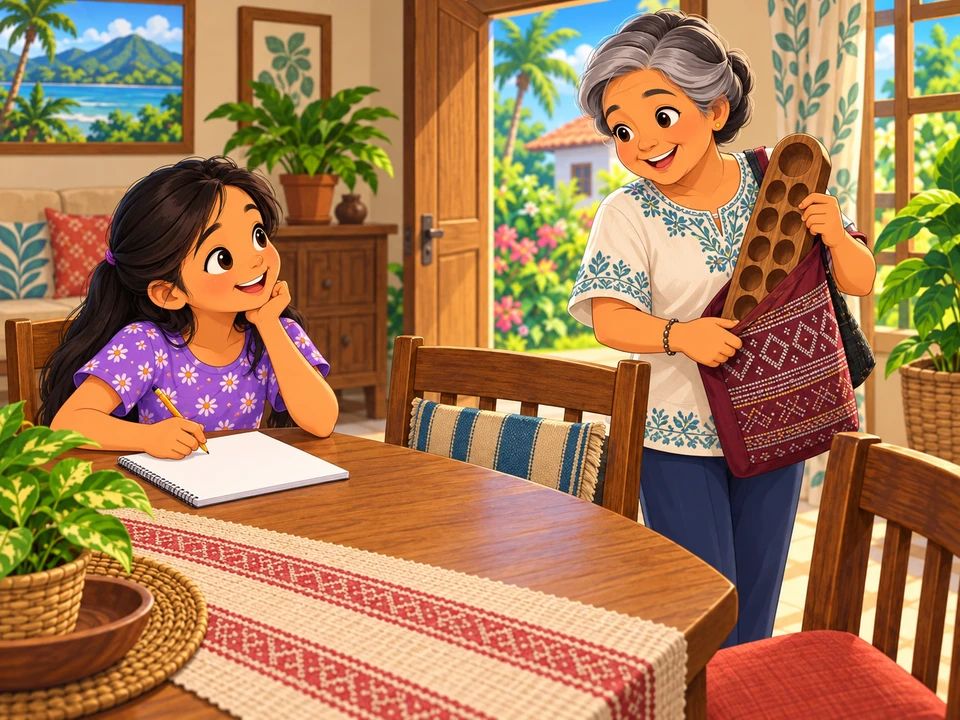
600 original practice passages for Grades 4–6, in English and Filipino. Pick one to try it in the demo.
Grade 4
Seeds on a Sock
Grade 4 · English
Ben came home with small burrs on his sock. He sat beside the doorway and picked off a burr with tiny hooks. “Did this plant…
Read the whole passage
Ben came home with small burrs on his sock. He sat beside the doorway and picked off a burr with tiny hooks.
“Did this plant bite me?” he asked.
His aunt smiled. “Some seeds catch on cloth and ride to a new place.”
Ben looked back at the path. He had walked all the way from the field.
“Then my sock was a bus!” he said. He set the burr on a sheet of paper.
Mia ran out to play after lunch but stopped and pointed up. A pale Moon hung in the blue sky. “You forgot to go home!”…
Read the whole passage
Mia ran out to play after lunch but stopped and pointed up. A pale Moon hung in the blue sky.
“You forgot to go home!” she called.
Her brother laughed. “We can see the Moon by day, too.”
Mia had only looked for it at night. Now she stood still and looked again.
The Moon had not made a mistake. Mia had found something new in a sky she saw every day.
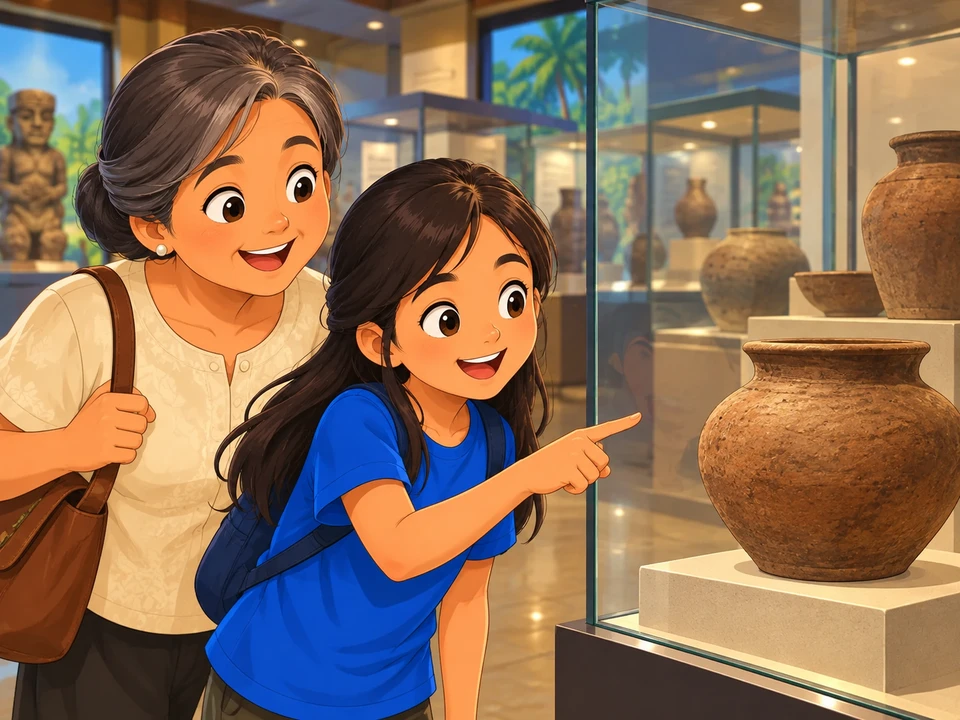
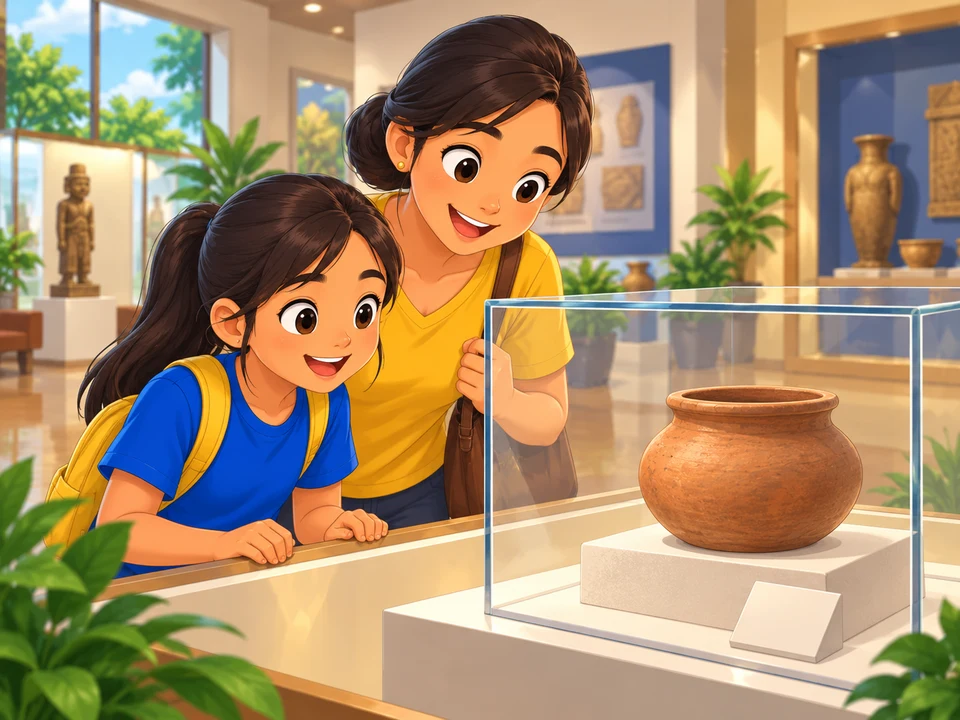
Nora stopped by a brown pot behind glass. She had come to see gold and jewels. “Why is that here?” she asked. “The museum keeps…
Read the whole passage
Nora stopped by a brown pot behind glass. She had come to see gold and jewels.
“Why is that here?” she asked.
“The museum keeps pots used for cooking, too,” said Lola.
Nora leaned closer but did not touch the glass. She thought of the pot at home and meals they shared.
“Was this part of someone's day?” she asked.
Now she wanted to know whose hands had held it.
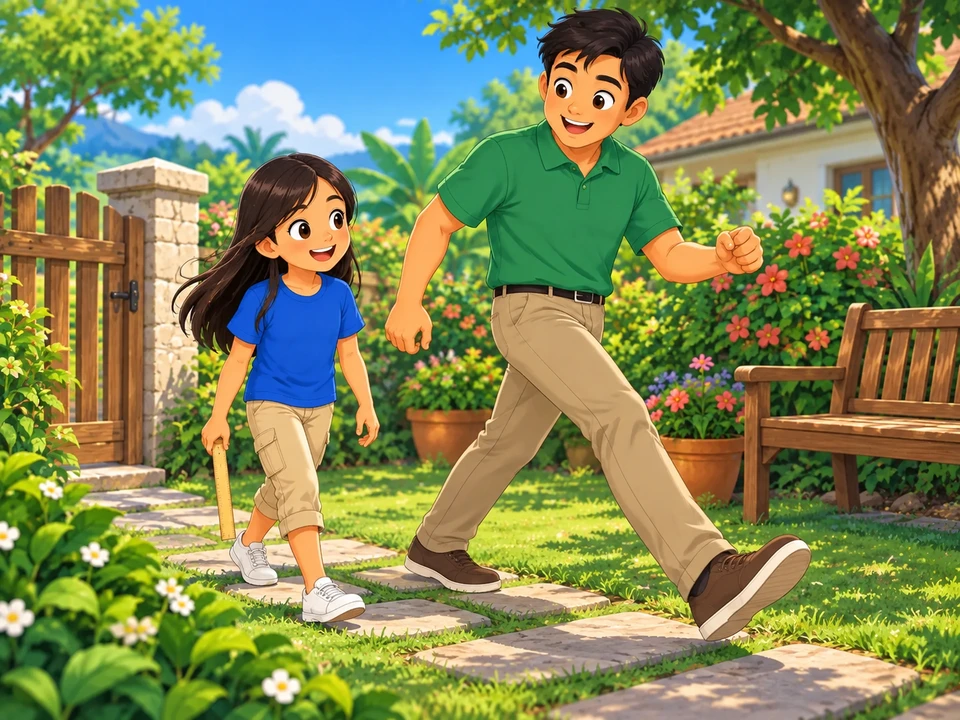
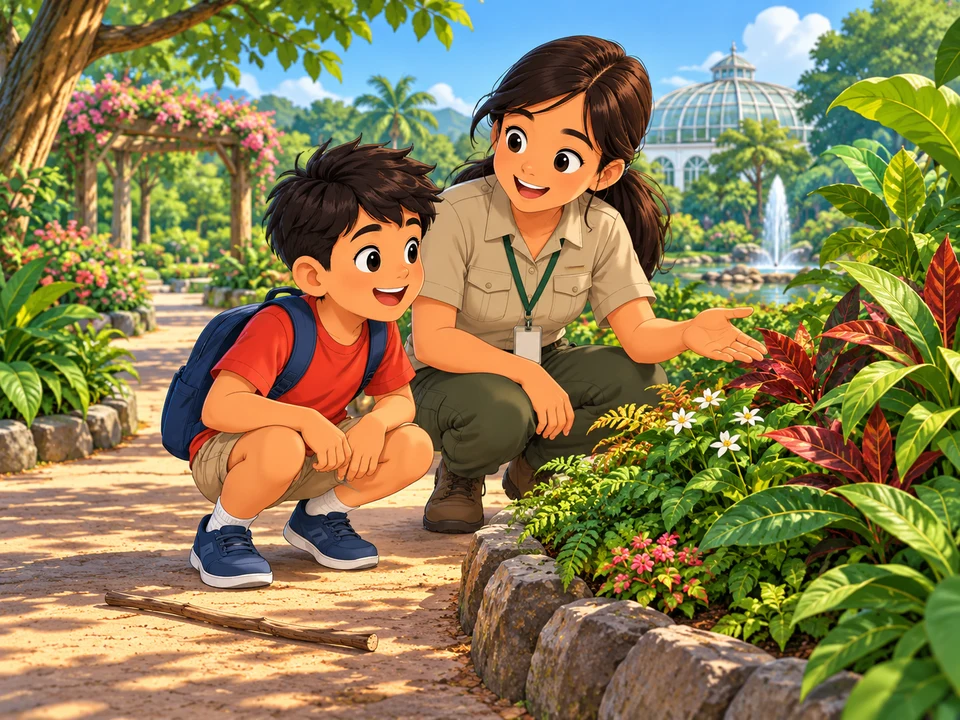
Ana took ten steps from the gate to a bench. Her father tried it and took just six. “Did our path shrink?” she asked. They…
Read the whole passage
Ana took ten steps from the gate to a bench. Her father tried it and took just six.
“Did our path shrink?” she asked.
They went back to the gate. Ana watched his feet this time. His long steps covered more ground than her short ones.
“Let's use this stick to check,” she said.
They laid it end to end along the path. The bench had not moved at all.
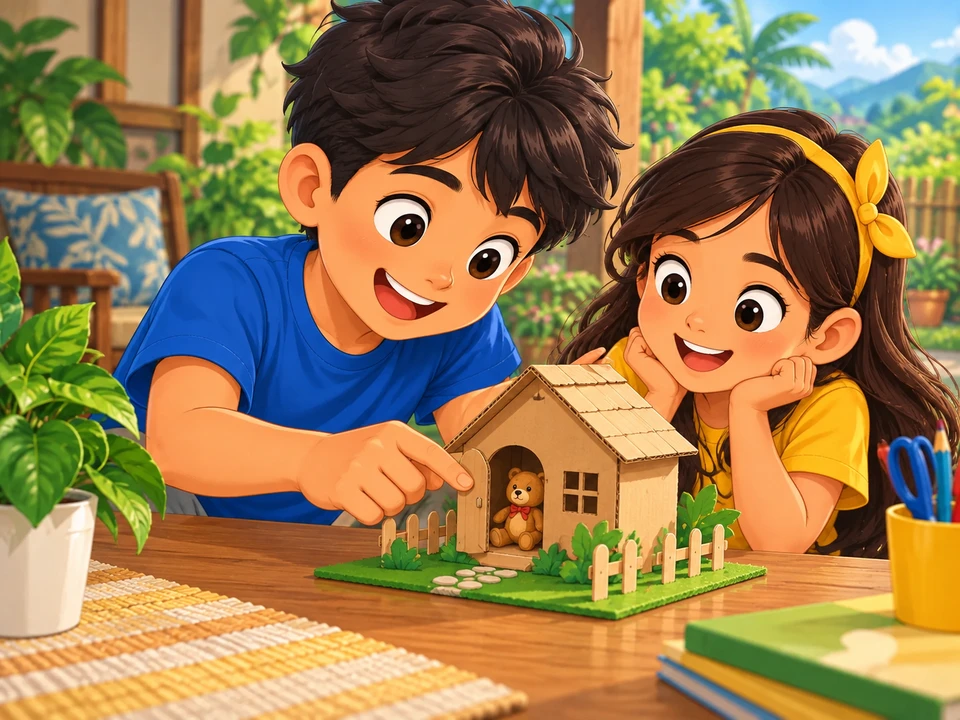
Luis made a tiny house from a box. He put his toy bear inside. Then he bent down beside the table to tell it a…
Read the whole passage
Luis made a tiny house from a box. He put his toy bear inside. Then he bent down beside the table to tell it a tale.
“A giant came to the door,” he began.
His sister peered under his arm. “Where is the giant?”
Luis looked at his hand beside the little door. He grinned.
To his toy bear, Luis was the giant. He tapped with one finger and asked if he could come in.
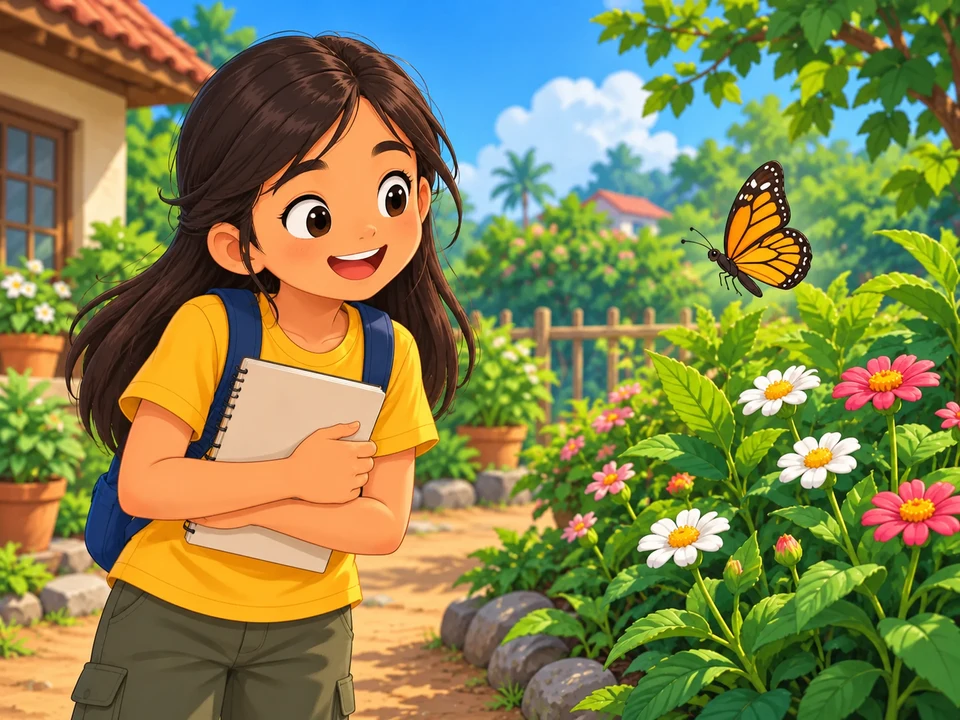
Lila wanted to paint the garden, but a butterfly kept moving. It flew from one bloom to the next. Her uncle asked her to watch…
Read the whole passage
Lila wanted to paint the garden, but a butterfly kept moving. It flew from one bloom to the next. Her uncle asked her to watch before she drew. “But it will leave!” Lila said. “Some butterflies carry pollen between flowers as they visit,” he explained. Lila put down her brush. She followed the small visitor with her eyes instead. Her page was still blank, but now she had a story to paint.
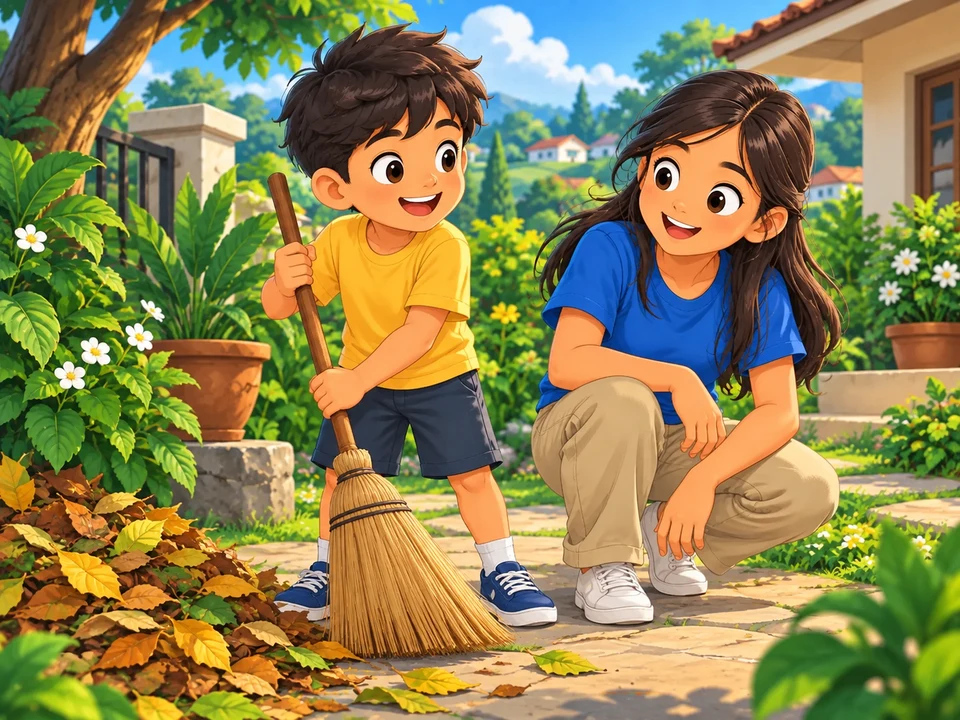
Rafi swept leaves into a corner of the yard. He was about to bag them when his sister bent down. “Look at this tiny caterpillar,”…
Read the whole passage
Rafi swept leaves into a corner of the yard. He was about to bag them when his sister bent down. “Look at this tiny caterpillar,” she said. Rafi stepped back. “Is that corner its room?” “Leaf litter can shelter small animals,” his sister told him. They cleared the walking path but left the corner alone. Later, Rafi showed his brother the neat path. Then he pointed proudly at the untidy corner beside it.
A seed packet fell from a shelf while Nena helped her aunt. Nena shook it gently. Nothing green came out. “Are the seeds asleep?” she…
Read the whole passage
A seed packet fell from a shelf while Nena helped her aunt. Nena shook it gently. Nothing green came out. “Are the seeds asleep?” she asked. “They need suitable water, air and warmth to begin growing,” her aunt said. They put a few seeds in a pot and kept the packet dry. Nena wrote the date beside the pot. Each morning she looked, even when the soil seemed just the same as before.
On a boardwalk, Carlo held his camera toward the wide blue water. His cousin pointed lower, between tangled mangrove roots. A small fish slipped through…
Read the whole passage
On a boardwalk, Carlo held his camera toward the wide blue water. His cousin pointed lower, between tangled mangrove roots. A small fish slipped through the shade. “Roots can give fish a place to hide,” his cousin said. Carlo lowered the camera. He waited without leaning over the rail. At home, his first photo showed only roots. He kept it anyway. He wanted to tell his mother about the fish she could not see.
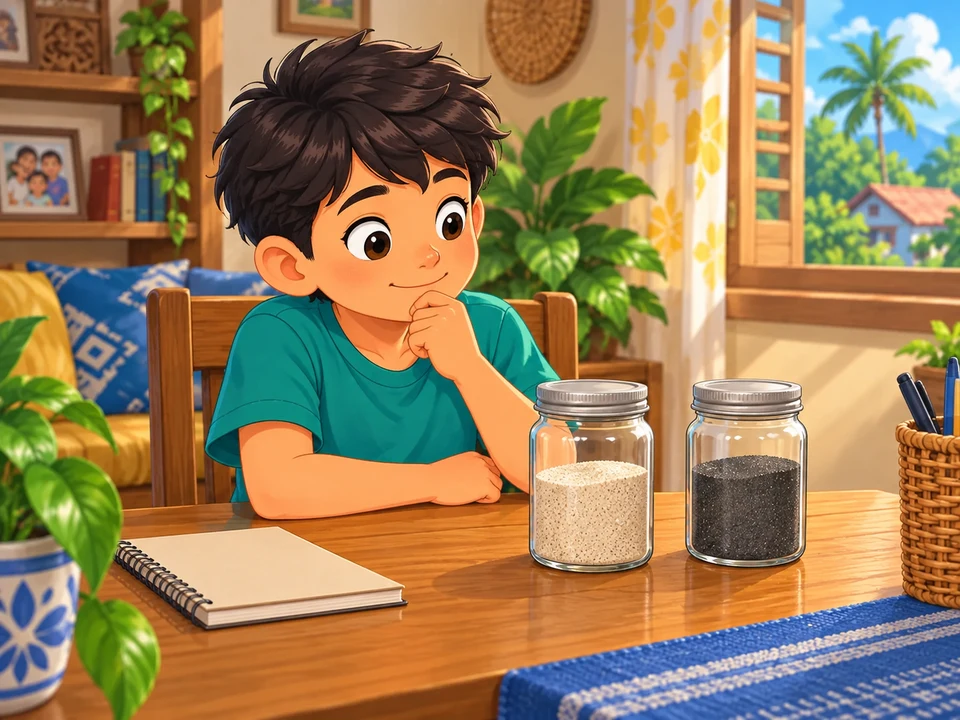
Sela spread a book on the table after a beach trip. Its pictures showed sand from different places. Some looked pale; some looked dark. “Did…
Read the whole passage
Sela spread a book on the table after a beach trip. Its pictures showed sand from different places. Some looked pale; some looked dark. “Did someone paint it?” she asked her father. “Sand can come from worn rocks or remains of living things,” he said. Sela opened her small jar. She held it beside the pictures but did not choose a label. “I still need more clues about mine,” she said, closing the lid carefully.
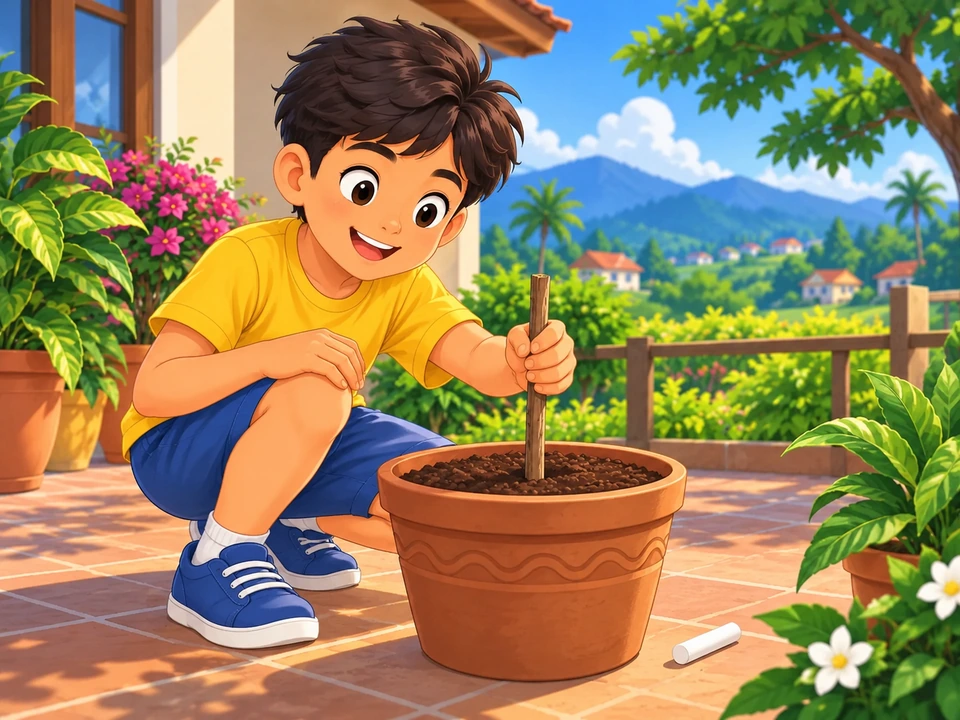
Tomas marked the tip of a stick’s shadow with chalk. The stick stood fixed in the school yard. After lunch, he came back and frowned…
Read the whole passage
Tomas marked the tip of a stick’s shadow with chalk. The stick stood fixed in the school yard. After lunch, he came back and frowned. “Who moved my mark?” he asked. His teacher pointed to the new shadow. “The shadow changes as the Sun appears to move.” Tomas found his first mark beside it. He drew a second one and left both in place. Tomorrow he would bring his notebook, not an eraser.
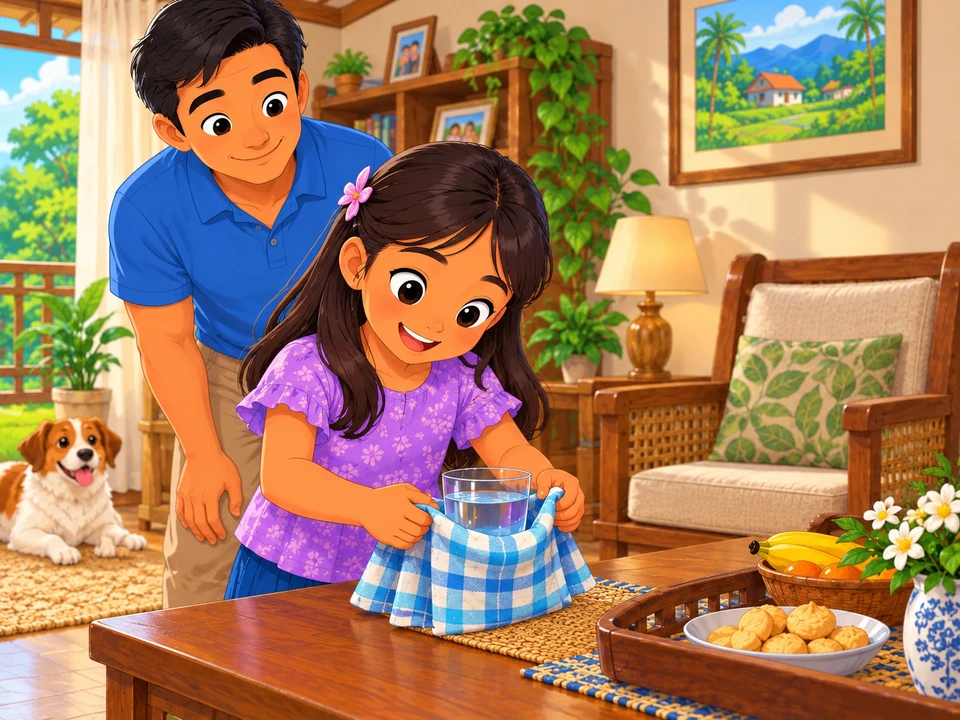
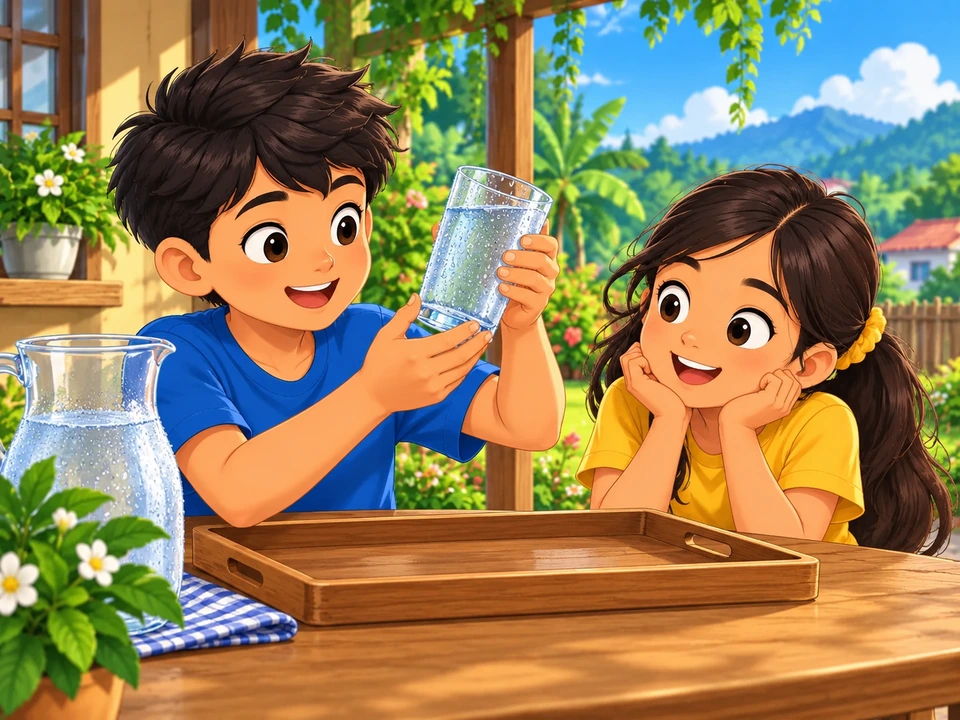
A cold glass stood on a tray at Jo’s home. Drops covered its outside. Jo thought the glass had a crack. Her father dried it…
Read the whole passage
A cold glass stood on a tray at Jo’s home. Drops covered its outside. Jo thought the glass had a crack. Her father dried it with a cloth. Soon, new drops appeared. “Moist air can leave water on a cold glass,” he said. Jo checked the water inside. The glass had no crack that she could find. She placed a mat under the tray. Next time, she asked to watch a warmer glass beside it.
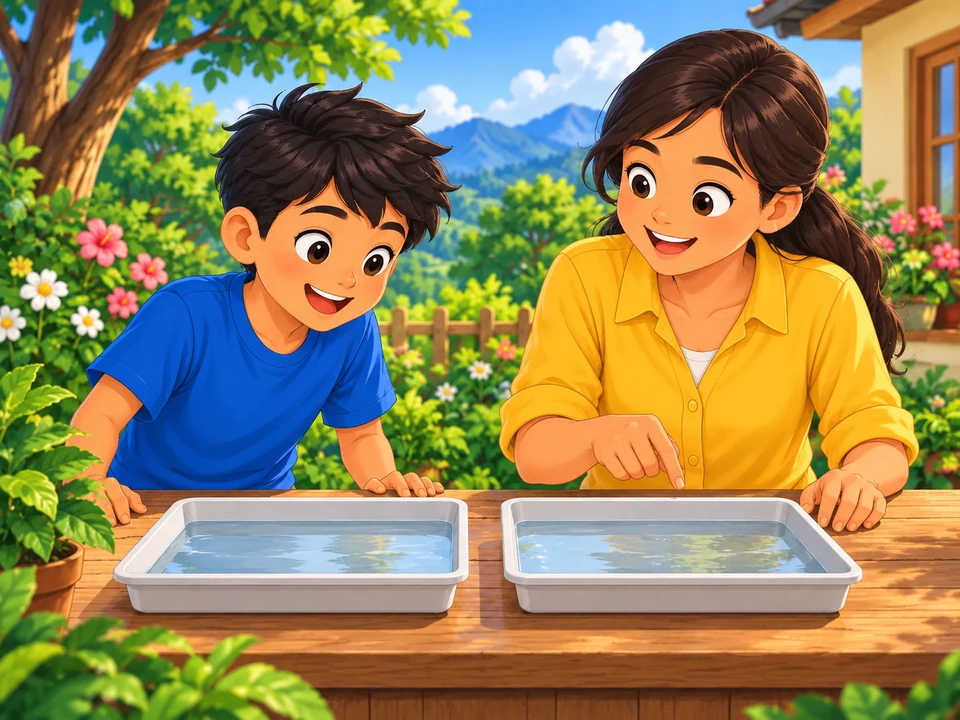
Aya left a shallow dish of water on the porch. The next day, there was less water. She looked under the dish, then asked her…
Read the whole passage
Aya left a shallow dish of water on the porch. The next day, there was less water. She looked under the dish, then asked her grandfather where it had gone. “Some may have changed into water vapor,” he said. “That is evaporation.” Aya could not see the vapor. She drew the dish in her notebook anyway. Beside it, she left space for a second drawing. This time she would measure before she waited.
Paolo drew the Moon with a cord and a switch. His sister laughed gently when she saw it. “The Moon reflects sunlight,” she told him…
Read the whole passage
Paolo drew the Moon with a cord and a switch. His sister laughed gently when she saw it. “The Moon reflects sunlight,” she told him. “It is not a lamp.” Paolo looked at his drawing. He had made the Moon shine like the lamp above his desk. He rubbed out the cord but kept the bright circle. Then he drew himself below it, looking up. His sister asked him what had changed besides the picture.
In the library, Bess saw a water-cycle picture with a white cloud. She pointed at it and told her friend that water vapor must be…
Read the whole passage
In the library, Bess saw a water-cycle picture with a white cloud. She pointed at it and told her friend that water vapor must be white. Their teacher heard them. “Water vapor is invisible,” she said. “A picture helps us discuss what we cannot see.” Bess looked again at the page. She drew a small question mark in her notes. Next time a picture showed something hidden, she would read the words beside it, too.
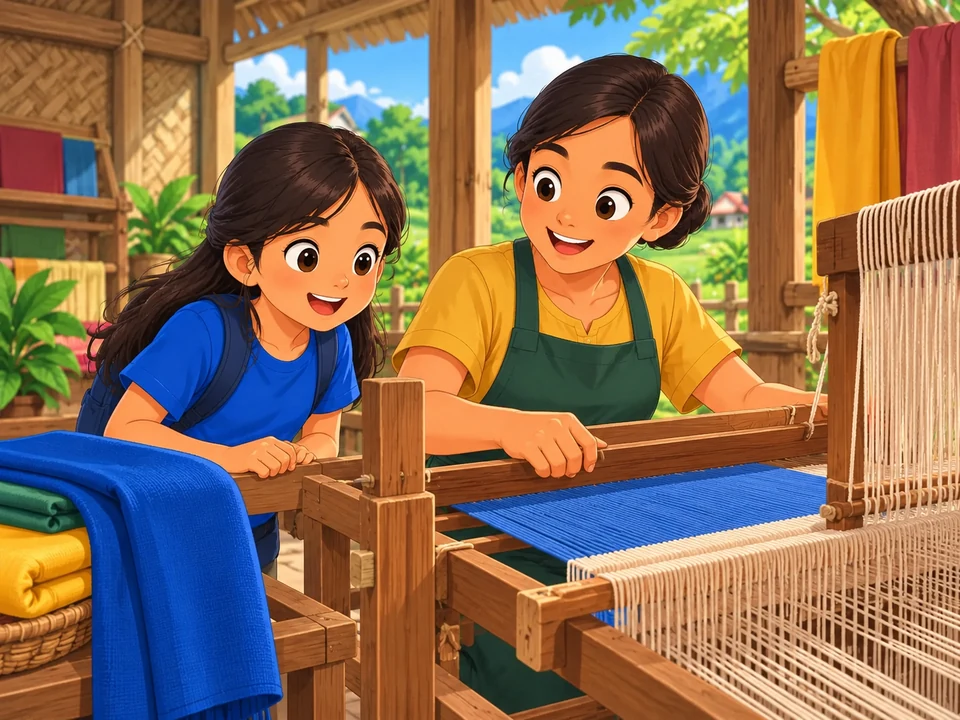
Mara admired a striped cloth at her aunt’s weaving table. She asked where the paint was kept. Her aunt turned the cloth over. The stripes…
Read the whole passage
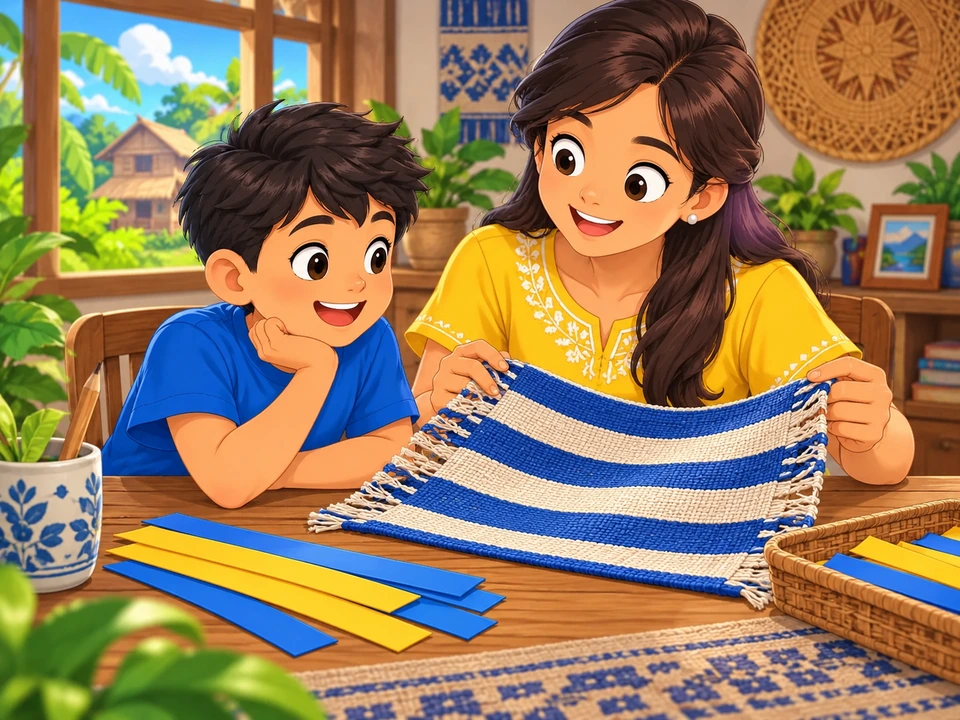
Mara admired a striped cloth at her aunt’s weaving table. She asked where the paint was kept. Her aunt turned the cloth over. The stripes were there, too. “These threads pass over and under other threads,” her aunt explained. Mara touched only the loose sample her aunt offered. She traced a stripe with one finger. At home, she opened her paint box, then paused. There were other ways to make a pattern.
Eli found a soft blanket. It lay in his grandmother’s chest. She called it abel, a woven cloth from Ilocos. Eli had seen blankets in…
Read the whole passage
Eli found a soft blanket. It lay in his grandmother’s chest. She called it abel, a woven cloth from Ilocos. Eli had seen blankets in shops, but this one came with her memories. She showed him an old photo of herself holding it. “It can be an heirloom,” she said, “something a family keeps and passes on.” Eli folded it slowly. That evening, he drew the chest and left room beside it for his grandmother’s words.
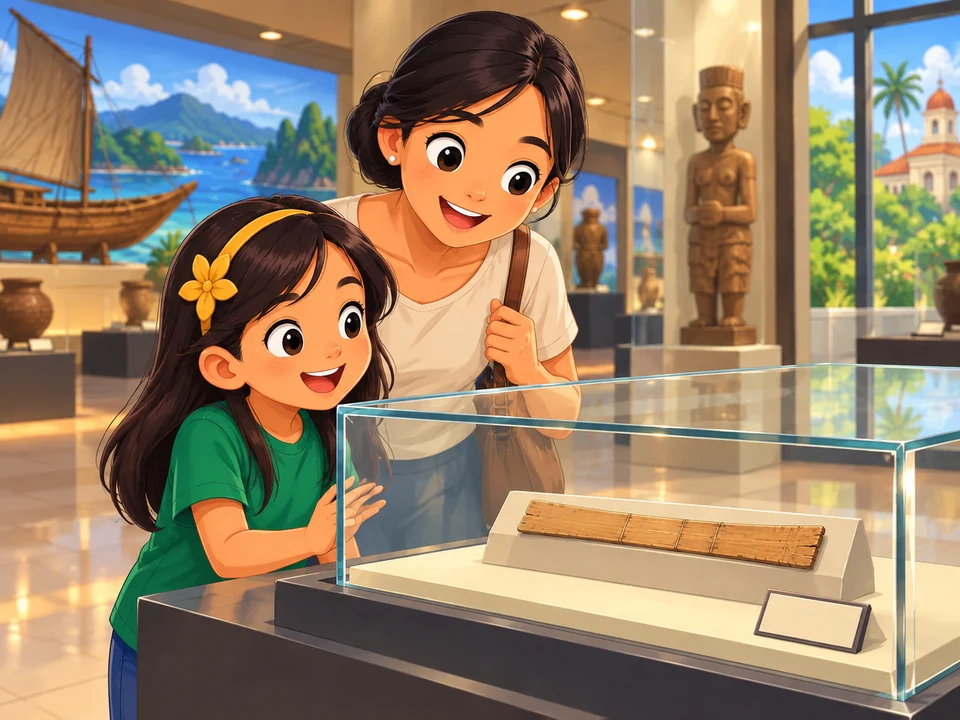
Dina saw a clay cooking pot in a museum display. She leaned toward her father. “Our old pot looks like that!” The guide explained that…
Read the whole passage
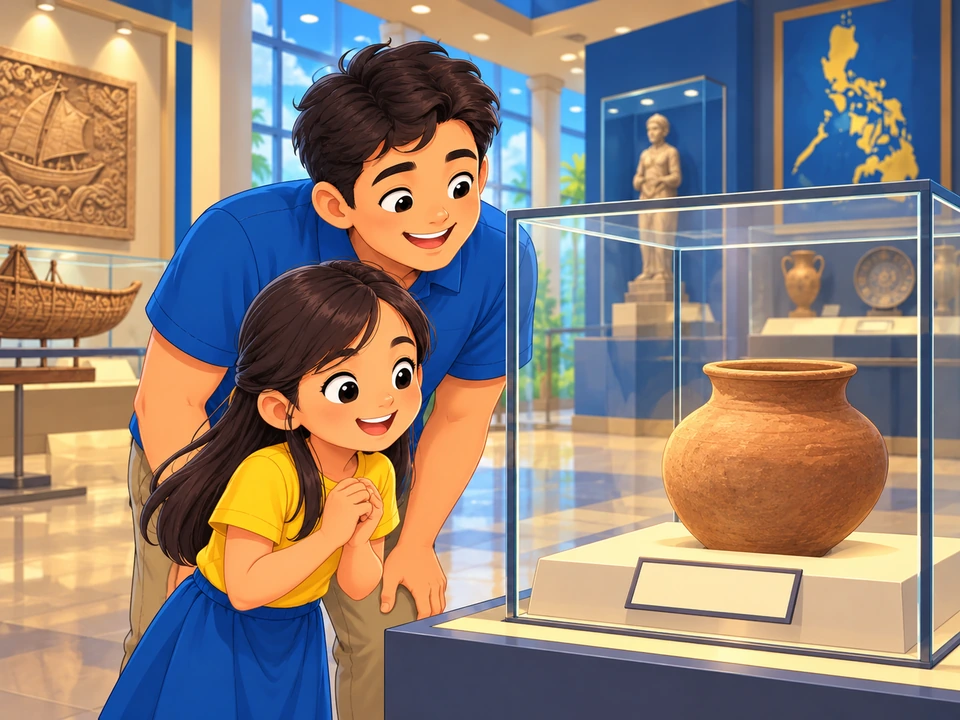
Dina saw a clay cooking pot in a museum display. She leaned toward her father. “Our old pot looks like that!” The guide explained that cooking pots were part of the museum’s ceramic collection. Dina had thought only shiny treasures belonged behind glass. She looked again at the pot’s simple shape. On the way home, she asked her father about their old pot. This time she wanted its story, not a new one.
A wooden board lay on a low table at Luis’s cousin’s house. Luis reached for a switch. His cousin laughed and brought a bowl of…
Read the whole passage
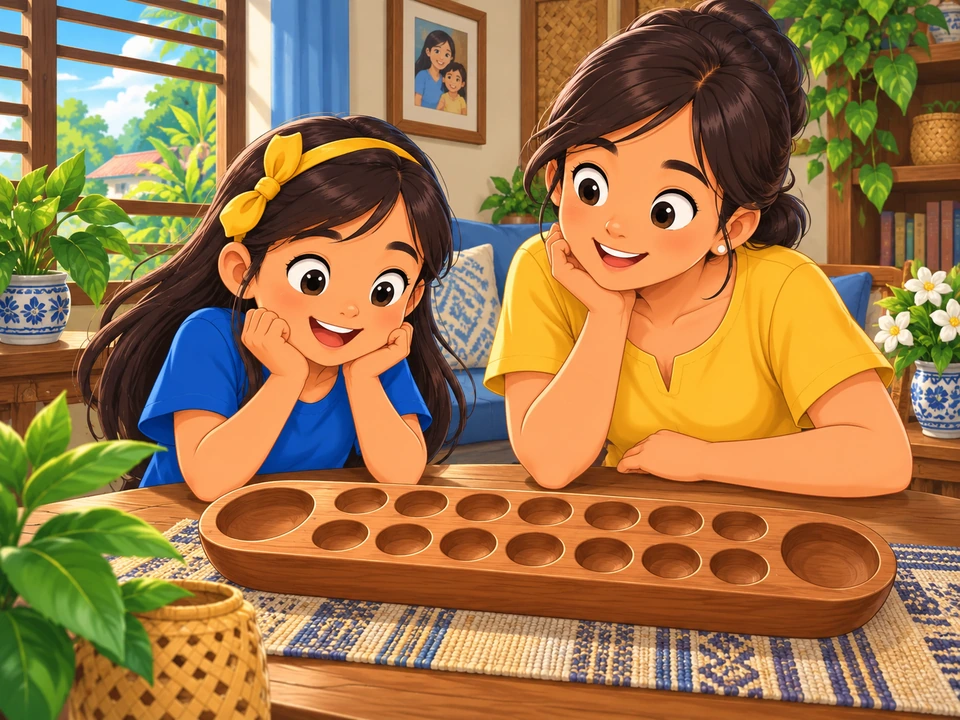
A wooden board lay on a low table at Luis’s cousin’s house. Luis reached for a switch. His cousin laughed and brought a bowl of shells. “This is sungka, a game for two players.” Luis counted the board’s small hollows and its two larger ends. His cousin invited him to sit opposite her. Luis put his phone away. He had come to show her a game, but now he wanted her to show him one.
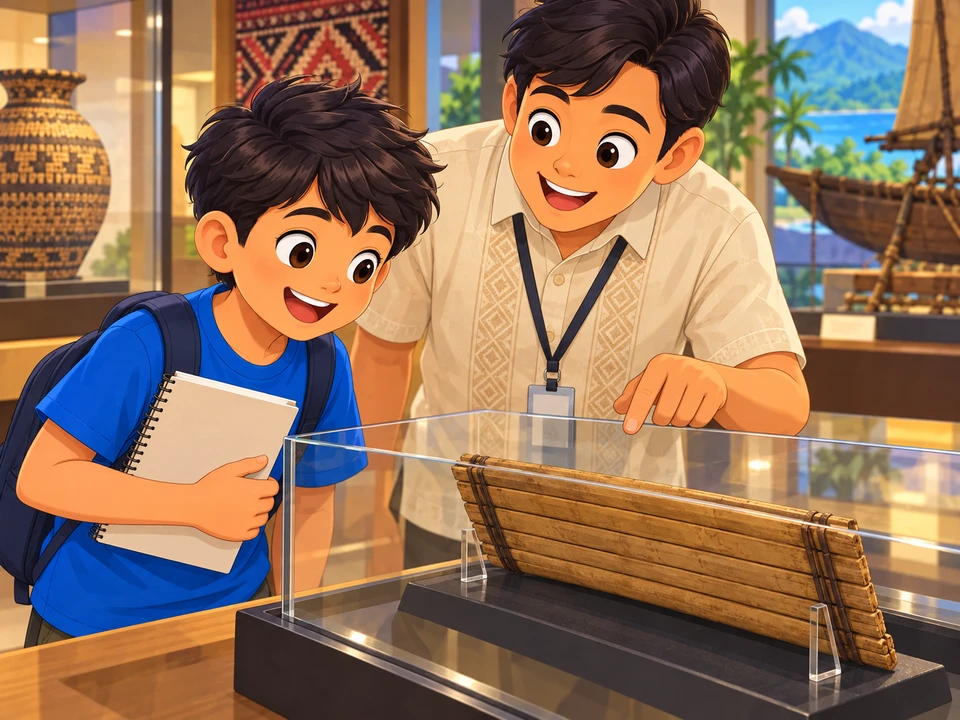
May visited a museum. There she saw a piece of bamboo with marks on it. She asked her brother if it was a broken fence…
Read the whole passage
May visited a museum. There she saw a piece of bamboo with marks on it. She asked her brother if it was a broken fence. A guide told them that people had engraved writing on bamboo long ago. May looked at the marks without trying to guess their message. At home, she set a blank sheet beside her pencil. She had thought a page always meant paper. Now even her empty page seemed full of new questions.
Nico carried a basket of bread to his aunt’s door. A blue ribbon was tied to its handle. His aunt smiled at the ribbon. Then…
Read the whole passage
Nico carried a basket of bread to his aunt’s door. A blue ribbon was tied to its handle. His aunt smiled at the ribbon. Then she looked at the bread. “Your mother used that ribbon on her school bag,” she said. Nico had thought it was just a pretty bow. He loosened it carefully and gave it to his aunt. She held it in both hands while the bread waited on the table.
Tess hurried to the window seat on the bus. Her little brother followed with his picture book. He sat beside her and held it closed…
Read the whole passage
Tess hurried to the window seat on the bus. Her little brother followed with his picture book. He sat beside her and held it closed. Tess noticed him looking past her shoulder, not at the book. She moved to the other seat. He pressed his face near the window and opened the book on his lap. At the next stop, Tess asked what he had seen. His answer filled the rest of their ride.
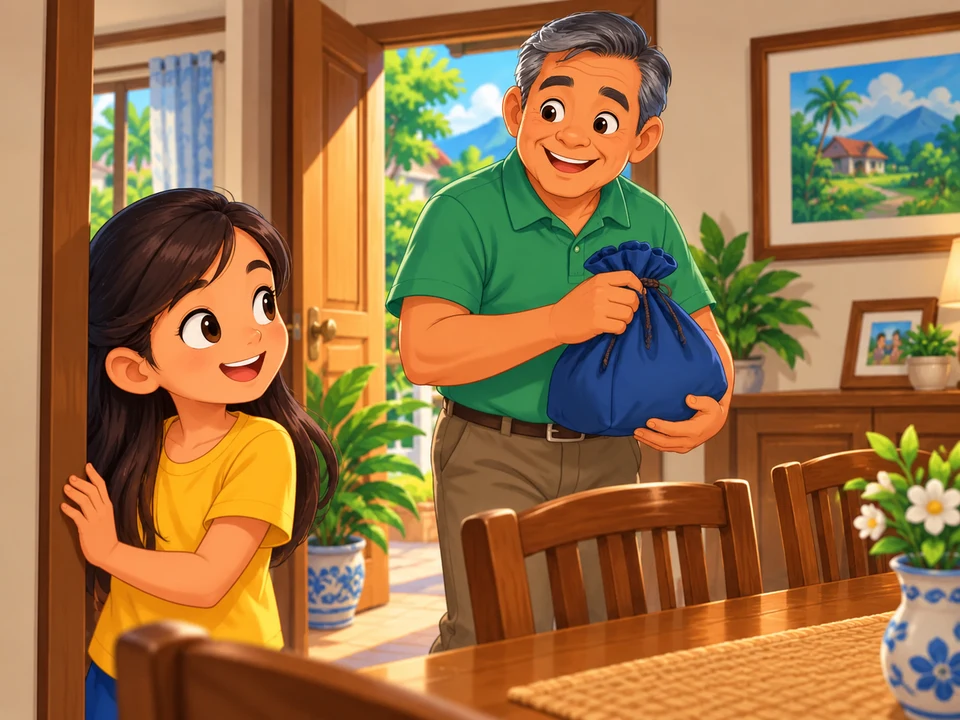
Pia heard a rustle from the cloth bag her grandfather carried. She hoped it held a gift. At home, he set it on the table…
Read the whole passage
Pia heard a rustle from the cloth bag her grandfather carried. She hoped it held a gift. At home, he set it on the table and took out old letters. “Your aunt asked for these,” he said. Pia watched him smooth each page. Then she brought an empty folder. Together they tucked the letters inside. When her aunt arrived, Pia gave her the folder. She stayed nearby to hear why the old pages mattered.
Owen practiced a bird call with a small whistle. His friend Bea sat on the porch, busy drawing. Owen blew a loud note. Bea kept…
Read the whole passage
Owen practiced a bird call with a small whistle. His friend Bea sat on the porch, busy drawing. Owen blew a loud note. Bea kept drawing. He tried a softer pair of notes. Bea looked up and tapped the same beat with her pencil. Owen sat beside her. Soon, they made a tune with a whistle and a pencil. He had wanted her to stop drawing. Instead, her drawing tool had joined his music.
Lea wanted to take the short lane home with her uncle. He chose the longer street instead. Lea sighed until they reached a small shop…
Read the whole passage
Lea wanted to take the short lane home with her uncle. He chose the longer street instead. Lea sighed until they reached a small shop. The owner came outside carrying a repaired bag. “Thank you for waiting,” he said. Her uncle put it over his shoulder. Lea touched the neat seam. The long way had a reason she had not known. She asked her uncle which way he would choose tomorrow, and why.
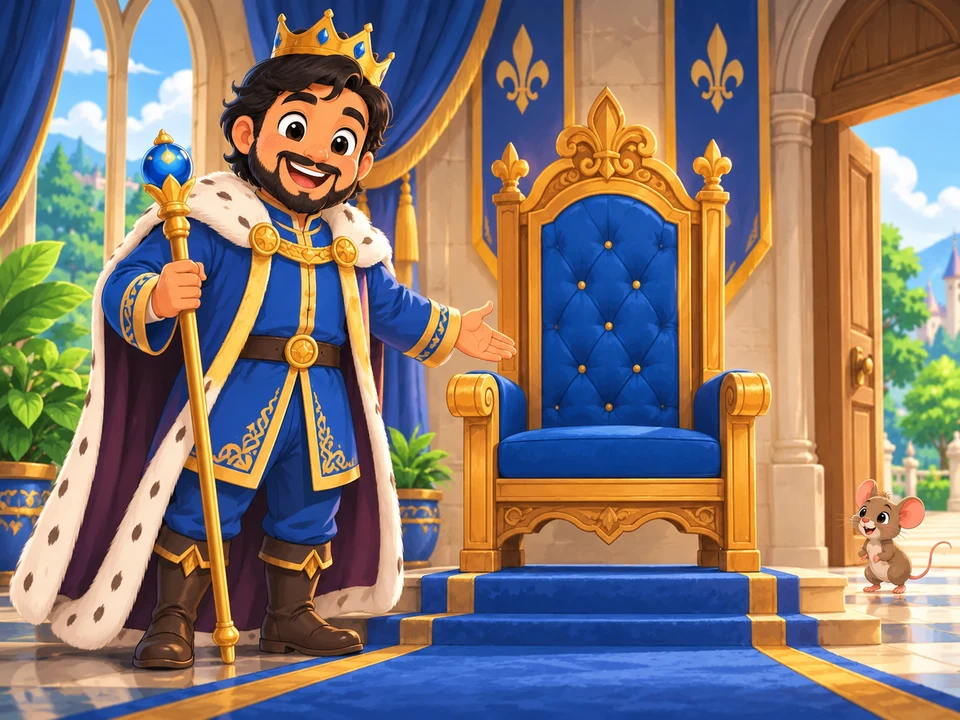
A king lived in a make-believe kingdom. He ordered the tallest chair for his hall. When he sat on it, his feet swung above the…
Read the whole passage
A king lived in a make-believe kingdom. He ordered the tallest chair for his hall. When he sat on it, his feet swung above the floor. He could not hear the quiet mouse who had come to speak. The mouse brought a small stool and climbed up beside him. The king leaned down at last. Next morning, the tall chair stood in a corner. Two small chairs faced each other where the king now met his guests.
In a story, a cloud kept lost colors in a pocket. A blue bird came looking for one bright feather. The cloud offered red, then…
Read the whole passage
In a story, a cloud kept lost colors in a pocket. A blue bird came looking for one bright feather. The cloud offered red, then green. The bird shook its head. “I need the blue that matches my wing.” The cloud opened the pocket wide. A tiny blue patch lay at the bottom. The bird took it and stayed to help sort the rest. By sunset, no visitor had to search through every color again.
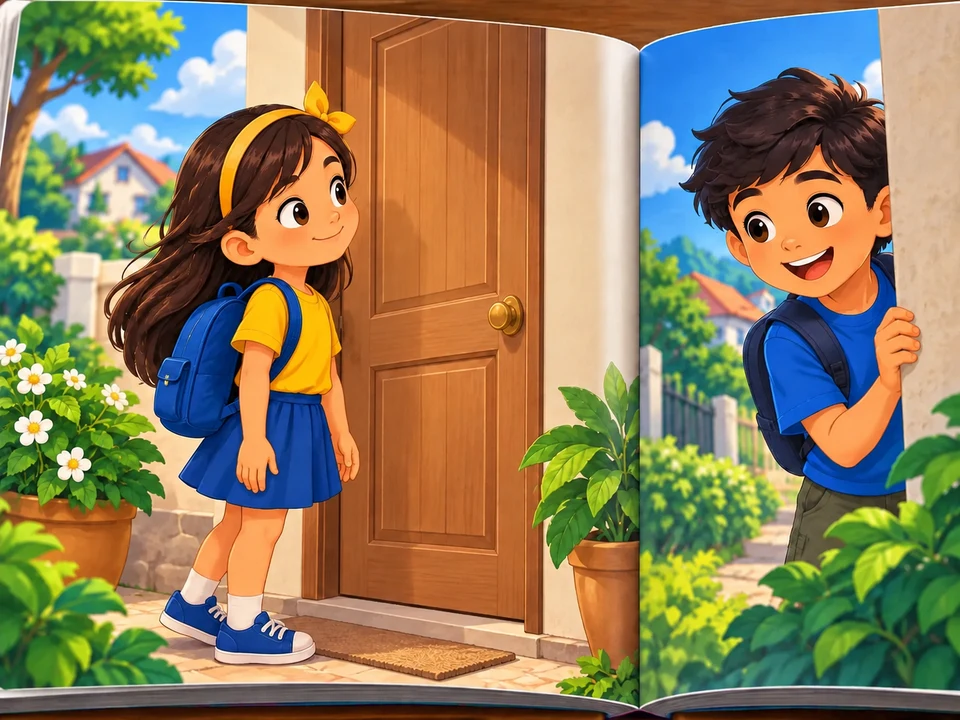
A paper girl found a door at the edge of her storybook page. She pulled, but it would not open. A paper boy on the…
Read the whole passage
A paper girl found a door at the edge of her storybook page. She pulled, but it would not open. A paper boy on the next page heard her sigh. “Read the line above it,” he said. The girl had been so eager that she had skipped it. The line asked for a knock. She knocked twice, and the door swung wide. Before stepping through, she went back to thank the boy across the fold.
In an invented village, a fox kept a lantern for evening walks. One night a rabbit asked to borrow it. The fox said yes, then…
Read the whole passage
In an invented village, a fox kept a lantern for evening walks. One night a rabbit asked to borrow it. The fox said yes, then paced by the gate. The rabbit returned late with a tired hedgehog beside her. “We walked slowly together,” she explained. The fox stopped pacing. He brought a low bench for both visitors. Next time, he would ask about the walk before he worried about the wait.
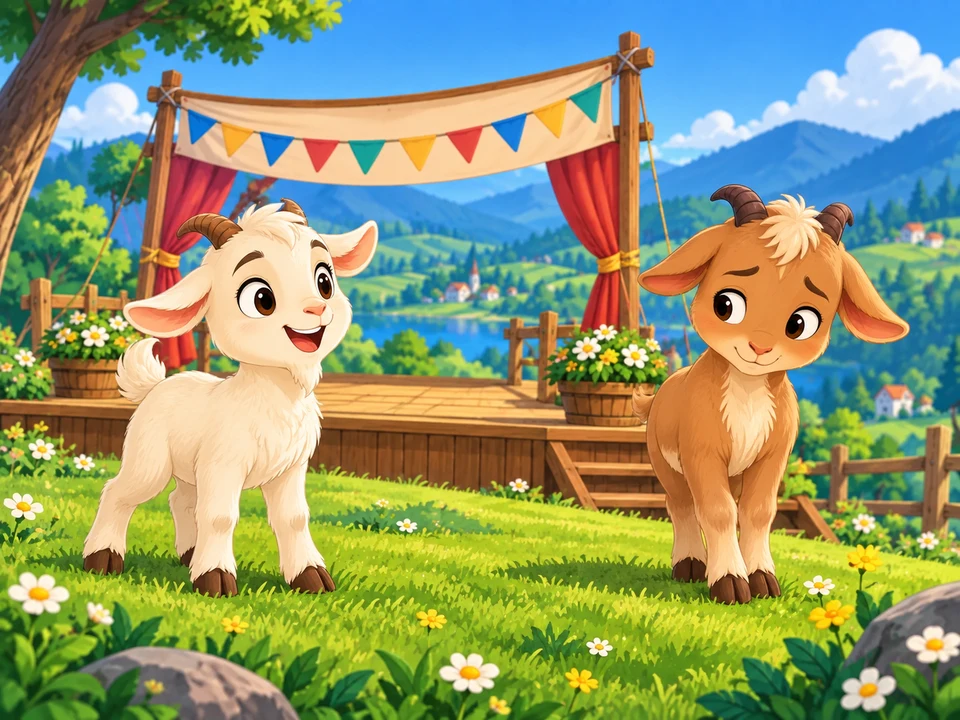
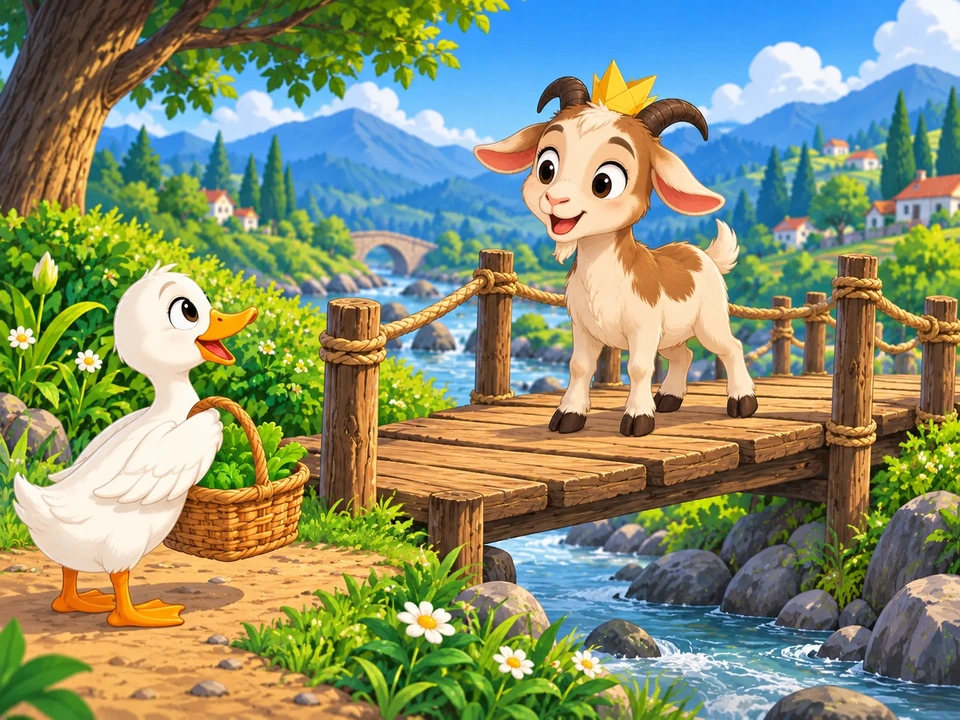
In a tale, a young goat climbed a hill to win a singing contest. She practiced her loudest note all morning. At the top, she…
Read the whole passage
In a tale, a young goat climbed a hill to win a singing contest. She practiced her loudest note all morning. At the top, she found a shy goat unable to begin. The young goat sang softly beside her. Soon, two voices rose together. The judge gave the prize to another singer. On the way down, the shy goat kept singing. The young goat joined in, carrying no prize but no longer walking alone.
Noel spotted a shell beside the shore path. He wanted it for his shelf. Then two small claws appeared. The guide stopped beside him. Hermit…
Read the whole passage
Noel spotted a shell beside the shore path. He wanted it for his shelf. Then two small claws appeared. The guide stopped beside him. Hermit crabs use old shells to protect their soft bodies. Noel kept his hands in his pockets. He opened his notebook and drew the shell where it lay. At home, his shelf held the drawing. Under it he wrote a question: who might still be using this home?
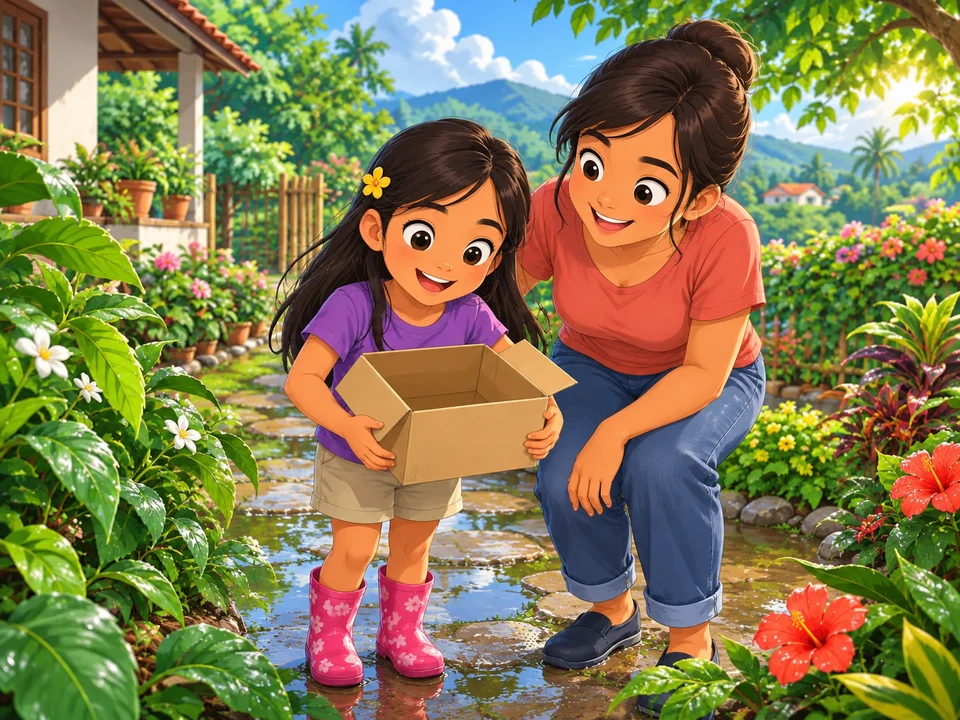
Rain had left a worm on the garden path. Mila fetched a dry box to take it home. Her mother stopped her. Earthworms can lose…
Read the whole passage
Rain had left a worm on the garden path. Mila fetched a dry box to take it home. Her mother stopped her. Earthworms can lose moisture through their skin. This box was not a good place to keep it. Together they moved the worm just off the path onto moist soil. Mila put the empty box away. She stayed to watch the small trail it made. Her guest had a place nearby, after all.
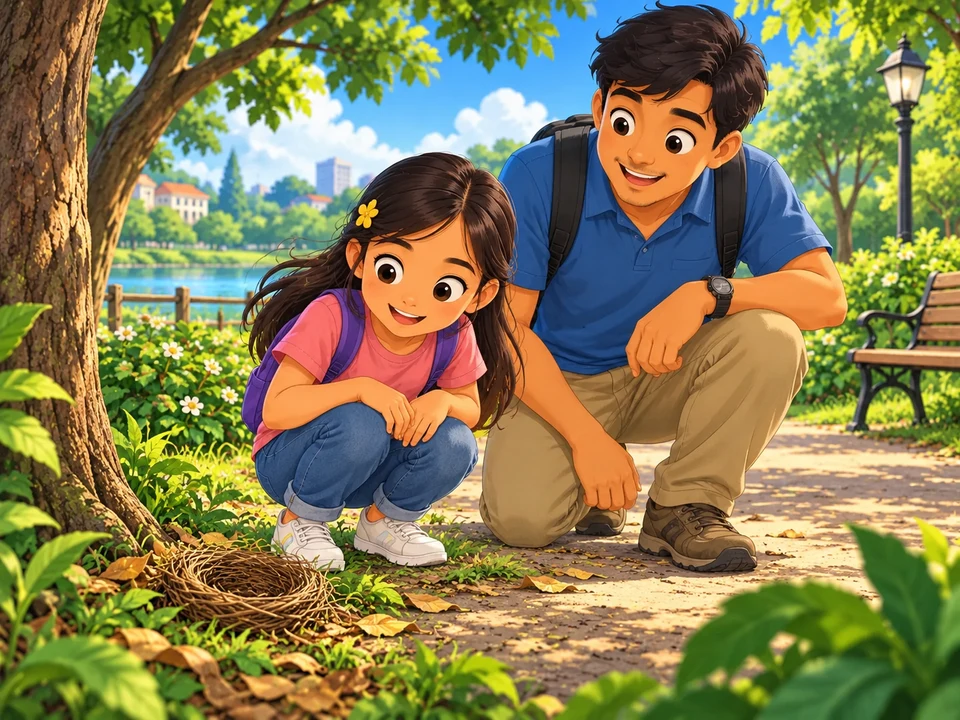
Cora found an empty nest under a tree. She asked Dad to put it on a branch. He looked up, then shook his head. They…
Read the whole passage
Cora found an empty nest under a tree. She asked Dad to put it on a branch. He looked up, then shook his head. They did not know when it had fallen or which bird had used it. Cora lowered the nest gently to its old spot. She sat on the path with Dad and watched the tree. No bird came that morning. Her notebook held a drawing and an unanswered question, instead of a repair plan.
Dino saw a fly inside a pitcher plant at the garden. He picked up a stick to help it out. The guide asked him to…
Read the whole passage
Dino saw a fly inside a pitcher plant at the garden. He picked up a stick to help it out. The guide asked him to wait. Some pitcher plants trap insects and get nutrients from them. Nutrients help living things grow. Dino put the stick down. He had never thought of a plant catching food. He walked beside the guide to the next bed. Now his questions were about the plant, not about finding a longer stick.
A steel clip slid under Ina’s drawing on the table. She could not see where it stopped. Her brother brought a magnet. A magnet can…
Read the whole passage
A steel clip slid under Ina’s drawing on the table. She could not see where it stopped. Her brother brought a magnet. A magnet can pull a steel clip through a sheet of paper. He moved it slowly above the page. The clip followed until it reached the edge. Ina picked it up without tearing her work. She gave her brother a smile and looked at the whole drawing again. The paper had not needed a hole.
Ruel set a spoon in a glass of water for Dad. From the side, its handle looked bent. Ruel went to fetch a new one…
Read the whole passage
Ruel set a spoon in a glass of water for Dad. From the side, its handle looked bent. Ruel went to fetch a new one. Dad lifted the spoon out. It was straight. Light can change direction between water and air, making an object look bent. Ruel put the same spoon back and moved his head. Then he took it out once more. Dad waited for his water while Ruel checked the view, not the drawer.
Lani had a paper star but no glue for her card. Aunt Rose rubbed a balloon on a cloth. The balloon drew the light star…
Read the whole passage
Lani had a paper star but no glue for her card. Aunt Rose rubbed a balloon on a cloth. The balloon drew the light star toward it. Rubbing can give a balloon a charge that attracts nearby things. Lani held the card below, hoping the star would stay there. It fell again when she moved the balloon away. She laughed and kept the balloon for a game. The card would wait until they found some glue.
Berto helped Uncle hold a drum during a song. He pressed one hand on its top. Uncle tapped, but the sound grew dull. A drum’s…
Read the whole passage
Berto helped Uncle hold a drum during a song. He pressed one hand on its top. Uncle tapped, but the sound grew dull. A drum’s moving skin helps make its sound; touching it can slow that movement. Berto lifted his hand and held the rim instead. A clear beat came back. He kept the drum steady without covering its skin. When the next song began, Uncle nodded. Berto already knew where his helping hand should go.
Pio tore a sweet’s wrapper and reached for another sweet. Aunt May spread the torn paper on the tray. Small cutout shapes ran along its…
Read the whole passage
Pio tore a sweet’s wrapper and reached for another sweet. Aunt May spread the torn paper on the tray. Small cutout shapes ran along its sides. She called this craft pabalat, made by cutting paper wrappers in Bulacan. Pio set his next sweet down. He opened its wrapper slowly and laid it flat. The sweet went into his mouth. The paper stayed on the tray. His little sister could see the careful work before choosing her own.
Iya sniffed the piña shirt her aunt had brought home. It did not smell like a pineapple. Her aunt showed her a loose fiber sample…
Read the whole passage
Iya sniffed the piña shirt her aunt had brought home. It did not smell like a pineapple. Her aunt showed her a loose fiber sample. Piña cloth is woven from fibers taken from pineapple leaves. The fruit was not mashed into the shirt. Iya ran one finger along the sample, with permission. Then she stopped sniffing and asked who had prepared the fibers. Her aunt pulled up a chair. There was more to tell than a shirt’s smell could show.
Jelo hurried toward a boat display at the museum. Beside it hung a picture of hands working on wood. Boats such as the old Butuan…
Read the whole passage
Jelo hurried toward a boat display at the museum. Beside it hung a picture of hands working on wood. Boats such as the old Butuan finds belong to Philippine maritime heritage. Jelo had come to draw a boat, but the hands held his eyes. He asked the guide what their owner was making. The guide invited him to read the picture’s note first. Jelo opened his book. His first sketch showed hands at work, with space left for the boat.
Sari brought a rolled mat to the family picnic. She planned to nap while the others ate. Aunt opened the basket beside her. A woven…
Read the whole passage
Sari brought a rolled mat to the family picnic. She planned to nap while the others ate. Aunt opened the basket beside her. A woven mat can serve several household and social uses. Today they needed a clean place to share their meal. Sari spread hers on the grass and moved the basket onto it. Soon everyone sat round the food. She could nap later. For now, her mat had made a place where the whole family could join her.
Nilo wrote his name on a cup for the family outing. After washing it, he saw that the name was gone. All three cups now…
Read the whole passage
Nilo wrote his name on a cup for the family outing. After washing it, he saw that the name was gone. All three cups now looked alike. Mum let him tie a blue thread through his cup’s handle. He washed it once more and checked. The thread stayed. At the picnic, his sister handed back the cup without asking whose it was. Nilo looked at the handle. His mark had finally lasted through the job it needed to do.
Dessa found her cousin’s puzzle almost done on the floor. Only two spaces were empty. She picked up the last loose piece. Her cousin held…
Read the whole passage
Dessa found her cousin’s puzzle almost done on the floor. Only two spaces were empty. She picked up the last loose piece. Her cousin held out a hand. “Please save that one for me.” Dessa put it down and searched for the other piece instead. It lay beneath the box. She slid it into the empty corner, then called her cousin. One space remained. The picture was nearly complete, and its owner still had the small joy she had been waiting for.
Each time Rob’s dog came through the gate, Rob heard a scrape. He thought the dog was making it. Then he watched the gate move…
Read the whole passage
Each time Rob’s dog came through the gate, Rob heard a scrape. He thought the dog was making it. Then he watched the gate move. Its lower edge dragged across the ground even before the dog passed. Rob showed Aunt the fresh line in the soil. She fixed the loose hinge and lifted the gate. The next scrape did not come. Rob opened it once again for his dog. This time he listened to the latch click shut.
Ella wrote “Bring lunch” on a note for herself. Her brother said he already had food. He was joining her for soup at school, but…
Read the whole passage
Ella wrote “Bring lunch” on a note for herself. Her brother said he already had food. He was joining her for soup at school, but he had packed only a fork. Ella crossed out his copy of her note. She wrote “Bring a spoon” instead and handed it to him. Next day, both could eat their soup. Ella kept her own note in her bag. Two people shared a meal, but they had not needed the same reminder.
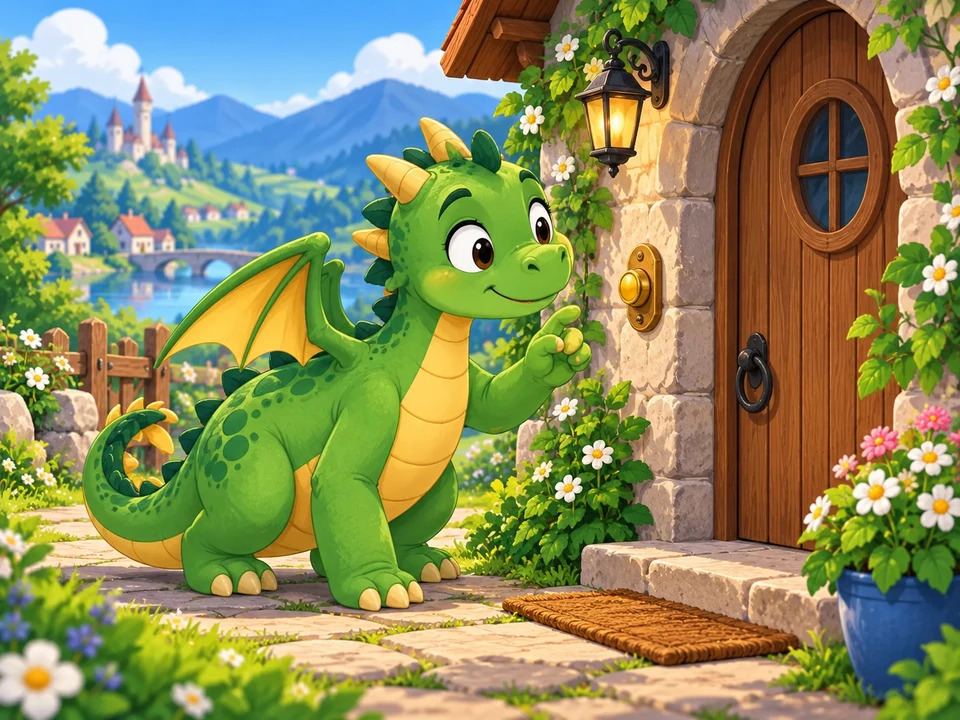
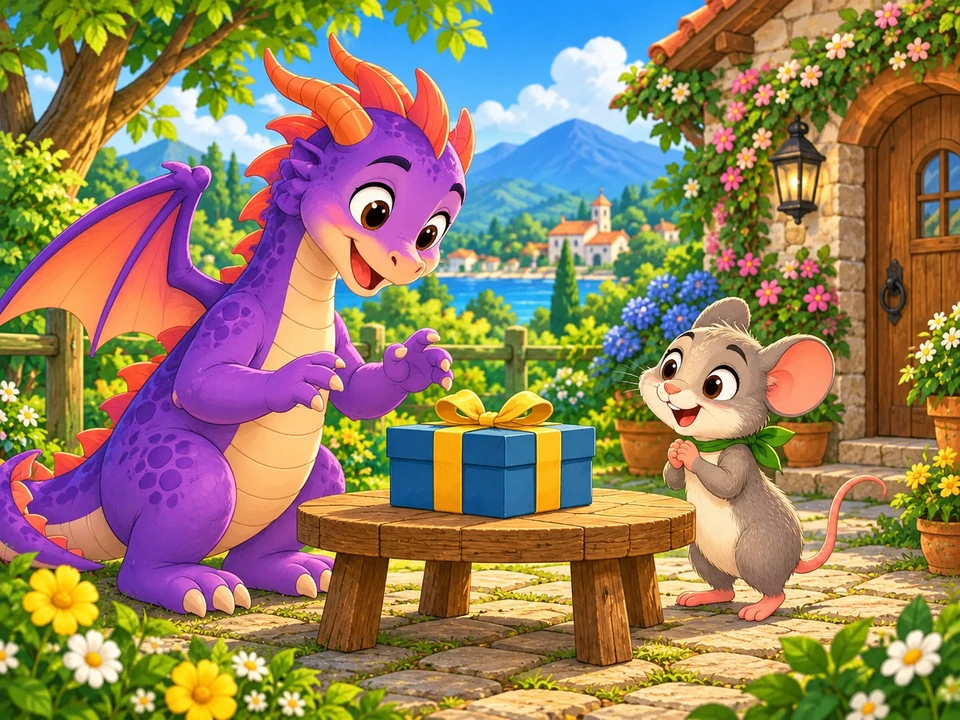
In a tale, a dragon visited a cottage with a tiny bell. His first ring shook the plates inside. He tried one gentle tap. The…
Read the whole passage
In a tale, a dragon visited a cottage with a tiny bell. His first ring shook the plates inside. He tried one gentle tap. The roof still rattled. A mouse peeked out. The dragon asked her to knock for him. Her small knock brought the host to the door. The dragon folded his wings and stepped in slowly. He had found a way to announce his visit. Inside, the plates stayed on the shelf while the friends shared their tea.
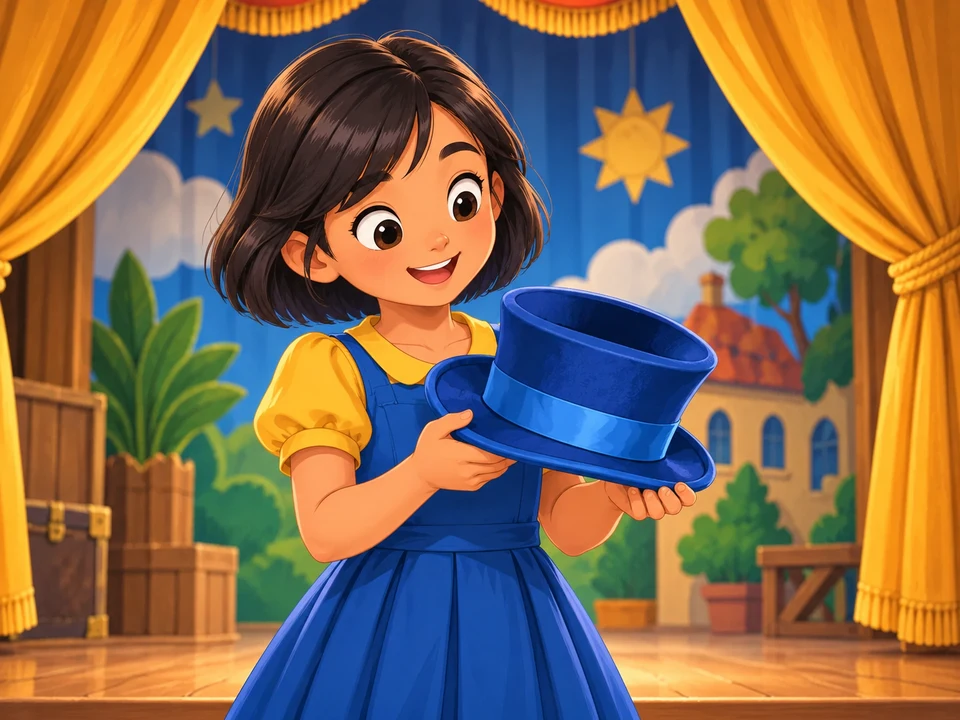
In Mina’s story, a hat could fly by itself. It left whenever she bowed during her play. Mina had to fetch it before her next…
Read the whole passage
In Mina’s story, a hat could fly by itself. It left whenever she bowed during her play. Mina had to fetch it before her next line. “My bow is part of the play,” she told it. They chose the closing curtain as their ending signal instead. Mina rehearsed with the hat on her head. This time it stayed through every bow. When the curtain closed, the hat rose gently to its hook. Mina clapped for the actor who had finally stayed.
In a made-up journey, Mouse found a cake drawn on his map. He bit the corner and got only torn paper. His friend gave him…
Read the whole passage
In a made-up journey, Mouse found a cake drawn on his map. He bit the corner and got only torn paper. His friend gave him a real bun. Then they looked for the path on the damaged map. The bite had removed a turn. Mouse fitted the scraps together while his friend held them still. The cake picture stayed on the page. This time Mouse followed the repaired line toward the bakery. His real snack stayed safely in his bag.
Tali made up a spell for an owl in her tale. It sent his broom flying across the garden. The owl called for a landing…
Read the whole passage
Tali made up a spell for an owl in her tale. It sent his broom flying across the garden. The owl called for a landing, but Tali had written no word to stop it. She quickly added one to her story. “Rest!” she called, and the broom settled by the gate. Before their next trip, the owl read the new line aloud. They tried a short flight first. This time the landing was part of their plan, not a surprise.
Kai brought a small brush to his uncle's sea-snail tank. He wanted the green rock to look clean. Behind the glass, a snail left a…
Read the whole passage
Kai brought a small brush to his uncle's sea-snail tank. He wanted the green rock to look clean. Behind the glass, a snail left a pale trail through green patches. Kai asked if he could use the brush. These sea snails scrape algae off rocks with a rough tongue called a radula. The green patches were food in this tank. Kai put the brush away and leaned closer to the glass. He followed the pale trail. His uncle called him for lunch.
Ben won his sister's looking game without moving his head. Then an owl film began. The owl turned its head when a boy walked beside…
Read the whole passage
Ben won his sister's looking game without moving his head. Then an owl film began. The owl turned its head when a boy walked beside it. Ben called that cheating. Owl eyes cannot move in their sockets. An owl turns its head to look in another direction. Ben moved his own eyes toward his sister and kept his head still. She pointed at the screen. Ben folded his winner's ribbon and watched the owl again.
Mia wanted a frog's face in her photograph. The frog faced a leaf instead. She had just rubbed lotion on her hands. She reached toward…
Read the whole passage
Mia wanted a frog's face in her photograph. The frog faced a leaf instead. She had just rubbed lotion on her hands. She reached toward the frog, then read her park leaflet. Amphibian skin can absorb salts, oils, and lotions from people. The leaflet advised looking without touching. Mia slipped her hand back into her bag. She walked to the other side with her aunt and raised her camera. The frog stayed where it was.
That night, Jo watched a hummingbird from his aunt's window in California. It hardly moved on its branch. He reached for his loud music player…
Read the whole passage
That night, Jo watched a hummingbird from his aunt's window in California. It hardly moved on its branch. He reached for his loud music player to wake it. His aunt asked him to read her zoo note first. Hummingbirds can lower their body temperature and heart rate during night rest. Jo left the music off. Next morning he watched a hummingbird fly toward flowers. Jo compared his two visits to the window. The quiet branch no longer seemed like the whole story.
Lena and Omar watched a butterfly feeding film. Omar waited for its mouth tube to open. Lena watched its feet land on a leaf first…
Read the whole passage
Lena and Omar watched a butterfly feeding film. Omar waited for its mouth tube to open. Lena watched its feet land on a leaf first. Butterflies taste with their feet. Their feeding mouthpart is a suction tube. Omar had missed the landing while looking only at the tube. Lena offered to replay the start before their club talk. This time Omar pointed at the feet, then waited for the tube. They kept both moments in their account.
Rafi's bat costume had cloth wings tied to his elbows. He could flap them, but they stayed narrow. Then he saw a bat-wing bone picture…
Read the whole passage
Rafi's bat costume had cloth wings tied to his elbows. He could flap them, but they stayed narrow. Then he saw a bat-wing bone picture at the park talk. Bat wings have hand bones spread inside them. Rafi held his fingers wide beneath a spare cloth. His sister loosened the costume ties with permission. Now his hands could spread the wings. He tried the movement beside the picture before joining the play, smiling at his wider shape.
That evening, the children's nature club played an animal-group game. Ana heard firefly and called out fly. Her friend asked her to check their park…
Read the whole passage
That evening, the children's nature club played an animal-group game. Ana heard firefly and called out fly. Her friend asked her to check their park page first. Fireflies are beetles, despite the fly in their name. Ana read the line twice. For her next turn, she asked for an animal clue as well as a name. The others gave her a moment to think. She answered beetle and passed the game card to her friend with a grin.
Nico saw a sea snail pull its soft body into a shell. He wanted a clear look inside the opening. His finger hovered over a…
Read the whole passage
Nico saw a sea snail pull its soft body into a shell. He wanted a clear look inside the opening. His finger hovered over a tool beside his uncle's tank. These sea snails have a trapdoor-like cover that helps limit water loss. Nico left the tool alone. He replayed an earlier feeding film of the tank instead. The soft body was visible there. Nico studied that view, then watched the closed shell in the tank without wishing it open.
Luis chased a small lizard across the garden path. His uncle called him back. Luis had heard that some lizards could drop their tails and…
Read the whole passage
Luis chased a small lizard across the garden path. His uncle called him back. Luis had heard that some lizards could drop their tails and grow them again. He thought a chase would do no harm. Growing a lost tail costs a lizard energy. Luis looked at his toy car beside the gate. He carried it to the path and made a race with his cousin. The lizard slipped into the plants while their car went around a stone.
Cora carried a towel into the greenhouse after rain. A roundleaf sundew shone with little drops on its leaf hairs. She offered to dry it…
Read the whole passage
Cora carried a towel into the greenhouse after rain. A roundleaf sundew shone with little drops on its leaf hairs. She offered to dry it. Those hairs carry a sticky coating that traps insects. The gardener showed Cora a close film of the plant instead of handing her the pot. An insect stayed caught against the hairs. Cora folded the towel and used it on her own wet hands. She watched the plant without wiping its shining drops.
Lia watched her teacher hold a bottle under a soap film. Warm water touched the bottle's base. The film grew into a bubble. Lia searched…
Read the whole passage
Lia watched her teacher hold a bottle under a soap film. Warm water touched the bottle's base. The film grew into a bubble. Lia searched for someone blowing into the bottle. Warming the air inside makes it push the film outward. The teacher moved the base into cold water, and the bubble shrank. Lia kept her goggles on and asked for the warm cup again. This time she watched the base instead of looking for a hidden mouth.
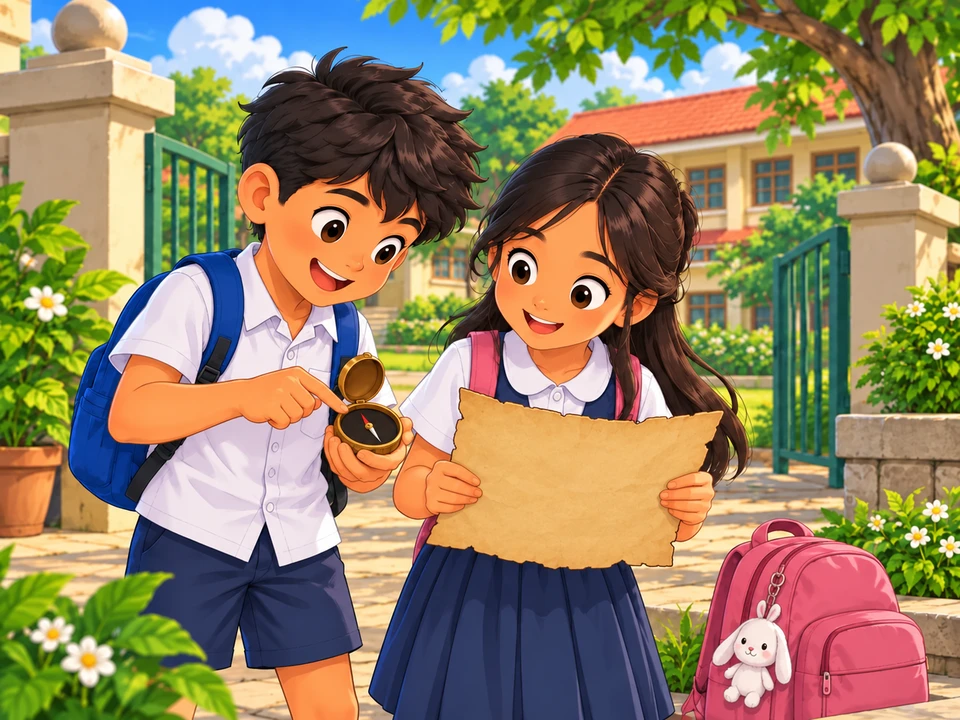
A treasure card told Tess to follow the compass toward a tree. At the gate, its needle swung toward her bag instead. Her partner got…
Read the whole passage
A treasure card told Tess to follow the compass toward a tree. At the gate, its needle swung toward her bag instead. Her partner got a different reading at the same spot. Nearby magnets can affect a compass needle. Tess remembered the magnetic toy in her bag. Her partner carried it to a bench. Tess tried the compass again, and it now matched her partner's reading. They left the toy away from the compass and resumed their hunt together.
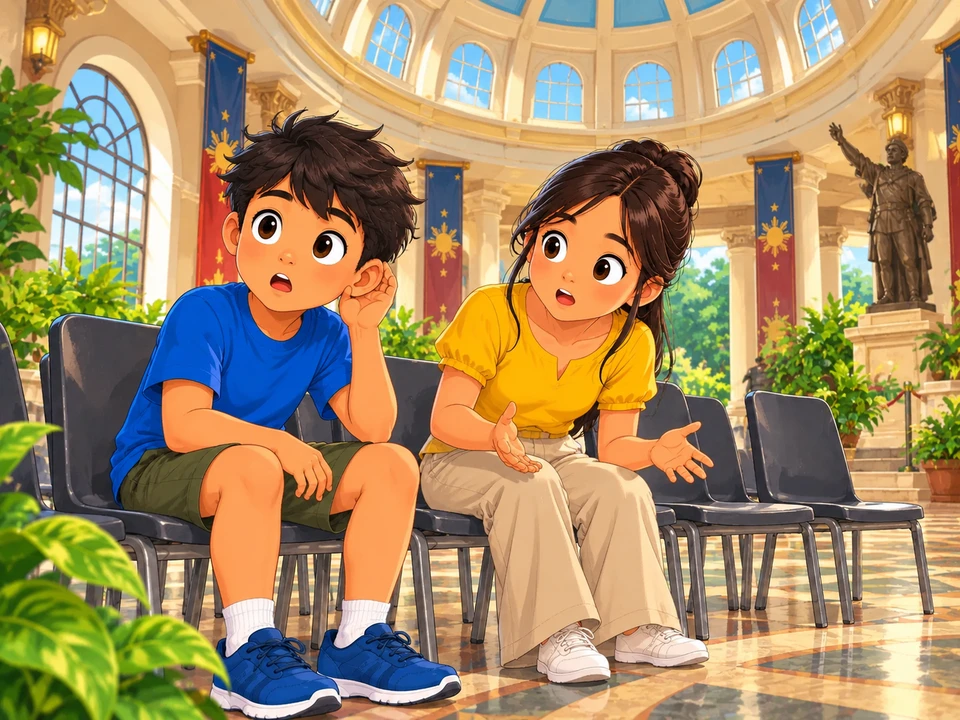
Ivo clapped once beneath a high dome. A second clap seemed to answer from above. He searched for a hidden friend behind the chairs. His…
Read the whole passage
Ivo clapped once beneath a high dome. A second clap seemed to answer from above. He searched for a hidden friend behind the chairs. His sister held both hands still. A dome can reflect sound back as an echo. She asked Ivo to clap once more, then wait quietly. The return reached them while her hands stayed apart. Ivo sat beside her and took turns making one clap at a time. They left room to hear each answer.
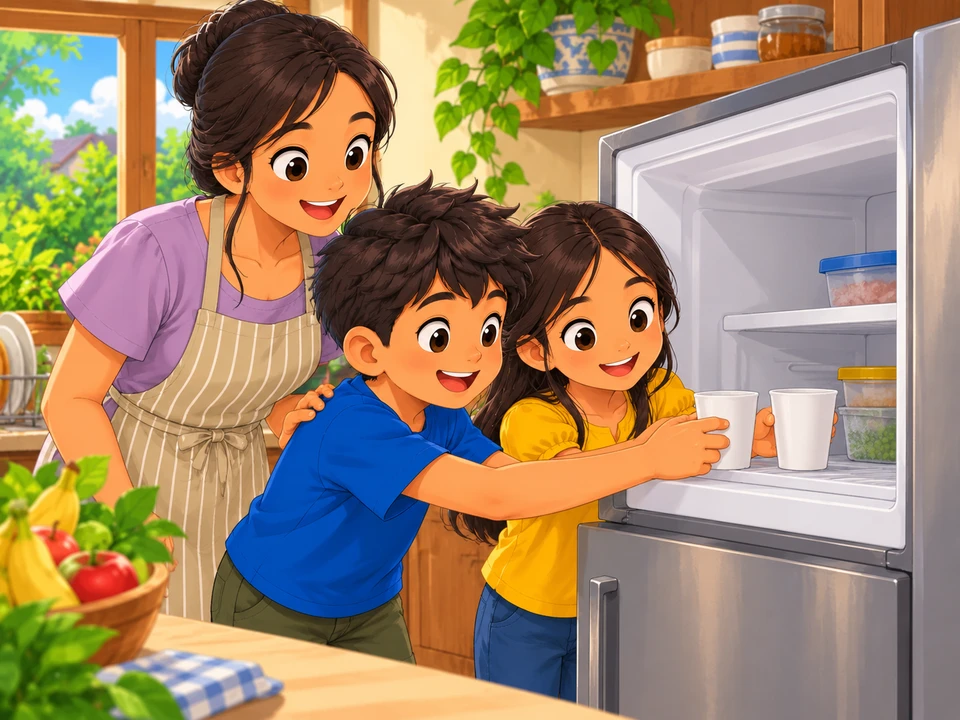
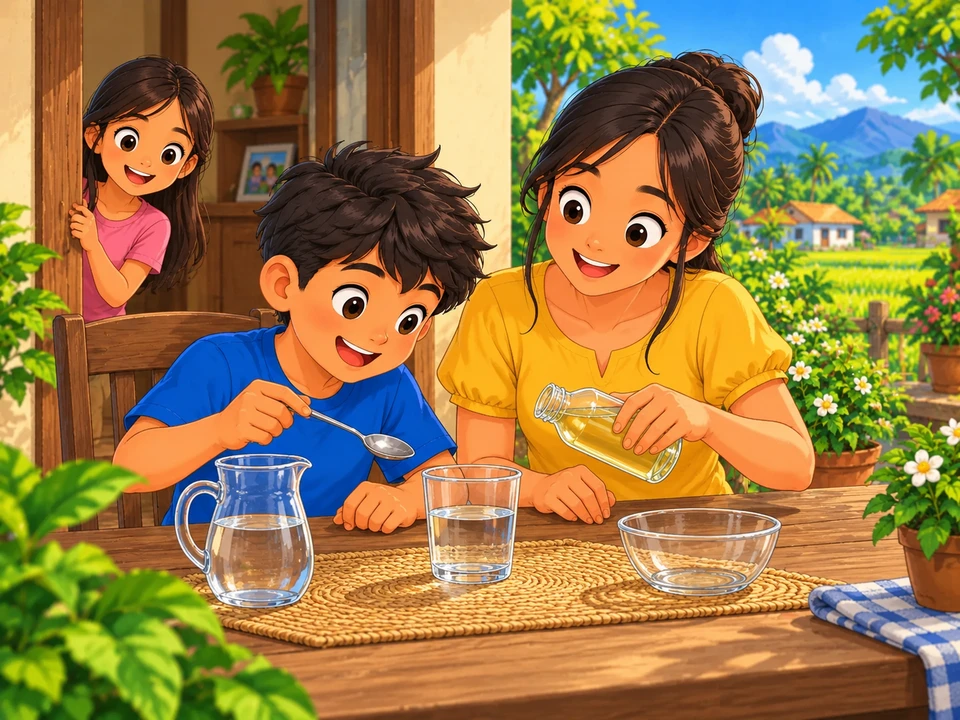
Pao and his cousin put two water cups in one freezer. One cup held saltwater. Later, plain water had ice while saltwater was still liquid…
Read the whole passage
Pao and his cousin put two water cups in one freezer. One cup held saltwater. Later, plain water had ice while saltwater was still liquid. Pao accused his cousin of warming one cup. Dissolved salt lowers the temperature at which water freezes. His aunt checked that both cups had stayed together. Pao asked to leave them longer instead of blaming his cousin. He gave his cousin the notebook and waited beside her for their next check.
Noel stirred mineral oil and water in a clear cup. The smooth oil layer broke into small parts. He told his friend that the liquids…
Read the whole passage
Noel stirred mineral oil and water in a clear cup. The smooth oil layer broke into small parts. He told his friend that the liquids had joined forever. His friend was still outside. Stirring can break mineral oil apart in water without dissolving it. Noel rested the spoon while he waited. Soon an oil layer formed again at the top. When his friend arrived, Noel stirred once more. He asked her to stay for the quiet part too.
May covered a cool drink with a cloth for a late guest. She hoped the cloth would make it warm. Her father lifted it and…
Read the whole passage
May covered a cool drink with a cloth for a late guest. She hoped the cloth would make it warm. Her father lifted it and found the drink still cool. Insulation slows heat transfer; it does not supply heat by itself. May fetched another drink that her father had warmed. They replaced the cool drink and covered the cup. When the guest arrived, May carried the cup carefully with her father. The drink was ready. Now the cloth had a useful job.
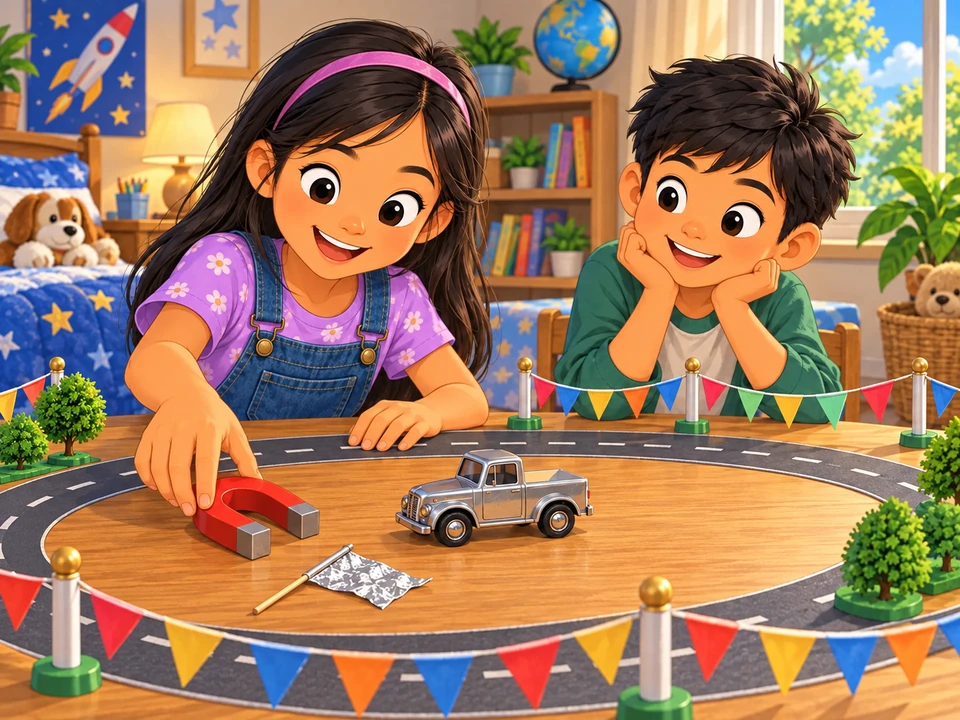
Gia made a foil flag for a toy parade. She hoped her magnet would carry it along the track. The foil stayed still, though the…
Read the whole passage
Gia made a foil flag for a toy parade. She hoped her magnet would carry it along the track. The foil stayed still, though the steel toy beside it moved. An ordinary magnet cannot lift every kind of metal. Gia clipped the flag onto the steel toy with a small peg. She moved the magnet again, and the toy carried its flag. Her brother cheered the passing flag. Gia kept guiding the toy around the final bend.
Dani went to a light show and saw three shadows. He looked behind him for other dancers. His friend found nobody there. Three lamps shone…
Read the whole passage
Dani went to a light show and saw three shadows. He looked behind him for other dancers. His friend found nobody there. Three lamps shone from different places toward the wall. One body can block several light paths and cast separate shadows. Dani lifted one hand slowly. All three shapes moved with him. His friend laughed, then took a turn while Dani watched from outside the lights. Each child could fill the wall without three others in the show.
Joel chose a star for the signal in his pretend night game. One flicker would mean start, and two would mean stop. The star seemed…
Read the whole passage
Joel chose a star for the signal in his pretend night game. One flicker would mean start, and two would mean stop. The star seemed to flicker before anyone was ready. Air between a star and a viewer can make its light seem to flicker. Joel could not tell the air when to wait. His aunt gave him a hand-held lamp instead. His sister watched him give their agreed start signal. The star stayed above them. The game followed Joel's lamp.
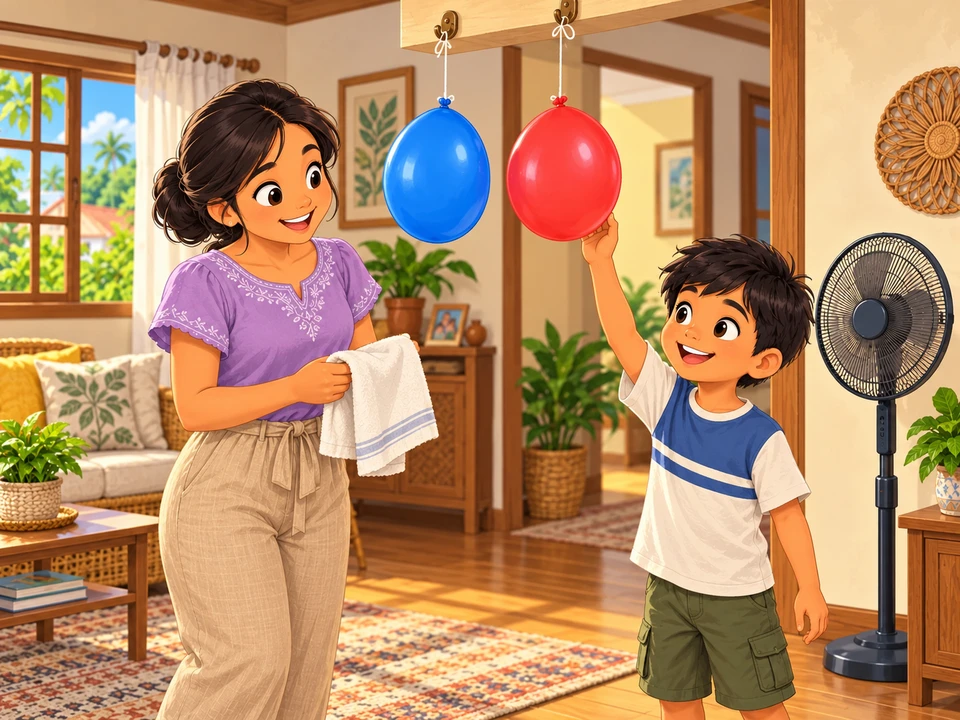
Eli wanted two party balloons to hang touching. His aunt tied them to strings. After she rubbed both the same way, a gap opened between…
Read the whole passage
Eli wanted two party balloons to hang touching. His aunt tied them to strings. After she rubbed both the same way, a gap opened between them. Eli looked for a fan, but it was switched off. Balloons with the same electric charge repel each other. His aunt brought the rubbed sides close again. They moved apart once more. Eli left room for the gap and placed a paper star between the strings. He smiled at his new decoration.
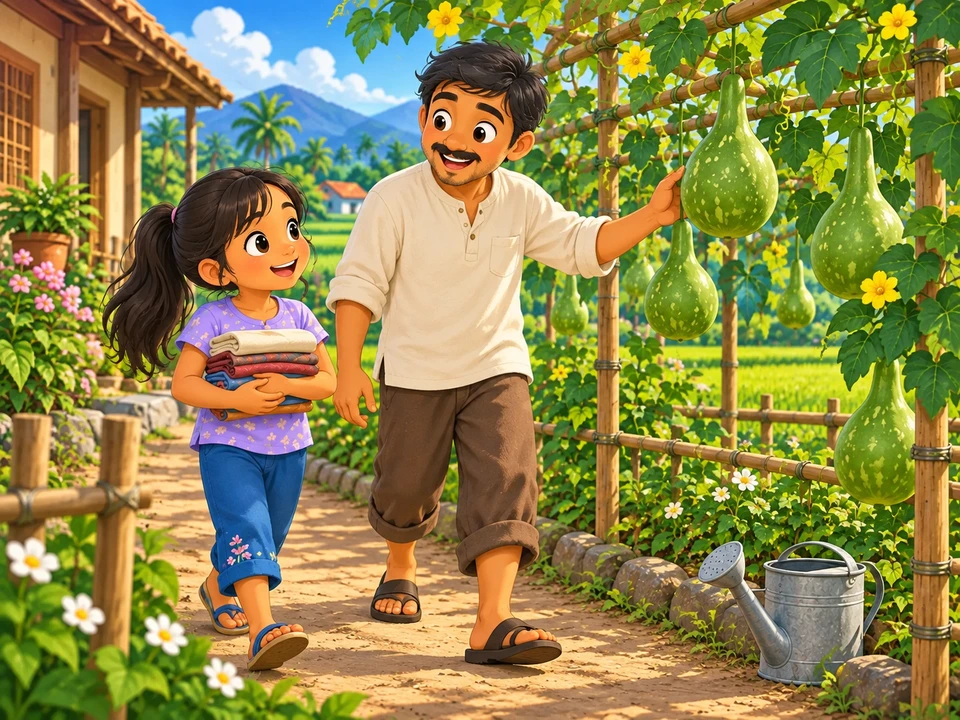
Sara brought cloth to help a local maker make a gourd hat. The maker set it aside and took Sara to the garden. A museum…
Read the whole passage
Sara brought cloth to help a local maker make a gourd hat. The maker set it aside and took Sara to the garden. A museum note described Teofilo Garcia growing gourds for kattukong hats in Abra. Sara had not thought a hat could begin among plants. The maker asked her to help water the gourds that day. Sara asked to use the small can. Then she fetched it. She kept the cloth for other work. She joined the garden task before looking at the hats.
Rex set his small top in a toy launcher. His cousin arrived with a much larger top for their game. It would not fit inside…
Read the whole passage
Rex set his small top in a toy launcher. His cousin arrived with a much larger top for their game. It would not fit inside the tool's narrow ring. Philippine spinning tops come in different shapes and sizes. Rex stopped pushing and moved his launcher aside. His aunt marked two open spaces for their tops on the floor. Rex invited his cousin to use one while he used the other. Both tops could join the day. They did not need the same toy tool.
Ari kicked the sipa object far across the yard. She smiled at the long distance, but her cousin stayed beside her. He used gentle touches…
Read the whole passage
Ari kicked the sipa object far across the yard. She smiled at the long distance, but her cousin stayed beside her. He used gentle touches to keep his own object off the ground. In sipa, players try to keep the object aloft with body movements. Ari fetched hers and stood near him. Her aunt watched their practice. Ari counted touches before it fell instead of measuring the longest kick. Her cousin offered another turn, and she stayed ready close by.
Luis helped make a model of the Las Piñas Bamboo Organ. He placed all the bamboo-shaped pipes, then left a metal one in the box…
Read the whole passage
Luis helped make a model of the Las Piñas Bamboo Organ. He placed all the bamboo-shaped pipes, then left a metal one in the box. The name had made him expect only bamboo. The actual organ includes bamboo pipes and metal pipes. His aunt showed him the city's account before they finished. Luis brought the metal pipe back to the model. They listened to an organ recording beside it. Luis kept the box nearby for spare parts. It was not for hiding the metal.
Nina wrote children only on her sungka note. Her grandmother came with the family board. Nina gave her a seat to watch, not a turn…
Read the whole passage
Nina wrote children only on her sungka note. Her grandmother came with the family board. Nina gave her a seat to watch, not a turn. Sungka is a two-player game enjoyed by adults and children. Her gran asked who would be Nina's first partner. Nina looked at the empty seat across the board. She pulled that chair out for her gran and changed the note. The young guests sat by the board. They waited for their own turns after the first game.
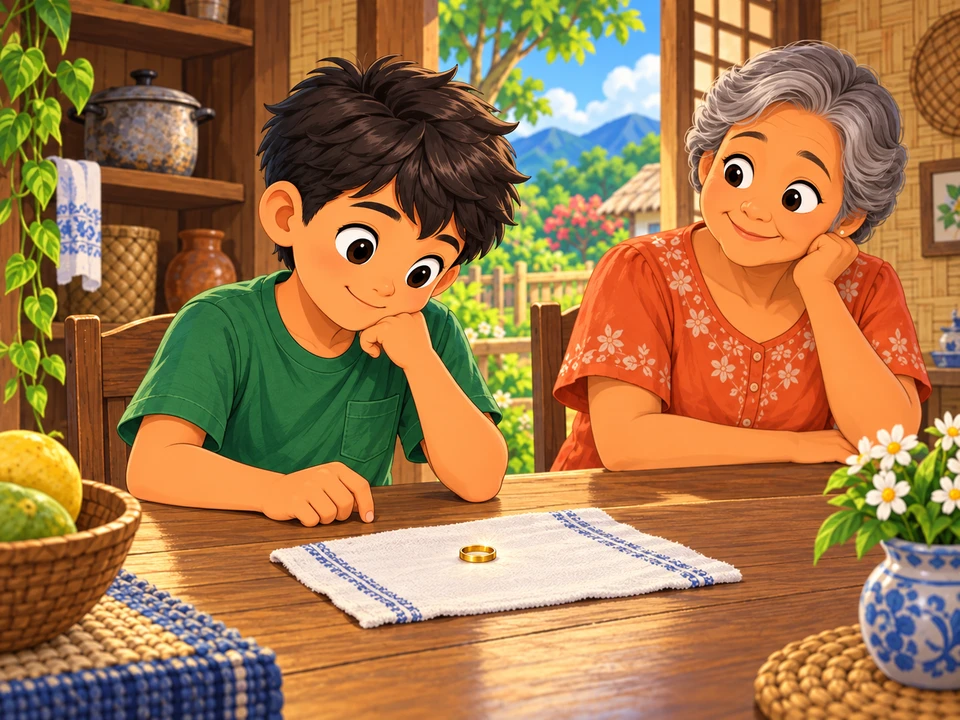
Emil chose a shiny ring for his family interview. He passed over the old cooking pot on the shelf. Cooking pots can belong in a…
Read the whole passage
Emil chose a shiny ring for his family interview. He passed over the old cooking pot on the shelf. Cooking pots can belong in a museum's record of everyday heritage. His grandmother asked why he had skipped her pot. She told him how she used it when his father was small. Emil put the ring aside. He asked about that meal next. With her permission, he wrote her account beside the pot's picture. This was for his family project.
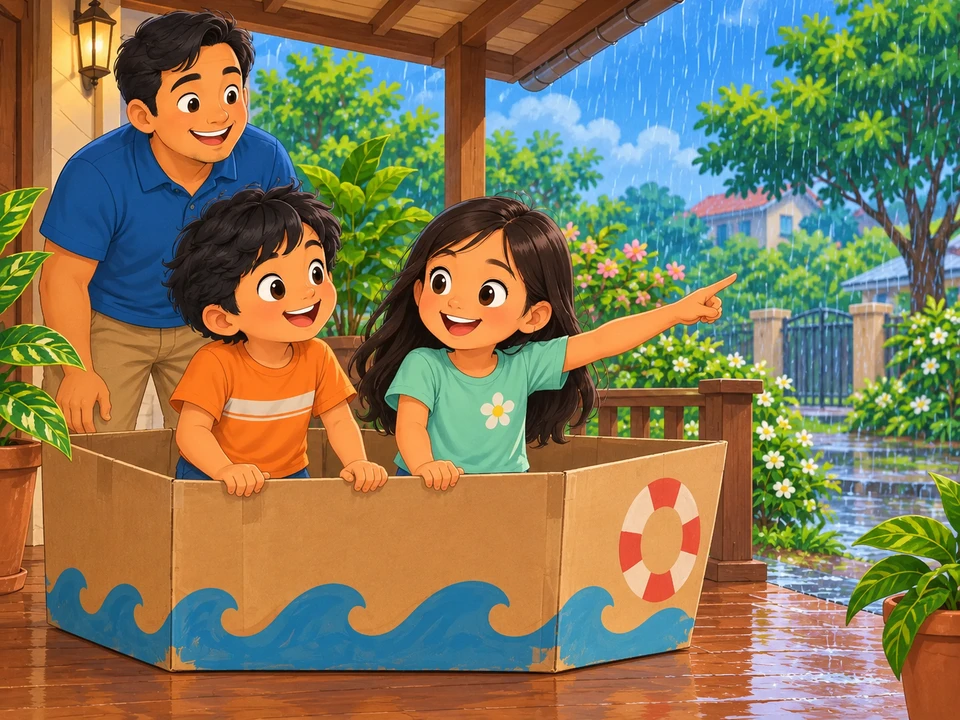
Bea's pretend boat journey stopped when rain reached the porch. Her friend said every boat game had to stay outside. They read a museum note…
Read the whole passage
Bea's pretend boat journey stopped when rain reached the porch. Her friend said every boat game had to stay outside. They read a museum note that included the lepa as a houseboat. Some boats can provide dwelling space as well as travel. Bea asked to use their cardboard boat inside the playroom. Her father moved it with them. They set a little table in its home corner and continued the journey. The rain no longer ended their pretend visit.
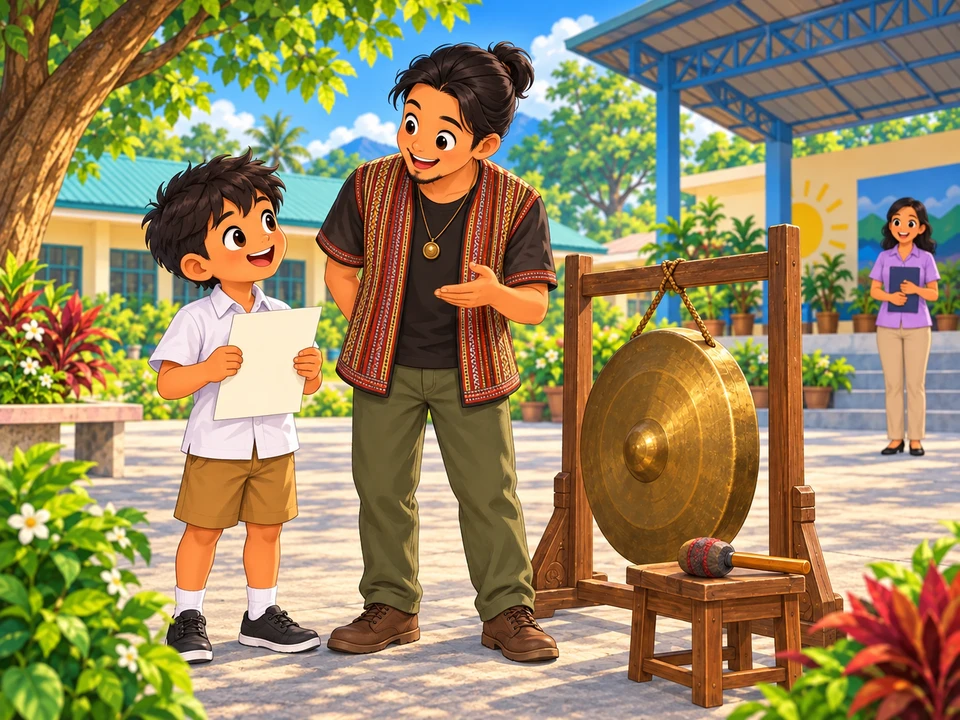
Tono promised the same gong tune for each school event. A guest player asked who would play and what the event was for. Philippine instruments…
Read the whole passage
Tono promised the same gong tune for each school event. A guest player asked who would play and what the event was for. Philippine instruments are used on different occasions, alone or in ensembles. Tono had not asked the host yet. He left his draft and went to find her. She asked for a short welcome with a group. Tono took her answer to the player before they chose a tune. Now he knew the task. He could ask for a tune.
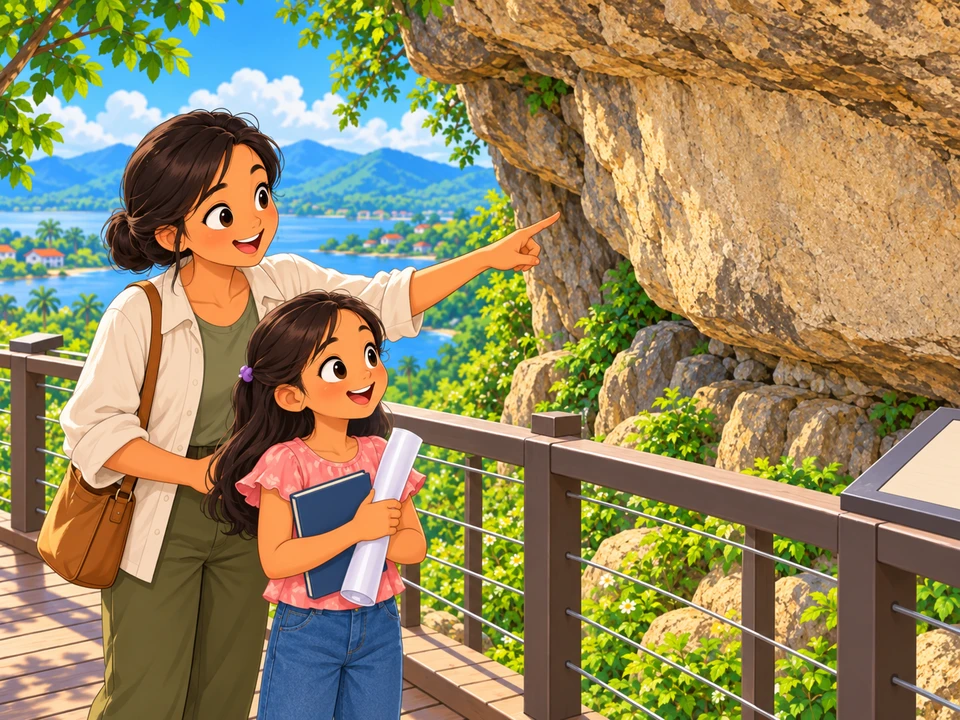
Faye brought her tracing paper to the Angono rock carvings. She hoped to press it against the figures for an exact copy. The rock engravings…
Read the whole passage
Faye brought her tracing paper to the Angono rock carvings. She hoped to press it against the figures for an exact copy. The rock engravings have a deck that helps protect them. Her aunt kept their visit on that deck. Faye put the paper under her book instead. She drew what she could see from the deck. Some lines were harder to see than others. Faye left a note by unclear lines. Then she asked the guide for help.
Miko made closed folders for the craft club's examples. His aunt brought a permitted pabalat wrapper to show. Pabalat is a cut-paper wrapper craft associated…
Read the whole passage
Miko made closed folders for the craft club's examples. His aunt brought a permitted pabalat wrapper to show. Pabalat is a cut-paper wrapper craft associated with Bulacan. Inside a solid folder, its cut work could not be seen. Miko wanted every visitor to look without passing it from hand to hand. His aunt supported the sample on a flat card. Miko made a viewing opening in the folder with her help. The visitors gathered around. She alone handled the wrapper.
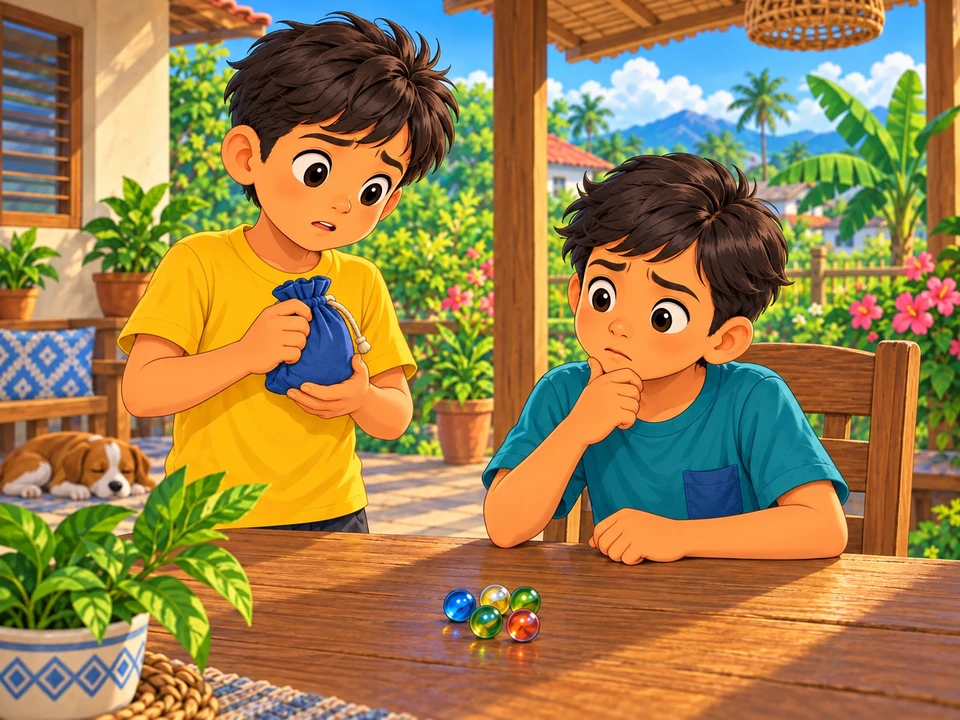
Rico put eight marbles in his bag before visiting Sam. At Sam's table, he found only five. He looked toward Sam's pockets, but had seen…
Read the whole passage
Rico put eight marbles in his bag before visiting Sam. At Sam's table, he found only five. He looked toward Sam's pockets, but had seen nobody take a marble. Sam pointed to a small hole at the bottom of the bag. They followed Rico's path back and found three marbles by the steps. Rico thanked Sam and asked his uncle to mend the bag. Before packing it again, he held it up. He checked the bottom in the light.
Lila's invitation had a flower picture on the front. She went to the garden shown in that picture. Nobody was there for the party. Her…
Read the whole passage
Lila's invitation had a flower picture on the front. She went to the garden shown in that picture. Nobody was there for the party. Her aunt turned the card over and found the address of a different garden. Lila had looked at only one side. They went to the written address together. At home, Lila set the card in a clear sleeve. She could turn it and see either side before telling her brother where the party had been.
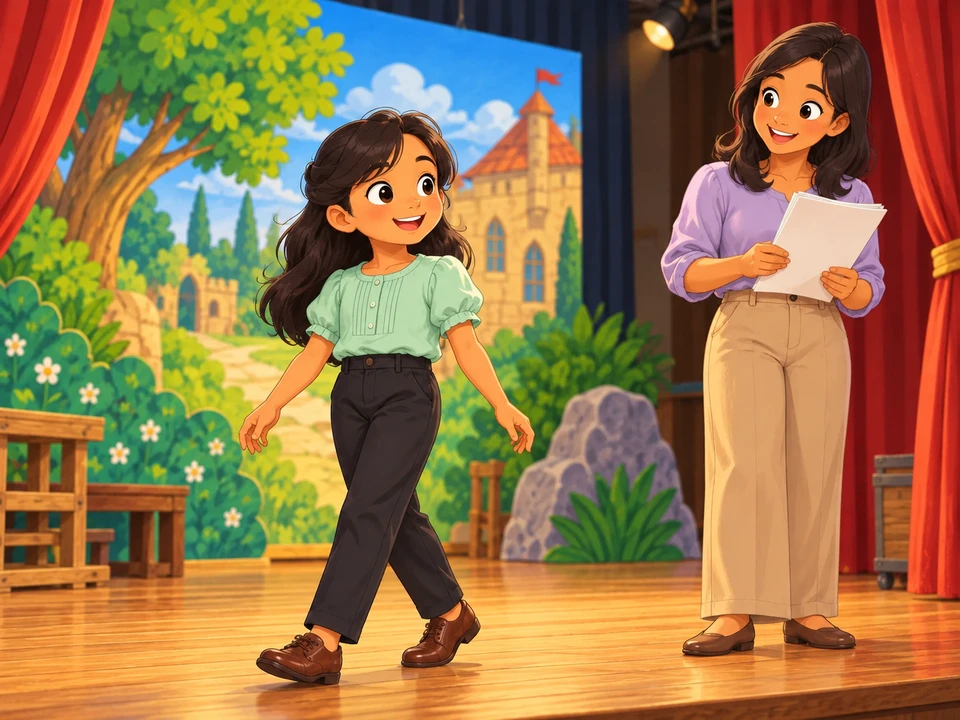
Mara had a silent walking part in the school play. Her shoes squeaked at each step on the stage. She tried holding her breath, but…
Read the whole passage
Mara had a silent walking part in the school play. Her shoes squeaked at each step on the stage. She tried holding her breath, but the squeaks remained. Her teacher let her repeat the short rehearsal path in socks. The floor stayed quiet that time. Mara pointed to the shoes beside her chair. She brought another pair for the next practice and tested the whole path with permission. The quiet walk could now belong to her part in the play.
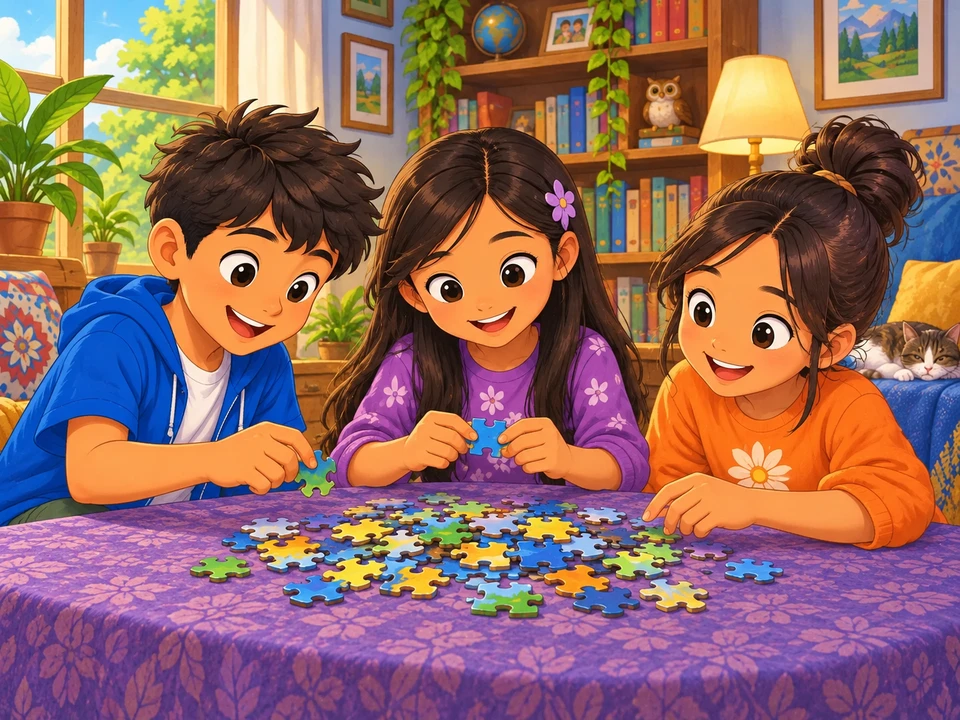
Three friends spread a square cloth over the puzzle table. They placed loose puzzle pieces near what seemed to be a corner. One piece dropped…
Read the whole passage
Three friends spread a square cloth over the puzzle table. They placed loose puzzle pieces near what seemed to be a corner. One piece dropped to the floor. Suri lifted the cloth and found the table had a round edge there. The cloth's corner had no table beneath it. They moved the pieces inward before working again. Suri left that edge uncovered so everyone could see the support. The next pieces stayed on the table while the picture slowly grew.
Sol drew a route arrow on both sides of a sign. Both arrows pointed toward the shed. On the return walk, his cousin followed one…
Read the whole passage
Sol drew a route arrow on both sides of a sign. Both arrows pointed toward the shed. On the return walk, his cousin followed one back toward the shed. She wanted the porch instead. Sol walked beside her from the shed to check that journey. He changed only the return arrow. They tested it from her approach. His cousin reached the porch. The front arrow still guided visitors on their outward walk.
Neri counted eight apples in the basket and wrote eight on a list. Before the delivery, she gave two apples to her neighbour. She copied…
Read the whole passage
Neri counted eight apples in the basket and wrote eight on a list. Before the delivery, she gave two apples to her neighbour. She copied the old list onto the delivery card. Her father counted six apples as he lifted the basket. Neri looked at the two apple spaces left near the handle. She changed the card before her father set out. The gift had been kind. Its change belonged in the count too.
Elma set a snack tray on a bench before the garden dance. When she sat down, the bench faced away from the little stage. She…
Read the whole passage
Elma set a snack tray on a bench before the garden dance. When she sat down, the bench faced away from the little stage. She twisted to look back and nearly tipped her tray. Her brother offered to move the heavy bench. Elma saw two light chairs already facing the stage nearby. Their aunt helped carry the tray to those chairs. The bench stayed beside the path. Elma and her brother ate while watching the dance. They no longer turned around at each step.
Owen copied the outer shape of his sister's card boat. His flat copy would not hold its sides up. With her permission, he opened her…
Read the whole passage
Owen copied the outer shape of his sister's card boat. His flat copy would not hold its sides up. With her permission, he opened her spare boat to look inside. Small folded tabs lay hidden behind its sides. They joined the parts that his outline had left loose. Owen marked the folds before making a new copy. His sister held the spare steady while he checked each join. He kept the outer shape in his pattern. The hidden fold marks stayed there too.
Pia and Ren needed the same blue pencil for their posters. Pia's next step was a blue lake. Ren needed blue only for his last…
Read the whole passage
Pia and Ren needed the same blue pencil for their posters. Pia's next step was a blue lake. Ren needed blue only for his last small border. They sat waiting for each other to finish. Then Ren picked up his red pencil and drew the roof first. Pia coloured her lake and passed the blue pencil to him. His roof was done by the time he began the border. Both posters were ready when their teacher called for them.
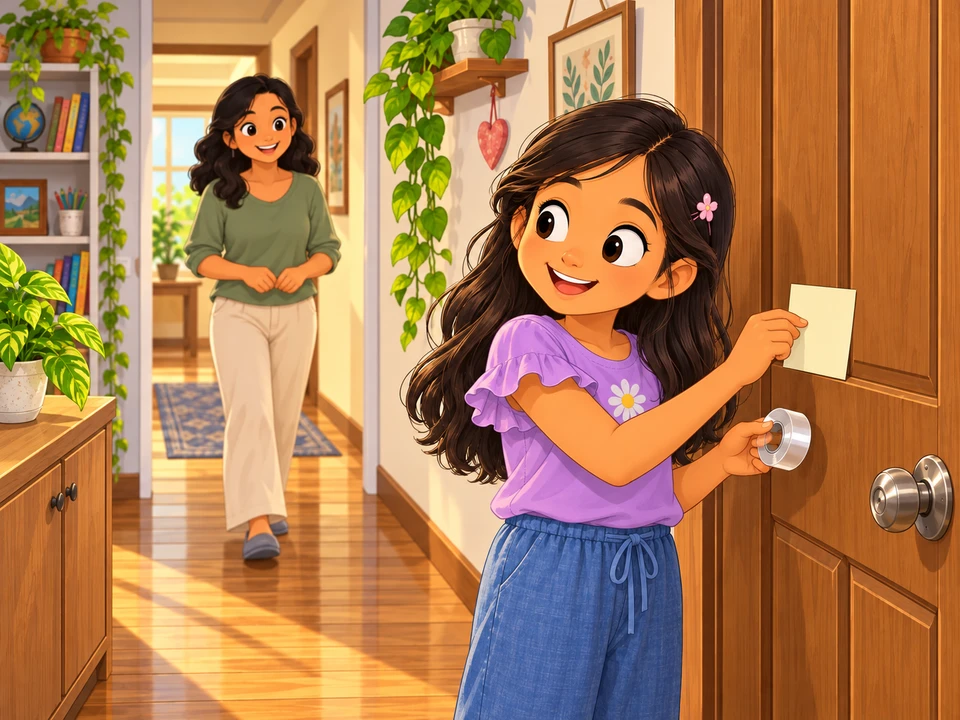
Ina wrote a keep-this-door-closed note for the model room. She stuck it beside the handle on the inside. Her aunt arrived from the hall and…
Read the whole passage
Ina wrote a keep-this-door-closed note for the model room. She stuck it beside the handle on the inside. Her aunt arrived from the hall and opened the door. Only then did she see the note. Ina asked her to wait while she moved it to the outside. Her uncle read it from the hall before touching the handle. He knocked and waited for Ina to come. The same words now reached a visitor before the choice. They could guide it in time.
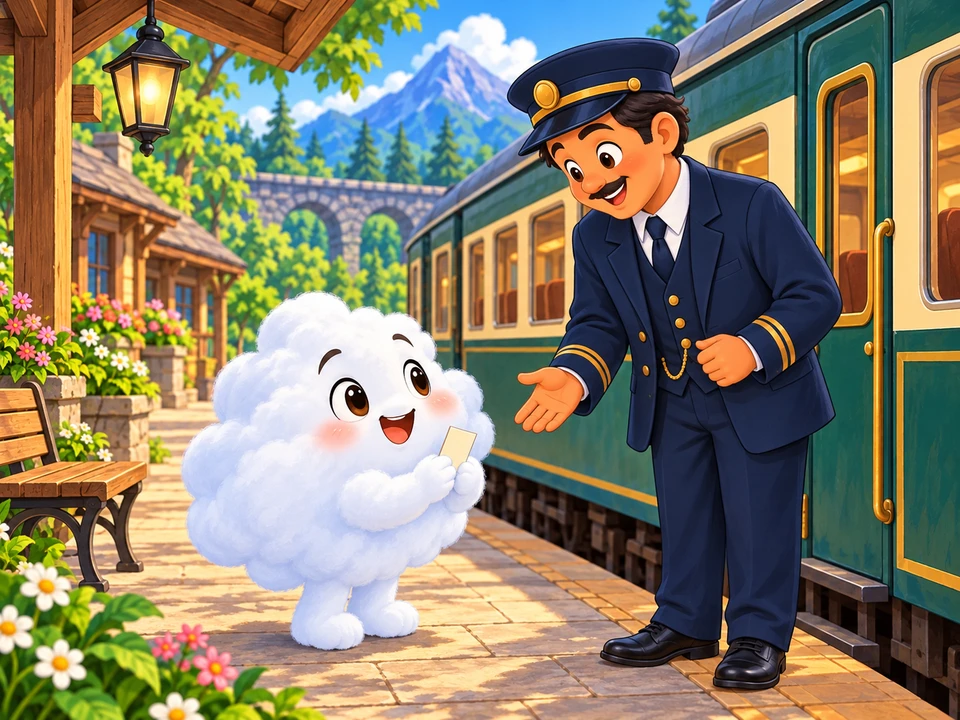
A little cloud bought a ticket for the forest train. It tried to pass through the door, but its soft top spread above the roof…
Read the whole passage
A little cloud bought a ticket for the forest train. It tried to pass through the door, but its soft top spread above the roof. The conductor checked the ticket and looked at the cloud's shape. He asked whether it could travel in an open carriage. The cloud nodded and floated beside him to the last car. There it settled without squeezing through a door. The train moved. The cloud waved to the trees from its roomy seat.
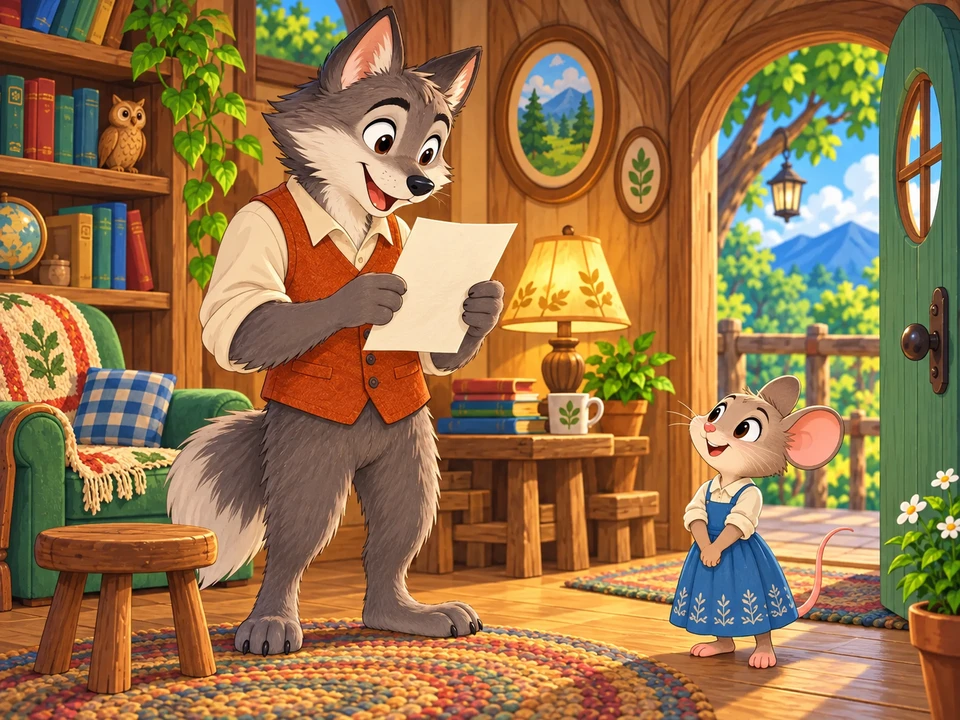
Wolf wrote a gentle apology to Mouse on a clean page. But when he read it aloud, every word came out as a roar. Mouse…
Read the whole passage
Wolf wrote a gentle apology to Mouse on a clean page. But when he read it aloud, every word came out as a roar. Mouse backed toward the door before hearing the whole letter. Wolf set the page on a low stool and stepped away. Mouse came back to read it in silence. She reached the last line. Then she sat beside the stool instead of leaving. Wolf waited for her answer. His mouth stayed closed and his paws rested quietly.
The keeper owned a magic clock. It paused whenever he closed his eyes. He shut them for a rest before his guest came. His clock…
Read the whole passage
The keeper owned a magic clock. It paused whenever he closed his eyes. He shut them for a rest before his guest came. His clock still showed an early hour when she knocked. He pointed at its hands and called her too early. The guest showed a plain clock she had brought from town. It had kept moving during his rest. The keeper opened his eyes wide, then invited her in. He stopped asking her to wait for his paused clock.
A giant promised Mouse one handful of fruit. He scooped a mound of berries into his huge palm. Mouse brought a little basket, but it…
Read the whole passage
A giant promised Mouse one handful of fruit. He scooped a mound of berries into his huge palm. Mouse brought a little basket, but it could not hold that mound. The giant had counted with his own hand in mind. Mouse showed him what her basket could carry. He set one berry inside and asked if that was enough. Mouse nodded and lifted the basket herself. The giant kept the rest for other guests while she carried her gift home.
The talking river sent a leaf message to its friend upstream. Its leaves could travel only with its flow. The message drifted past the lower…
Read the whole passage
The talking river sent a leaf message to its friend upstream. Its leaves could travel only with its flow. The message drifted past the lower bridge, away from the friend's home. The river waited all day for an answer. A bird asked which way the friend lived. After hearing upstream, it offered to carry a new message there. The river gave it the words and watched it fly toward the hills. Next time, the river would ask about the route. Then it would choose a messenger.
King Rollo's crown moved chairs by command while he wore it. He set it on his desk before clearing the hall. He ordered a chair…
Read the whole passage
King Rollo's crown moved chairs by command while he wore it. He set it on his desk before clearing the hall. He ordered a chair aside, but it stayed still. A girl holding flowers waited at the doorway. Rollo looked at his bare head and the crown on the desk. Then he asked the girl politely for help. She chose to move one chair with him. Rollo thanked her and made space for the flowers. His crown stayed on the desk.
The painted door in the tale could follow pictures but not written words. Tia wrote open on a card and held it up. The door…
Read the whole passage
The painted door in the tale could follow pictures but not written words. Tia wrote open on a card and held it up. The door stayed shut. Her friend drew a little door with a gap beside its frame. Tia held that picture in the same place. The painted door swung open, and both friends stepped through. Tia kept the picture beside the door for their return. Her word card stayed in her pocket. She could show it to an ordinary reader.
A little star won a heavy medal at the night fair. It hung the medal around its neck and began to sink below the clouds…
Read the whole passage
A little star won a heavy medal at the night fair. It hung the medal around its neck and began to sink below the clouds. The star wanted to shine high again, but also wanted to keep its prize. Its friends placed a shelf in the fair's viewing room. The star set the medal there and rose without its weight. Visitors could admire the prize below. The light shone above. Each evening, the star returned. It could see both parts of its happy night.
Rabbit tied two long ribbons around his tail for the parade. He loved the grand shape they made. On his walk, both loose ends caught…
Read the whole passage
Rabbit tied two long ribbons around his tail for the parade. He loved the grand shape they made. On his walk, both loose ends caught in a narrow gate. The tailor asked before helping him free them. Rabbit agreed, then took the ribbons off for the rest of the path. He saved them in a box beside his parade suit. He reached the wide parade ground. There he asked the tailor to tie them safely again. His ordinary tail had stayed clear throughout the narrow walk.
The baker's magic oven baked only orders named with the word today. He asked for a tomorrow bun for the next day's picnic. No bun…
Read the whole passage
The baker's magic oven baked only orders named with the word today. He asked for a tomorrow bun for the next day's picnic. No bun came out. His neighbour asked for a today bun, and one appeared. The baker gave her that warm bun and looked at his empty picnic tray. He set the tray aside. It was ready for the next morning. When that morning came, he would use today for the new order. The picnic plan could wait without another failed name.
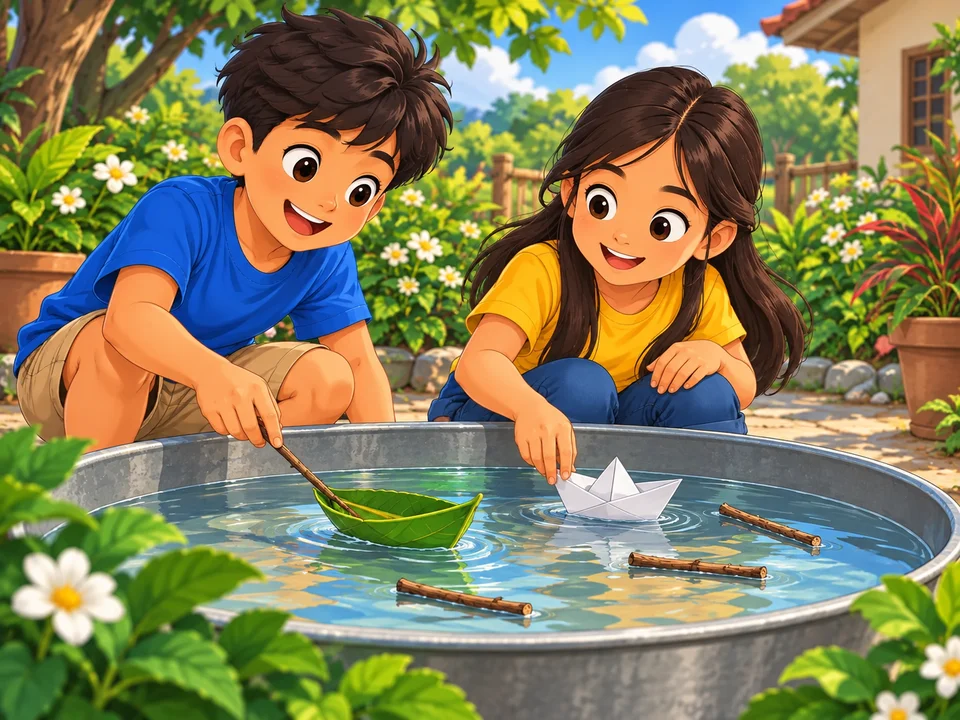
Jo made a small boat from a leaf. Her cousin made one from a scrap of paper. They put both boats in a wide tub…
Read the whole passage
Jo made a small boat from a leaf. Her cousin made one from a scrap of paper. They put both boats in a wide tub.
“First to that side wins,” said Jo.
She blew hard. Her leaf spun round and came back. Her cousin laughed, but his boat had caught on the rim.
“Our boats need help,” he said.
Jo found a twig. She pushed his boat free. He made a small wave with his hand to move hers.
The race became a rescue trip. Each boat had to bring a lost twig home.
When their aunt asked who had won, both hands went up. Then both children burst out laughing.
Rosa went with her aunt to see a weaver in Ilocos. A strip of cloth grew on a wooden frame. Blue and white lines ran…
Read the whole passage
Rosa went with her aunt to see a weaver in Ilocos. A strip of cloth grew on a wooden frame. Blue and white lines ran across it.
“When will you paint the rest?” Rosa asked.
The weaver held up a blue thread. “Look here,” she said.
Rosa saw the thread go over some threads and under others. She pushed each new row close to the last.
The pattern came from the threads. There was no brush and no pot of paint.
At home, Rosa looked at her own shirt. She could see tiny rows in the cloth. She had worn it all day without once thinking about its threads.
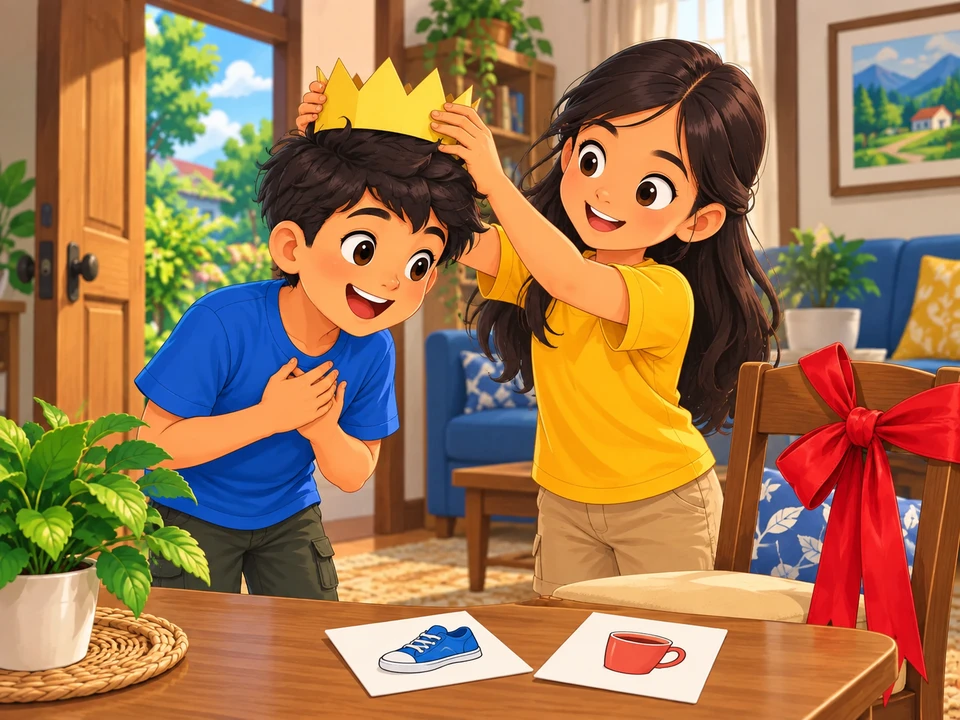
Rafi found a red ribbon tied to his chair. Beside it lay a card with a sketch of a shoe. He looked in his shoe…
Read the whole passage
Rafi found a red ribbon tied to his chair. Beside it lay a card with a sketch of a shoe. He looked in his shoe and found a sketch of a cup.
“Is this a hunt for a gift?” he asked.
His sister only smiled.
Under the cup, a last card showed a crown. Rafi searched the shelf, then the toy box. No crown was there.
At last he saw his sister at the door. She held a paper crown above his head.
“The king is late,” she said.
The prize was not in a box; it was a part in the play. His cousins waited behind a curtain. Rafi bowed and stepped through the curtain.
Lena set two pieces of cake on each plate. One plate held two large pieces. The other held two thin strips from the edge. “Two…
Read the whole passage
Lena set two pieces of cake on each plate. One plate held two large pieces. The other held two thin strips from the edge.
“Two for you and two for me,” she said.
Her cousin tilted his head. “Which plate would you choose?”
Was that fair to both of them? Lena looked again. Two pieces each did not mean the same amount of cake.
She called her aunt to help. They put the pieces side by side, then shared each large piece and each strip. Now both plates held a mix of the same sizes.
Lena slid a plate across the table.
“This time I looked at more than the number,” she said. Her cousin took a bite and grinned.
Jun took a broom to the path near his aunt's garden. A pile of leaves lay beside a pot. He was about to sweep it…
Read the whole passage
Jun took a broom to the path near his aunt's garden. A pile of leaves lay beside a pot. He was about to sweep it into a bag when his aunt called him.
“Look at the edge,” she said.
A small caterpillar rested under a curled leaf. Jun put down the broom.
His aunt explained what he had found. Some small animals use fallen leaves as shelter.
“So this pile is more than a mess,” he said.
They left the leaves in that part of the garden and cleared the path. Jun stepped back to look. He could still see the pot, but now he knew to look beneath the leaves as well.
Neri came home with a rough lump on her sleeve. She thought her brother had played a trick. He shook his head and showed her…
Read the whole passage
Neri came home with a rough lump on her sleeve. She thought her brother had played a trick. He shook his head and showed her his own cuff. It had three small burrs on it. They had both passed the tall weeds by the gate. Their aunt set one burr on a dark plate. Some burrs have hooks that carry seeds on fur or cloth. Neri could see tiny hooks round the seed case. So the lump was not a trick at all. She left the burr on the plate and put on a clean shirt. Her brother held up his cuff like a flag. "We gave some seeds a ride," he said. Neri laughed and checked the rest of her clothes.
Pio drew a clear pool with one big fish in it. He wanted his picture to look like the shore near his aunt. His aunt…
Read the whole passage
Pio drew a clear pool with one big fish in it. He wanted his picture to look like the shore near his aunt. His aunt pointed to the bare edge of the pool. "Where will a small fish hide?" she asked. Pio drew a huge wall round the fish. His aunt showed him a photo of mangrove roots. Many mangrove roots give fish places to find food and shelter. The photo had roots with small gaps between them. Pio rubbed out his wall and drew a tangle of roots. He left little spaces in his drawing. Then he added a small fish near one gap. His aunt smiled at the new picture. Pio had thought a safe place needed a solid wall. Now his drawing had a place to hide and room to move.
Dina went to sweep the path beside a tree. Her uncle asked her to keep one patch of leaves off the path. Dina looked at…
Read the whole passage
Dina went to sweep the path beside a tree. Her uncle asked her to keep one patch of leaves off the path. Dina looked at the dry brown heap. She could not see why he wanted it there. Her uncle bent down but did not turn the whole heap over. Leaf litter can give small animals shelter as the leaves break down. Dina saw a tiny shape move beside a curled leaf. She did not know what kind of creature it was. She swept the clear path and left the patch alone. Her cousin came with a large sack. "Will that go in too?" he asked. Dina pointed to the heap beneath the tree. "This part can stay," she said. The yard still had a clear way to walk and a place for small life.
Tess tried to draw a flower in her book. A butterfly sat on it, then flew to the next bloom. Tess put her pencil down…
Read the whole passage
Tess tried to draw a flower in her book. A butterfly sat on it, then flew to the next bloom. Tess put her pencil down and watched. She wanted it to come back so she could draw its wings. Her dad came to her side. Some of these insects can carry pollen from one flower to another. Pollen has fine grains that they may pick up on a visit. A visit does not mean that the pollen transfer will succeed. Tess had thought this insect was just part of her picture. Now she wondered what it might carry with it. She drew the two flowers on the same page. She left a space where the insect had been. When it came back, she watched first and drew later. Tess now drew a visit as well as a bloom.
Rafi put pale sand in one jar and dark sand in a new jar. He wanted to tell the class where each grain had begun…
Read the whole passage
Rafi put pale sand in one jar and dark sand in a new jar. He wanted to tell the class where each grain had begun. His sister asked how he could know. "By the color," he said, but his voice grew less sure. They read a short note about sand. Sand may come from worn rocks or from the remains of living things. A grain’s color alone does not tell its whole journey. Rafi looked at the two jars again. He could describe what he saw, but he could not name each grain’s source. He made two drawings and kept his guesses on a separate sheet. When the class asked about the colors, he showed both sheets. "Here is what I saw," he said. "Here is what I still want to find out."
Luis set a stick upright in a pot of soil. He drew a chalk mark at the end of its shadow. He went indoors to…
Read the whole passage
Luis set a stick upright in a pot of soil. He drew a chalk mark at the end of its shadow. He went indoors to eat with his aunt. When he came back, the shadow no longer reached his mark. "Did you move my pot?" he asked. His aunt shook her head. A fixed upright stick’s shadow changes as the Sun’s place in the sky seems to change. Luis checked the pot against a crack in the floor. It was still in the same spot. He drew a new mark and wrote the time beside it. He would check again later. This time he would watch the shadow without blaming the pot. His aunt lent him a piece of blue chalk for the next mark.
Ina saw a pale round shape above the school roof. It was not dark, so she rubbed her eyes. Her friend called it a small…
Read the whole passage
Ina saw a pale round shape above the school roof. It was not dark, so she rubbed her eyes. Her friend called it a small cloud. But its edge stayed sharp as the clouds drifted past. Ina asked their teacher what she could see. The Moon can at times be seen in daylight. Its place and brightness help decide when it can be seen. That does not mean it is visible all day, every day. Ina had thought it had a place only in a night sky. She drew the pale shape beside the blue roof. The next day she looked from the same spot and did not find it. She kept both dates in her book. One sight had raised a thought; the next kept her from making a rule too soon.
Miko set a cold glass of water on a dry tray. Soon the outside of the glass felt wet. He looked for a crack but…
Read the whole passage
Miko set a cold glass of water on a dry tray. Soon the outside of the glass felt wet. He looked for a crack but could not see one. His sister asked him to wipe the outside and watch again. He did, and more drops formed there. Moist air cooled by a cold glass can leave drops on its outside. This change from water vapor to liquid is called condensation. A wet glass alone does not prove a leak or a spill. Miko checked the rim and tray as well. He had blamed the glass before looking at the air around it. Now he drew the tray and glass in his book. He put a question beside the drawing. His sister smiled: it was worth a close check, not just a guess.
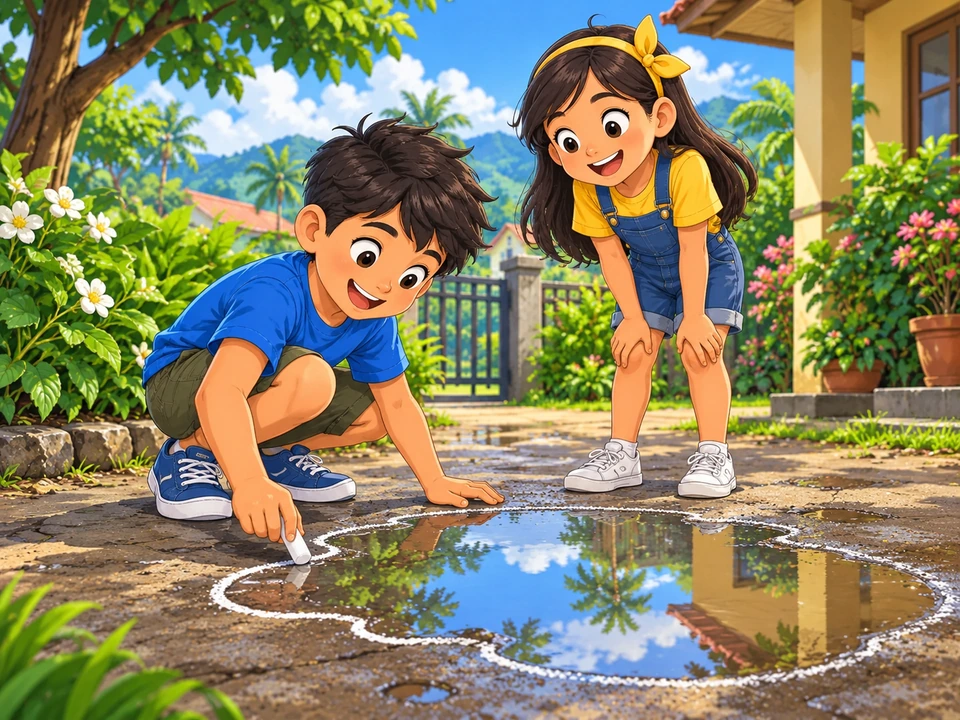
Aris drew a thin chalk ring round a pool of rain in the yard. He wanted to see if the water would reach the line…
Read the whole passage
Aris drew a thin chalk ring round a pool of rain in the yard. He wanted to see if the water would reach the line later. By noon the edge was well inside the ring. "The Sun took it all," he told his cousin. His cousin pointed to the soil beside the stones. Some water can enter soil, and some can turn to vapor. Water vapor is invisible to our eyes. A smaller puddle does not show how much went each way. Aris sat down with his chalk. He could show that the puddle had shrunk. He could not yet tell where all its water had gone. He drew a question mark near the ring. His cousin brought a book so they could plan a good check together.
Bela stopped at a sea display with her uncle. She saw a photo of coral and called it a strange stone. Her uncle asked her…
Read the whole passage
Bela stopped at a sea display with her uncle. She saw a photo of coral and called it a strange stone. Her uncle asked her to read the note beside it. Corals are animals, and many live in groups of small polyps. A polyp is a small body with parts that can catch food. Some corals have hard skeletons, but soft corals exist too. Bela went back to the photo. Its shape had made her guess, but the note gave her a different clue. She left room in her drawing for a question. Could every hard shape be called a stone? Her uncle did not ask her to guess the kind of coral. They had only a photo and a short note. Bela now wanted to know more than what the shape looked like.
Sela found an old game board in her aunt’s chest. It had rows of small hollows and two bigger ones at the ends. Her aunt…
Read the whole passage
Sela found an old game board in her aunt’s chest. It had rows of small hollows and two bigger ones at the ends. Her aunt said it was a sungka board. Sungka is a game for two, and players can use shells, seeds or pebbles. The board tends to have fourteen small pits and two large end pits. Sela laid out a few shells but did not start to play. She had seen a cousin use seeds to play on a board like this. Her aunt brought a small bag of pebbles. Sela had thought the shells were part of the board itself. Now she saw that the pieces used for play could change. They cleared a space to sit facing each other. Before the first turn, Sela asked how her aunt played. She wanted to learn their rules. She would not guess them from the pits.
Rico ran his finger along a stripe on his aunt’s cloth. He thought she had painted it with a fine brush. His aunt gave him…
Read the whole passage
Rico ran his finger along a stripe on his aunt’s cloth. He thought she had painted it with a fine brush. His aunt gave him two strips of blue paper and one of yellow. He passed the yellow strip over one blue strip and under the next. Woven cloth has threads that pass over and under other threads. Not all designs on cloth are woven; some are printed or sewn. Rico tried the paper crossing again. The stripe came from how the strips fit. He turned the cloth over. He looked at its other side. His aunt told him not to guess who made a cloth from one stripe. He had seen one way to form a design. He did not yet know who had made his aunt’s cloth. Rico put his brush away and took one more strip of paper.
Lira saw a plain clay pot behind glass at a museum. She had hoped to see bright jewels and tall statues. "Why keep a pot?"…
Read the whole passage
Lira saw a plain clay pot behind glass at a museum. She had hoped to see bright jewels and tall statues. "Why keep a pot?" she asked her dad. He helped her read a note about clay pots. A museum can show a cooking pot as part of the craft of this country. Other clay vessels have uses besides cooking. Lira looked at the pot’s worn rim. She imagined hands carrying it, but knew that was only her guess. The note did not say who had owned this one. Her dad asked which object she would draw. Lira chose the plain pot. She left room by it for things she still wished to ask. The plain shape behind glass now seemed worth a long look. She did not need a jewel to enjoy the visit.
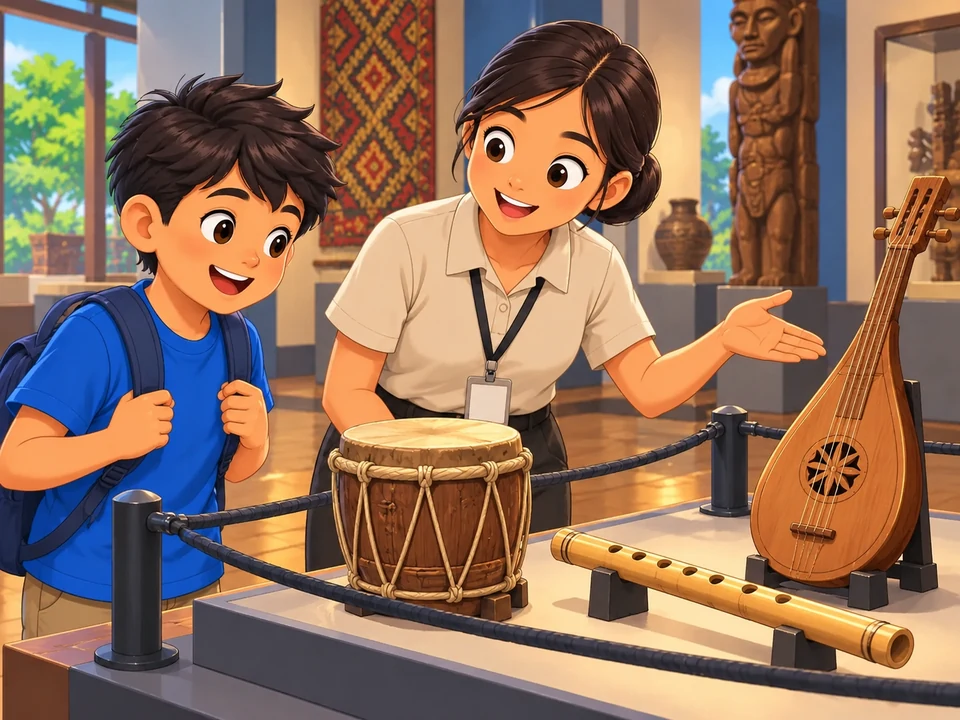
Noel saw a long wooden box at the school display. Inside lay a drum, a flute and a lute with strings. He wanted to name…
Read the whole passage
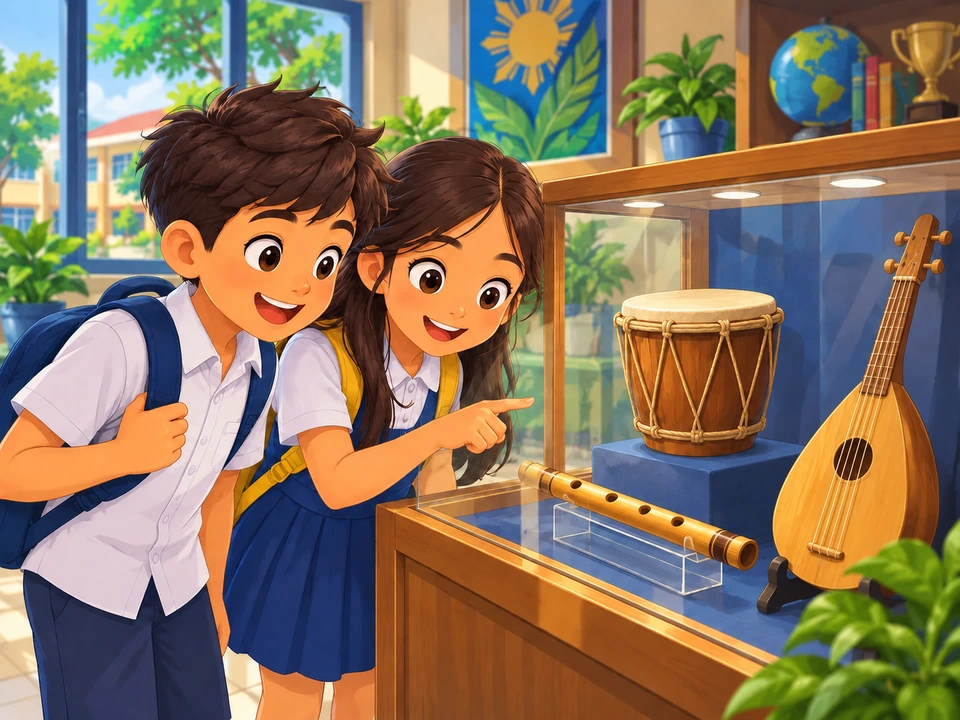
Noel saw a long wooden box at the school display. Inside lay a drum, a flute and a lute with strings. He wanted to name a tune from the wood alone. His teacher asked him to read the display note first. Old types of music tools in this country often use brass, wood and bamboo. What they are made of alone does not tell a tune or what it means. Noel set his pencil down. He could name the things he saw, but not the tunes he had never heard. A classmate asked him which group had made the flute. Noel read the note again. He would not make up a name. They wrote down what the display actually said. Then they left a question for the guest who would talk to their class. The long box had given them a start, not all the answers.
Aya saw a strip of bamboo in a case of old scripts. At first she thought the marks were just scratches. Her mom helped her…
Read the whole passage
Aya saw a strip of bamboo in a case of old scripts. At first she thought the marks were just scratches. Her mom helped her read the note near the case. A museum gallery shows old ways of writing on leaves and carving words on bamboo. That does not make every mark on bamboo a piece of writing. Aya looked at the strip once more. She did not try to invent words for its marks. The note made her want to know more about ways to write a note. At home she drew the bamboo’s shape on a plain page. She wrote a question below her drawing. What else would she need to know to read those marks? Her mother asked her to keep the question for their next trip. Aya had learned to look beyond paper. She did not claim to read a script she had not been taught.
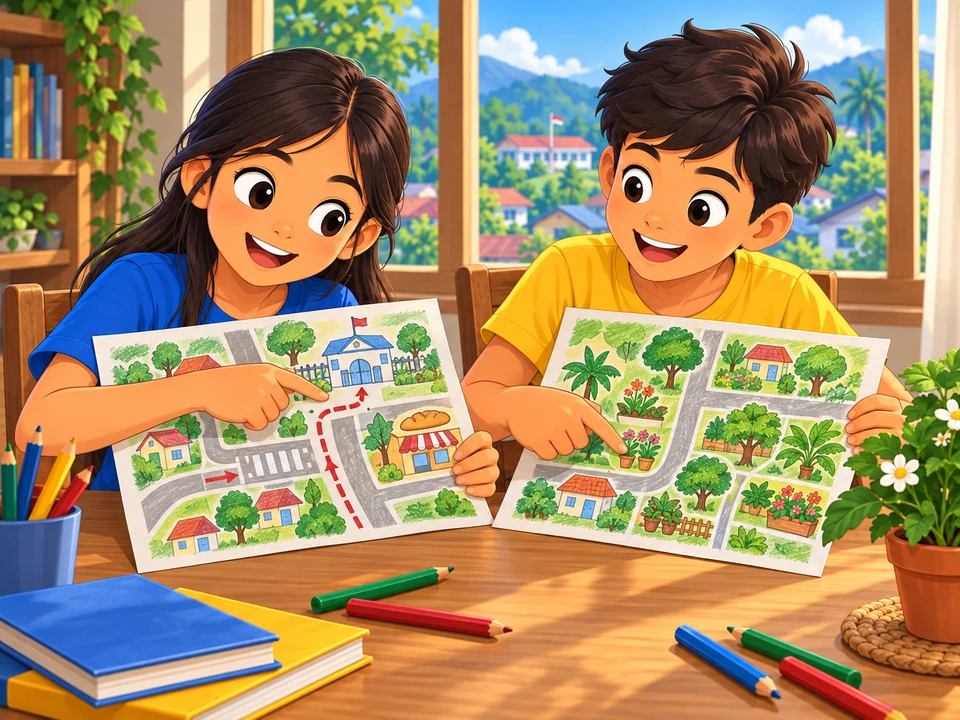
Bing drew a map to help his cousin find their home. He put a large arrow beside the sari-sari store. His cousin came back to…
Read the whole passage
Bing drew a map to help his cousin find their home. He put a large arrow beside the sari-sari store. His cousin came back to the gate with a frown. "Your left or my left?" she asked. Bing had drawn the map while facing the store from his own yard. His cousin had reached it from the other side. He turned the page round and saw the trouble. The same arrow did not mean the same turn from both ways. They walked the path side by side and added the gate and a big tree. Bing drew the path from the bus stop instead. His cousin tried it again and came straight to their door. He kept the first map beside the new one. A mark that seemed clear to him had needed a starting point for someone else.
Jana put a blue toy truck in the class lost box. She had found it under a bench after lunch. Two boys came to claim…
Read the whole passage
Jana put a blue toy truck in the class lost box. She had found it under a bench after lunch. Two boys came to claim it. Both said the blue truck was theirs. Jana did not choose the louder voice. She asked each boy to describe a part she had not shown. One said his truck had a red wheel. The other said there was a small crack below the back window. Jana turned the truck and found the crack. The first boy frowned, then said his own truck was at home. Jana gave the toy to the second boy. He thanked her and showed where his name was hidden underneath. The lost box was empty, but Jana kept the clue that had helped.
Omar set six chairs round a table for a game. He had six friends coming, so he thought the plan was done. His sister looked…
Read the whole passage
Omar set six chairs round a table for a game. He had six friends coming, so he thought the plan was done. His sister looked at the chairs and asked where he would sit. Omar gazed at the bare table for a bit. He had counted the guests but left himself out. There was one small stool by the door. He brought it over, then tried to fit it between two chairs. His elbows touched the backs on both sides. He set the chairs a bit farther apart. Now each place had room to sit and move. When his friends came, Omar asked them to try the spaces first. They shifted one chair and began the game. A count helped him plan, but a test showed what the count had missed.
Mae tied a yellow ribbon to a bag of bread for her aunt. Her brother tied one to a bag for the family next door…
Read the whole passage
Mae tied a yellow ribbon to a bag of bread for her aunt. Her brother tied one to a bag for the family next door too. Both bags sat by the door. Mae reached for the first yellow ribbon. Then she saw that the other bag had two small buns, while her aunt’s had one long loaf. She stopped and opened each bag to check. Her brother came in and laughed at the matching ribbons. They had each thought the color would be a clear sign. Mae drew a loaf on one tag and two buns on the other. Her brother tied the tags on. Then he took a step outside. At the two doors, they checked the pictures once more. Both bags reached the right home. The ribbon was bright, but a sign only helped if it told the two bags apart.
Kaye made a list of tools for the class garden. She wrote two spades, a rake and a green bucket. When the work began, nobody…
Read the whole passage
Kaye made a list of tools for the class garden. She wrote two spades, a rake and a green bucket. When the work began, nobody could find the rake. It was not lost; her cousin had taken it to the side gate. The list said what they had, but not where it was. Kaye added a blank space beside each tool’s name. Each child wrote where the tool was being used. When the bucket was needed, she checked its place on the list. A friend brought it from the bench and put it back there later. Kaye changed the list again when the rake moved. At the end, the group used it to collect the tools. No one had to guess which corner held them. The list had become a way to follow changes, not just count things.
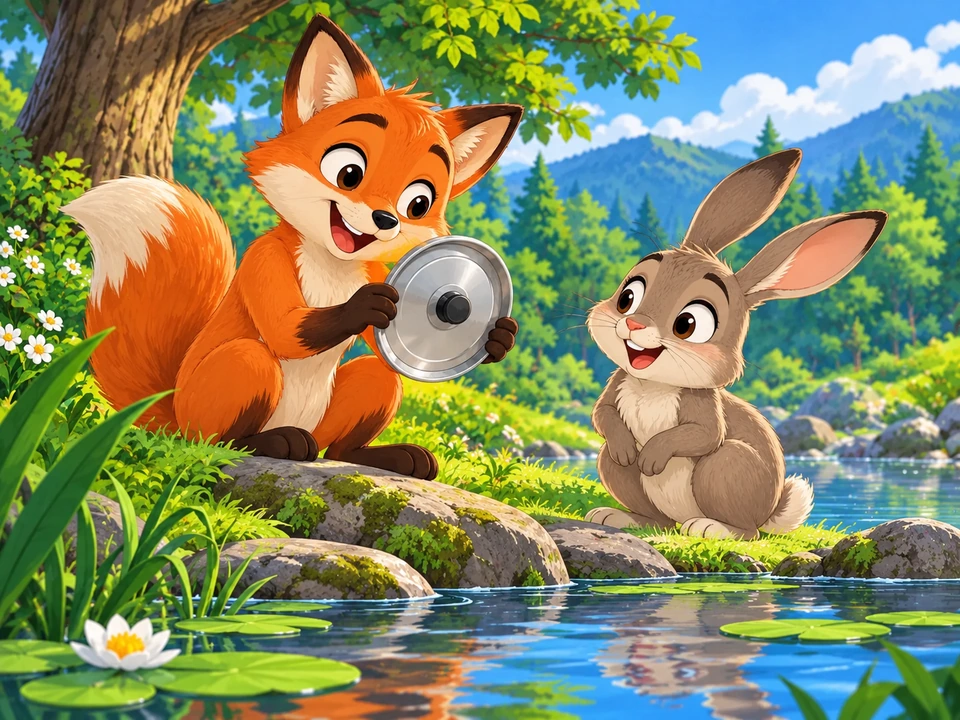
In an imagined forest, Fox found a silver lid by the pond. He held it up and called it his spare moon. Hare asked to…
Read the whole passage
In an imagined forest, Fox found a silver lid by the pond. He held it up and called it his spare moon. Hare asked to borrow it for a dark walk. Fox said the lid would work only if she paid him three nuts. Hare gave him the nuts and waited for night. Then she held the lid high, but it lit no path. She brought it back and found Fox under a bright lamp. "Your moon works here," she said, turning the lid toward the lamp. Fox looked at the bright patch on its rim. Hare turned the lamp off, and the patch was gone. Fox put the nuts back in her bag. He kept the lid as a tray instead. The next time he made a grand claim, Hare asked to see it work where it was needed.
In a make-believe town, Bird opened a shop for silence. She put empty jars on a shelf and tied each with a ribbon. Mouse bought…
Read the whole passage
In a make-believe town, Bird opened a shop for silence. She put empty jars on a shelf and tied each with a ribbon. Mouse bought one to stop the noise near his bed. He opened it at home, but the street was still loud. He went back to Bird with the jar. Bird said he had let the silence fly out too fast. Mouse asked her to open another jar in her own shop. She took a jar from the shelf and pulled off the lid. The shop bell rang just then. Mouse waited, but Bird had no new answer. She gave back his coin and took down the jars. Later she offered a quiet place to read behind her shop. This time Mouse could try the place before he paid.
In a made-up town, Goat called himself king of a small bridge. He stood in the middle and told each guest to turn back. Duck…
Read the whole passage
In a made-up town, Goat called himself king of a small bridge. He stood in the middle and told each guest to turn back. Duck came with a basket and asked to cross. Goat stamped his foot and said the bridge was his. Duck sat down by the path and waited. Soon Goat wanted to leave for his supper. Duck was still sitting at the end he needed to reach. "Move," said Goat. Duck asked whose path it was. Goat looked at the empty basket beside her. He stepped back and let her cross with it. Then he asked if he might pass in turn. Duck moved aside. Goat took his crown off before going home; it had not made the bridge any wider.
In a tale Maya made up, a small cloud fell into a cup. It asked a girl named Sol to hide it from the sky…
Read the whole passage
In a tale Maya made up, a small cloud fell into a cup. It asked a girl named Sol to hide it from the sky. Sol put a cloth over the cup and went to play. When she returned, the cloth rose and sank like a tiny sail. "It is too small in here," said the cloud. Sol found a larger bowl, but the cloud still pressed against the edge. She carried it outside and lifted the bowl toward the open sky. The cloud rose out and spread across the blue. Sol kept the empty cup on her desk. Her brother asked why she had saved it. She told him about a gift that needed room instead of a lid. Then Maya closed her storybook. She had made the cloud speak so readers could think about keeping and letting go.
In an invented valley, a giant told long tales at the town square. He spoke so loudly that no one else could add a word…
Read the whole passage
In an invented valley, a giant told long tales at the town square. He spoke so loudly that no one else could add a word. One day a small child held up a blank page. The giant stopped to ask where the story had gone. "There is no room for mine while yours goes on," said the child. The giant sat down and took a deep breath. He told one short tale, then closed his mouth. The child began a story about a lost blue button. A baker added an ending, and a farmer gave it a new twist. The giant leaned closer to hear the soft voices. At dusk the square was still full of tales. For once, none belonged to him alone. He went home with more stories than he had brought.
Nilo sat on the porch to show his pals small lights near the gate. Some flashed, then went dark for a while. He reached for…
Read the whole passage
Nilo sat on the porch to show his pals small lights near the gate. Some flashed, then went dark for a while. He reached for a flashlight so the pals could see more. His aunt held his wrist. Many fireflies use flashes to send signs to each other, often to find a mate. Not every kind makes the same light. Nilo set the flashlight down and stayed on the porch. “Let us see what they do,” he said. At first, he counted only the lit flashes. Then he saw the dark gaps between them. His pals sat beside him and watched without chasing the bugs. “The gaps are part of what we see,” he said. He had planned a light show for his guests. Now he was a quiet guest at someone else’s show.
Mara played a bat track on Sir Dan’s sound box. She heard no calls and moved her hand to the delete key. Sir Dan asked…
Read the whole passage
Mara played a bat track on Sir Dan’s sound box. She heard no calls and moved her hand to the delete key. Sir Dan asked her to wait. Many hunting bats make calls too high for human ears to hear. The device could play a changed copy at a lower pitch. When Sir Dan chose that copy, a string of clicks came out. Mara looked at the old track again. “So quiet to me does not mean empty,” she said. She saved both files with new names. One kept the first sound; one let the class hear the changed copy. She played the clicks for her friend, then showed him the first file. He reached to the same key she had almost pressed. This time Mara was the one who said, “Wait.”
Paco waited by the pond with a camera his aunt had lent him. He wanted one fine photo of a duck facing him. The duck…
Read the whole passage
Paco waited by the pond with a camera his aunt had lent him. He wanted one fine photo of a duck facing him. The duck turned its head and ran its bill through its feathers. Paco sighed each time it bent away. His aunt asked him to watch the bill. Birds use their bills to clean and arrange their feathers, a kind of care called preening. Paco kept his hands still and left the duck alone. When it bent again, he took a photo. Then he took two more as it worked along its side. At home, he put the three prints in a row. His sister asked why none faced the camera. “I came for a pose,” he said, “but I stayed to see its work.”
Celia took her shore sketch back to the same rail the next day. The water now reached farther up the sand. She held an eraser…
Read the whole passage
Celia took her shore sketch back to the same rail the next day. The water now reached farther up the sand. She held an eraser above the old line. Her uncle pointed to the date in the corner. Tides make the sea level rise and fall along a coast. “Were you here at the same time?” he asked. Celia checked her note and shook her head. She put the eraser back in her bag. On a fresh sheet, she drew the edge she could see today. She wrote the time beside the new date. At home, she hung both sheets on her door. Her young pal wanted to know which one was the right sketch. Celia showed him both notes before she answered.
Jem planned a trick for the school fair. He would wave a magnet and lift every metal thing on a tray. A steel clip jumped…
Read the whole passage
Jem planned a trick for the school fair. He would wave a magnet and lift every metal thing on a tray. A steel clip jumped up when he tried it. A ball of foil stayed where it was. He tried once more, then asked Sir Dan for help. A plain magnet pulls hard on iron and much common steel, but not on foil made of aluminum. Jem looked at the card he had made for his trick. It said too much. He crossed out the word every and made a new plan. At the fair, he asked his pals to guess what would lift. Each guess was checked with the same magnet. The foil stayed on the tray again, but this time no one called the trick a failure.
Rina saw a strip of colors fall on paper beside Sir Dan’s prism. She drew round the strip to keep it. When Sir Dan moved…
Read the whole passage
Rina saw a strip of colors fall on paper beside Sir Dan’s prism. She drew round the strip to keep it. When Sir Dan moved the prism, the colors left her line. Rina checked the paper for a stain. There was none. A prism can split white sunlight into colors because each color bends by its own amount. “The glass gave me light, not paint,” Rina said. She did not throw the plain sheet away. So she asked Sir Dan to put the prism back. The colors lay across the outline once more. Rina called her pal over to watch the change. “What if we move it this way?” she asked. Her line could not hold the light, but it gave them a place to try again.
Dio packed a cube of ice for a class test. He set it in a cup inside a thick box. His friend said the box…
Read the whole passage
Dio packed a cube of ice for a class test. He set it in a cup inside a thick box. His friend said the box must make cold. Dio had thought the same thing. Their teacher asked what was cold before the box was closed. “The ice,” Dio said. Insulation slows heat transfer; it does not make cold or stop heat forever. Dio set a second cup of ice outside the box. He wrote down when the test began and checked both cups later. There was still more ice in the covered cup in this test. He did not call the box a cold maker again. His friend asked how long it would keep the ice. Dio opened his notes instead of making a promise.
Lani made a toy Moon from soft gray clay. She set small cone-shaped hills all over it. Her brother asked where the round pits had…
Read the whole passage
Lani made a toy Moon from soft gray clay. She set small cone-shaped hills all over it. Her brother asked where the round pits had gone. “I thought the pits were holes in hills,” she said. They opened a book about the Moon. Many Moon craters are pits formed when space rocks strike its surface. Lani took a round bead and pressed it into spare clay. It made a low hollow, not a tall hill. She knew a slow bead was not a real crash in space. Still, the hollow helped her change some parts of her model. She left the bead beside it for her brother to try. The toy Moon now gave them a question about an old crash instead of a hill on every spot.
Sami helped set out photo cards for a school table. He put a shirt card far from the fruit cards. His aunt asked him to…
Read the whole passage
Sami helped set out photo cards for a school table. He put a shirt card far from the fruit cards. His aunt asked him to read the cloth’s note. Piña cloth is woven from fibers taken from leaves of a pineapple plant. The fruit in the photo was not the part used for those fibers. Sami placed the shirt by a card with a long leaf. He took a short bit of thread and laid it between them. His pal asked why a leaf had joined the clothes. Sami pointed to the note before he spoke. They left space for a photo of the weaver’s hands. The thread now linked a plant, a craft and a shirt. Sami had sorted by how things looked. Now his work showed how one thing could start in the next.
Mila went with her father to see a parol maker. She walked past a bare star frame and stopped by the lit parol. The maker…
Read the whole passage
Mila went with her father to see a parol maker. She walked past a bare star frame and stopped by the lit parol. The maker called her back to the frame. Some parol are made with thin sticks of bamboo with a cover of paper or cellophane. He had joined the sticks. This one had no cover yet. Mila could see through it to his busy hands. She asked if she could draw the star before its cover was added. The maker nodded and held it still. On a second page, she drew the sheet that would cover it. Her father asked which lit parol she would choose to draw. Mila held up her two pages to him. “I want to show the work we will not see when it shines,” she said.
Ramon made a card for his class model of a torogan. He wrote that it was a home and planned a tour of private rooms…
Read the whole passage
Ramon made a card for his class model of a torogan. He wrote that it was a home and planned a tour of private rooms. Sir Dan gave him a museum note to read. A Maranao torogan has served as a home of a sultan or datu. It is also a place for town affairs. It often has a large hall under a high roof. Ramon checked the wide room in their model. He had filled it with tiny walls that were not in their guide. He moved the loose walls to one side. Then he left room for small paper people to gather. He kept the model labelled as a school copy. His new tour asked who might meet in the hall as well as who lived there.
Nena drew a bahay kubo for her uncle’s model. She made the roof, walls and steps, then took out the long posts. “They look like…
Read the whole passage
Nena drew a bahay kubo for her uncle’s model. She made the roof, walls and steps, then took out the long posts. “They look like stray lines,” she said. Her uncle put the floor back in place over the table. Old homes like a bahay kubo often have a floor raised on posts. He asked what would hold their model’s floor up. Nena looked at the steps that led to it. The posts were not spare lines after all. She drew them again and left a clear space under the floor. Her pal bent down to see that space in the model. Nena kept her first sketch beside it. A neat sketch, she saw, could still leave out a part that the whole house needs.
Ari helped at his aunt’s shop after lunch. A man paid fifty pesos for two items worth twenty and ten. Ari gave twenty pesos back…
Read the whole passage
Ari helped at his aunt’s shop after lunch. A man paid fifty pesos for two items worth twenty and ten. Ari gave twenty pesos back. Then, the man gave back the ten-peso item. His aunt marked the return on the bill and gave back ten more pesos. Ari saw thirty pesos in the man’s hand. “Did we pay him too much?” he asked. “That is too much change,” he said. His aunt asked which item the man had kept. Ari looked at the mark by the small price. Only the twenty-peso item was left in the bill. He counted from twenty to fifty and smiled. The coins had not been counted wrong; he had kept using the old total.
Tia and Ren made a board game with four paths. Each moved along a path at their own pace. Their rule was to get the…
Read the whole passage
Tia and Ren made a board game with four paths. Each moved along a path at their own pace. Their rule was to get the most stars before the bell. Tia took six turns and Ren took only four. When the bell rang, Tia raised both hands. “I had more turns!” she said. Ren laid three stars beside her three stars. Tia checked the rule they had written on a card. It said stars, not turns. They set the two rows side by side. Neither row had more stars. Tia lowered her hands and asked for a new round. This time she put the rule where both could see it. When the next bell rang, both reached for their stars before telling who had won.
Berto chose a print for the wall after a short race. It showed a runner sitting on a bench with a wide smile. “Here is…
Read the whole passage
Berto chose a print for the wall after a short race. It showed a runner sitting on a bench with a wide smile. “Here is the winner,” he told his pal. His pal asked when he had taken the picture. Berto knew he had waited until all the runners had rested. They checked the race list kept by Sir Dan. The glad runner had come third. Berto looked at the print again. It showed a happy moment, but not the order at the finish. He wrote a new note about resting after the race. Then he asked to place the race list beside it. His pal smiled at the pair of sheets. The print could still belong on the wall without being asked to say more than it showed.
Faye set aside time to read two half pages before supper. One held a short talk between two friends. The other gave steps for a…
Read the whole passage
Faye set aside time to read two half pages before supper. One held a short talk between two friends. The other gave steps for a new paper game. “They are the same size, so each will take the same time,” she said. Her pal asked her to try them. She read the talk once and closed that page. At the game page, she paused to fold paper and checked the steps twice. Supper was ready before she reached the last step. She left a marker rather than rush. Next day, she gave the game page more time in her plan. The pages had not grown. Faye now looked at what she had to read and do, not just the edge of each page.
In a made-up town, Bear baked a prize bun shaped like a crown. The judge gave it a bow before taking a bite. Mouse had…
Read the whole passage
In a made-up town, Bear baked a prize bun shaped like a crown. The judge gave it a bow before taking a bite. Mouse had brought a plain round bun and stood close by. When Bear cut his bun, the middle was still raw. Mouse showed the card for the contest. The card said the prize was for taste. The judge looked at the bow in Bear’s paw. “I chose with my eyes too soon,” she said. Bear asked for time to bake it through rather than hide the cut. The judge returned the bow to its box. Later, both buns were ready for tasting. Bear kept his crown shape, but he no longer thought shape alone would win.
In a tale, a small dragon lived beside a tall hill. He tried to climb it three times and slid back each time. At last…
Read the whole passage
In a tale, a small dragon lived beside a tall hill. He tried to climb it three times and slid back each time. At last he built a wall so he would not have to see it. His friends waved from the far side, but the wall hid them too. The dragon cut a small window to wave back. Through it, he saw a path curl round the foot of the hill. He had looked only at the steep top before. “May I try your path?” he called. His friends waited while he walked round to meet them. He did not reach the hilltop that day. Still, he had reached a place he wanted to be. Back home, he left the window open and made a door beside it.
In a made-up sky, the Moon kept a book of names. A sailor called her a silver coin. A child called her a round bun…
Read the whole passage
In a made-up sky, the Moon kept a book of names. A sailor called her a silver coin. A child called her a round bun. The Moon tried to choose which name to become. She drew a coin on one page and a bun on the next. At a pond, she asked her own image which was right. “Both people looked at you,” the image said. “They brought different things to mind.” The Moon turned back to her book. She put each person’s words beside that person’s name. Now the pages were messages to keep, not new selves to try on. When a painter called her a pearl, she made space for a third message and stayed the Moon.
In a magic town, Fox sewed a coat with an invisible pocket. Hare slid two coins into it and wore the coat home. At a…
Read the whole passage
In a magic town, Fox sewed a coat with an invisible pocket. Hare slid two coins into it and wore the coat home. At a shop, she felt the coins but could not find the opening. She had to take off the coat and search with both paws. Back at Fox’s bench, she asked him to wear it and try. He felt along the coat for a long time. “It holds things well,” he said, “but how do I get them out?” He sewed one red button beside the opening. The pocket stayed invisible. Hare put the coat on and found her coins at once. Fox asked if she wanted the button hidden too. She shook her head and tapped the red spot.
Ben took a soft cloth to the yard. His job was to clean the bare pots. A fern stood by them. Its leaves were green…
Read the whole passage
Ben took a soft cloth to the yard. His job was to clean the bare pots. A fern stood by them. Its leaves were green on top. Then he saw brown dots on the back of one leaf. He held up his cloth but stopped. Were these dots dirt or part of the plant? His aunt got her fern book. Ferns grow from spores, not seeds. They have no flowers. Spore cases can form on the back of their leaves. The book showed dots like the ones Ben had found. His aunt took a close look and told him to leave them. Ben used his cloth on a bare pot. It still had dry mud on its rim. Then he looked at the back of one more leaf. His job now came with a new thing to learn.
Lina's toy sea star had a bright fish tail. She took it to the museum's toy table. A small screen showed a real sea star…
Read the whole passage
Lina's toy sea star had a bright fish tail. She took it to the museum's toy table. A small screen showed a real sea star. Its top side seemed still at first. Lina waited for a tail to push it. The film then showed the animal from below. Small feet moved on its lower side. Sea stars use tiny tube feet to move. Lina bent close to watch their work. Her toy's top view had hidden the part she sought. She took off the fish tail. But one top view still could not show the feet. The guide helped her make a new view on a card. She set it by the toy, not under it. Guests could now see both views at once. Lina kept the toy still and let the film show how the feet moved.
Ari chose clips for a film about dolphins. He liked the long swims deep in blue water. The clips on top of the waves seemed…
Read the whole passage
Ari chose clips for a film about dolphins. He liked the long swims deep in blue water. The clips on top of the waves seemed to break the flow. He marked them to be cut. Then he saw a set of steps in the full film. A deep swim came before each short scene on top. Another swim followed it. Ari read the note beside the screen. Dolphins breathe air with lungs. They must come to the top to take a breath. The note changed his plan. A scene on top was part of its life, even if Ari liked the deep views more. He put one break back between two swims. His film now showed a swim with a pause it needed. Ari played the whole set for his sister. She could follow the swim and see the break that made the next dive possible.
Mia made a small stage for a soybean play. Her paper seed woke in the soil. It had no large green leaves yet. Mia sent…
Read the whole passage
Mia made a small stage for a soybean play. Her paper seed woke in the soil. It had no large green leaves yet. Mia sent a tiny cook onstage with a bowl. How else could the young plant get its first food? Her teacher held up a seed chart. A soybean seed has a food store in its seed leaves. This food helps it start to grow. Mia saw the thick parts in the chart. Her bowl had come from far from the seed. The chart gave her a beginning inside it. She moved the cook to the next play. For this one, she made two thick seed leaves from paper. Her seed could use its own store as it grew. The stage still had soil and a water drop. Mia had changed the food scene, not all the rest of what the plant would need.
Rain had stopped when Jo got to the pond. He stood on the path with his mum. Round drops sat on a lotus leaf. Jo…
Read the whole passage
Rain had stopped when Jo got to the pond. He stood on the path with his mum. Round drops sat on a lotus leaf. Jo hoped to draw that view in his book. He drew a dark flat patch for the water. Then one real drop rolled to the leaf's edge. It stayed round as it moved. His mum read the pond's plant card. A lotus leaf has a top that sheds water. Jo looked from his flat patch to the round drops. His first mark missed their shape. He used a clean part of the page. There he drew a drop before it moved. By it, he drew the next view near the edge. The two small views kept the change he had seen. Jo did not touch the leaf but watched for the next drop.
Tess sat on the porch with her dad. Ants crossed the path near her feet. Their line bent round a pot, then went back toward…
Read the whole passage
Tess sat on the porch with her dad. Ants crossed the path near her feet. Their line bent round a pot, then went back toward a crumb. Tess drew the route on a small map. She thought the bend was a wrong turn. A straight line would be much shorter. Before changing her map, she asked her dad. Many ants follow trails made with scents left by other ants. Tess watched one ant reach the bend. It took the same way as the ant ahead. She could not see the scent, but she could see the route. Her map was meant to show where the ants went. It was not a plan telling them where to go. Tess kept the bend on her map. She moved her chair back so the real trail stayed clear.
Noel helped set out fruit for a class show. One tray held figs. His friend asked where their blooms had been. Noel looked at the…
Read the whole passage
Noel helped set out fruit for a class show. One tray held figs. His friend asked where their blooms had been. Noel looked at the fruit's smooth skin. He could see no petals there. He put a card with a question by the tray. Their teacher had a close view of a cut fig. Tiny flowers grow in the soft case of a fig. Noel had looked just at the part he could see. The new view showed a place his first look could not reach. He kept the card but put the cut view by it. His friend could now follow the search from the skin to the space within. Noel did not write that all fruit hid blooms in this way. The note was about figs. When the next class arrived, he asked them to look at both views before they gave an answer.
Ada watched a short film with her brother. A small pufferfish swam past a rock. Soon it looked like a round ball. Ada looked at…
Read the whole passage
Ada watched a short film with her brother. A small pufferfish swam past a rock. Soon it looked like a round ball. Ada looked at the clock on the screen. Had the fish grown so much in so short a time? Her brother read the film's note with her. This fish can fill its stomach with water to make its body larger. This change can help it fend off an attack. Ada played the same short clip again. The clock had not jumped ahead by days. Her first idea of growth did not fit what she read. She wrote a new question for the class: why had this fish changed shape? The two views had one short time label. Ada did not ask to make a real fish puff up. The saved film gave her a way to look and leave a real fish at peace.
Rico could bring one small object to his nature talk. He hoped to speak about sea otters. A toy otter would not fit in his…
Read the whole passage
Rico could bring one small object to his nature talk. He hoped to speak about sea otters. A toy otter would not fit in his bag. Then he saw a film of an otter using a rock on a hard shell. Sea otters can use rocks as tools to break open hard shells. Rico chose a small rock from his own yard. His mum asked if that rock had come from an otter. It had not. Rico wrote that on his card. The rock would stand for a kind of tool, not a found animal object. At the talk, he held it up and told the class about its possible job. He showed the film's source note too. One plain rock had given him a way to talk about how an animal reached its food.
Leo had a plant play with three jobs. One actor held up the plant. One made its food. One showed its leaves. His cactus puppet…
Read the whole passage
Leo had a plant play with three jobs. One actor held up the plant. One made its food. One showed its leaves. His cactus puppet had a green stem and sharp spines. Leo gave the stem only the first job. Then he read his plant card. Cactus spines are changed leaves. Green cactus stems can make food with light. Leo looked at the three actors in line. If each job had to belong to a new part, his play would miss the stem's second role. He asked the stem actor to stay for the food scene too. The leaf actor held the spine card. No one had to leave the play. The same green stem could have more than one job. Leo tried the new scene with his friends, and the cactus kept all its parts.
Ivo's toy dock had a load waiting below its top deck. He tried to lift it by hand. His hand hid the place where the…
Read the whole passage
Ivo's toy dock had a load waiting below its top deck. He tried to lift it by hand. His hand hid the place where the load should stop. He asked his aunt to help with the model. She fixed a small pulley above the deck. A cord ran over its wheel, with the load tied to one end. Ivo could reach the other end below. A fixed pulley can change the way a pull points. Ivo pulled down on his end of the cord. The load rose to the deck. He could see it reach the mark without his hand in the way. His aunt held the model steady as he tried again. The wheel stayed in its place while the cord moved. Ivo's hand could now stay low and still guide the load up.
A toy car waited at the end of Bea's paper bridge. The flat sheet sagged over the gap. Bea thought she needed a new kind…
Read the whole passage
A toy car waited at the end of Bea's paper bridge. The flat sheet sagged over the gap. Bea thought she needed a new kind of paper. Her dad asked her to try one change first. They kept the two bases in the same places. Bea folded two long edges up on the sheet. Folds can change a paper sheet's shape and help it resist bending. She laid it across the same gap again. This time the small car crossed. Bea set the flat sheet's photo beside the new bridge. She had not added a second layer or made the gap shorter. The changed shape was worth showing. Her dad asked what a bigger car would do. Bea did not guess that every load would cross. She left space in her notes for a new test with the larger car.
Nina wanted to read the small print on an old card. She pressed a hand lens flat on the words. They did not look much…
Read the whole passage
Nina wanted to read the small print on an old card. She pressed a hand lens flat on the words. They did not look much larger. She thought the lens was of no use. Her uncle asked her to lift it slowly. A lens can give new views as its distance from an object changes. Nina raised it a little. The words grew clear and large. She could read the name at the top of the card. Her uncle then held the card for his own turn. Nina did not tape the lens at her first height. He might hold the card in a new place. She kept the handle free for him to move. The useful view came from a gap she could adjust, not from pressing the glass hard against the print.
A cup tipped on the class table. Omar put the end of a paper strip in the small pool of water. He left the rest…
Read the whole passage
A cup tipped on the class table. Omar put the end of a paper strip in the small pool of water. He left the rest of the strip up against a stand. Soon a wet line rose above the pool. Omar looked for a hole in the cup that might spray water up. There was none. His teacher pointed to the paper instead. Water can rise through tiny spaces in paper by capillary action. The paper was part of the route, not just a place to catch a falling drop. Omar marked the wet line at two times. The later mark stood higher. He did not claim the water could climb to any height. He had watched it move this far in this strip. After the teacher dried the table, Omar kept his two marks beside the strip's name.
Ella helped her uncle plan a bread show. They had made a small stage with a low roof. Ella placed a bowl of yeast dough…
Read the whole passage
Ella helped her uncle plan a bread show. They had made a small stage with a low roof. Ella placed a bowl of yeast dough beneath it. The dough's top lay well below the roof. She said the bowl would fit there for the whole show. Her uncle asked her to wait. Soon the dough rose, and its top moved close to the roof. Yeast can release a gas that helps bread dough rise. Ella had judged the space from the dough's first size. She lifted the stage roof before the show began. The bowl could stay in place while the dough had room above it. Ella kept the first height mark on her plan. Beside it, she left more space for the later view. A place that fit at the start was not enough for all the action they meant to show.
Kim helped sort dry bits for a class model. She shook them through a sieve over a tray. Some big bits stayed above the mesh…
Read the whole passage
Kim helped sort dry bits for a class model. She shook them through a sieve over a tray. Some big bits stayed above the mesh. The bits in the tray looked much alike from far away. Kim wrote that all of them were the same size. Her teacher gave her a fine mesh with holes less wide. Kim put the bits from the first tray through it. This time some stayed while others passed. A sieve sorts bits by the size of its holes. Kim saw the two new groups up close. The first sieve had let both through, but that did not make them equal. She made her note say which mesh each group had passed. Her teacher put the holes' size tags by the trays. Now the class could tell what each step had shown.
Luis made a toy with two gears whose teeth met. He drew an arrow on each wheel. Both marks showed the same way round. He…
Read the whole passage
Luis made a toy with two gears whose teeth met. He drew an arrow on each wheel. Both marks showed the same way round. He hoped to use them as signs for his class. Before class, he gave the first gear a slow turn. The second turned the other way. Two gears side by side with teeth that meet turn in opposite ways. Luis saw the teeth push each other where they met. He had used the first arrow twice and had not checked the other wheel. He wiped out just the wrong arrow. Now each sign showed how its own wheel moved. His pal asked him to pull the gears apart to keep the old arrows. Luis left them joined. That would change how the toy worked just to save a wrong sign. He gave his friend a turn and saw the signs match the wheels.
Ria hung two toy bells on strings at a low stand. One string was long and one was short. She hoped to let them swing…
Read the whole passage
Ria hung two toy bells on strings at a low stand. One string was long and one was short. She hoped to let them swing in time for her song. Her teacher helped her start each with a small swing. Ria timed each full swing with a clock. The long one took more time to go out and come back. For small swings, a long pendulum takes more time per cycle than a short one. Ria could not keep the beats in time just by a shared start. She thought of a push for one bell each time it fell late. Her teacher asked what that would change. Ria hoped the stand would show how the bells swung on their own. She chose a song with turns for each of the bells. Each beat now had a place. Ria's hands could rest while she heard them.
Dan built a small model door with his dad. A thin shaft stuck out where the knob should go. Dan tried to turn it with…
Read the whole passage
Dan built a small model door with his dad. A thin shaft stuck out where the knob should go. Dan tried to turn it with two fingers. It was hard to grip and turn. He chose a wide wheel for the end because he liked its bright blue color. His dad fixed it firmly to the shaft. A wheel and axle can make a turning task easier. Dan turned the wheel's outer edge. The shaft turned with it, and the model door opened. He saw that the wheel did more than add color. He put the plain shaft and wheel in his show tray before joining them again. His dad asked if any loose wheel would do. Dan checked their firm link. The wheel needed to turn the shaft, not just sit beside it and look nice.
Luz sat behind a low screen in a class game. A toy tree stood on the far side. Her teacher gave her a model periscope…
Read the whole passage
Luz sat behind a low screen in a class game. A toy tree stood on the far side. Her teacher gave her a model periscope. Luz thought its tube must be a direct path to the tree. But the eye hole faced one way and the top hole another. She asked how a view could get round that bend. Mirrors can change the way light travels by reflection. The model had two mirrors set at angles. Luz followed the light route on its card, then looked in again. She could see the tree with her chair still low. Her friend wanted to remove the mirrors to make more room. Luz kept them in place. A wider empty tube would not do their job. She moved the whole model for a new view instead of taking out the parts that made it work.
Cora sat near the keys at a music visit in Las Pinas. She had come to hear the Bamboo Organ. The player pressed a key…
Read the whole passage
Cora sat near the keys at a music visit in Las Pinas. She had come to hear the Bamboo Organ. The player pressed a key. Cora watched his hand for the sound. But her eyes alone could not tell which part made the note. The organ has many bamboo pipes and some metal ones. In a pipe organ, keys can open valves that let air into pipes to make tones. The guide asked Cora to look up at the pipes too. The hand chose a note while air did work in another place. Cora kept her seat. She turned her head between the keys and pipes. Her first close view had shown only one part of the job. When the next note came, she followed both places. She could now tell her brother why watching the hands was only a start.
Dino asked a dancer for a pose to draw. She said yes when her class was done. In his first sketch, her fingers were long…
Read the whole passage
Dino asked a dancer for a pose to draw. She said yes when her class was done. In his first sketch, her fingers were long and curved. He thought that was the shape of her hands. Then she took off the metal pieces she had worn. Her own fingers were far shorter than his lines. In pangalay, janggay are metal finger tips that help show the hand's moves. Dino asked to see the tips by her bare hand. She held both still for his next look. He drew the hand and the added pieces on two parts of his page. The pair could show her dance pose. Set apart, they could show what she put on. The dancer read his notes before he shared the sketch. Dino's art now showed what she wore in the dance, not a claim about how long her own fingers were.
Mara wrote a list of cues for a music visit. A player had agreed to show his kubing. Mara put a flute cue beside its…
Read the whole passage
Mara wrote a list of cues for a music visit. A player had agreed to show his kubing. Mara put a flute cue beside its name: wait for a breath before the first note. The player asked her to watch his hands as well as his mouth. A kubing is a bamboo jaw harp. Flexing and letting go of its frame's tip sets a carved tongue vibrating. The player held it near his lips. Then he flicked the end. Mara heard a note at that small flick of his hand. Her breath cue alone would miss the start she meant to mark. She asked the player to check a new cue about the flick. He agreed to use it for this visit. Mara kept the instrument's own name on the list. The bamboo material and place near the mouth did not make it a flute.
Faye watched her aunt weave a small fan from plant strips. Loose ends stuck out from one edge. Faye feared the fan would snag her…
Read the whole passage
Faye watched her aunt weave a small fan from plant strips. Loose ends stuck out from one edge. Faye feared the fan would snag her sleeve. She was ready to call it a failed piece. Her aunt asked her to wait for the last step. Weavers in the Philippines use plants to make mats and baskets. This fan still needed work on its edge. Her aunt tucked and bound the loose ends. Then she offered the fan to Faye. Faye moved it gently near the same sleeve. This time, the edge did not catch. She had judged a stage in the work as if the work were done. Faye kept her first note, but wrote when she had made it. Her next note told what the last step had changed. Two views of one fan could now show how its edge was made.
Toby made a tiny clay pot at a craft class. Its sides had dried by the next visit. He wanted to put it with the…
Read the whole passage
Toby made a tiny clay pot at a craft class. Its sides had dried by the next visit. He wanted to put it with the finished pots on the shelf. The maker asked him to read the work card first. It named a step the little pot had not reached. Potters fire shaped clay to make ceramic ware. Drying and firing are not the same step. Toby's pot had not been fired. The maker set it on the waiting tray. Toby kept its name tag there too. He did not try to use the small pot for food or water. His model could show the shape he had made while it waited for the maker's next work. Toby wrote down the stage beside its name. A dry surface had not told him the whole story of how the pot was made.
Ella offered to help a player take one gong on a music visit. A small shelf had been set aside for him. Ella thought one…
Read the whole passage
Ella offered to help a player take one gong on a music visit. A small shelf had been set aside for him. Ella thought one gong would fit there well. He showed her the row he meant to bring. Kulintang can name a group, or its main row of eight gongs with knobs. This visit would use the row. He tapped two of its gongs for Ella. She heard two notes, one higher than the other. Taking just one would leave out part of what he meant to play. Ella asked the host to clear a wide table instead. He checked its space and said yes. Ella could still help carry the case with an adult. She had changed the space, not cut the music down to fit her first plan. The small shelf could hold the song cards.
Nico helped find a place for his uncle's parol. His uncle had made it for their porch. Some parol have frames of bamboo with paper…
Read the whole passage
Nico helped find a place for his uncle's parol. His uncle had made it for their porch. Some parol have frames of bamboo with paper or cellophane on them. This one had red and blue paper parts. Nico chose a dark spot where its light shone at night. His uncle asked him to look there by day too. In that shade, Nico could not see the colors well. His uncle hoped to show the colors by day and the light at night. They tried the spot beside the porch door next. Nico could see the red and blue parts there. At dusk, his uncle tried the light in that same spot. Both views met his aims. Nico helped hang the parol there. A good spot for one view alone had not met both aims.
Rose made a name card for the mat her family would lend. She wrote her aunt's name, since her aunt had woven it. Then her…
Read the whole passage
Rose made a name card for the mat her family would lend. She wrote her aunt's name, since her aunt had woven it. Then her aunt asked why she had left out Ben. Rose had left him out since he had not woven the rows. To make mats and baskets, people may first choose and prepare plant strips. Uncle Ben had found, cleaned, and cut the strips for this mat. Her aunt had then woven them. Rose asked if she could name both jobs on the card. Both said yes. She wrote each name beside the work that person had done. Now two names did not mean two people had each made a whole mat. They showed how the work had passed from one pair of hands to another. Rose read them the card. Her aunt and uncle could both hear their part in it.
Mae kept the count in her class's tinikling lesson. They first worked on steps with no poles. In tinikling, people dance between bamboo poles that…
Read the whole passage
Mae kept the count in her class's tinikling lesson. They first worked on steps with no poles. In tinikling, people dance between bamboo poles that move to a beat. In this class, the teacher left a pause before a new pair began. Mae saw a gap on her count sheet and called the next pair too soon. The teacher held up a hand. Mae stopped, and the pair stayed back. The pause gave those at the sides time to get set for the next turn. It was part of this plan, not a lost beat to fill. Mae marked the wait on her sheet. Then she read the next cue when it was due. Later, the teacher led the slow work with poles. Mae kept her eyes on the teacher as she counted. This time, her quiet wait helped the group stay together.
Kai wrote out a story Lola had said he could share. She called the hour by her old door their soft time. Kai wanted to…
Read the whole passage
Kai wrote out a story Lola had said he could share. She called the hour by her old door their soft time. Kai wanted to change those words to nap time. He thought readers would know that phrase better. A life story told on tape can keep the teller's own words and views. Kai read his change to Lola before he copied it. She said no one in that part of her story slept. They sat by the door and spoke in low voices before work. Soft time was her own name for that hour. Kai kept her words and added what she meant beside them. Lola read both lines and said they fit. Kai did not call it a phrase used by every family. The page kept the way she named an hour from her past. Readers could learn what she meant, with no need to trust his first guess.
Noah had two empty boxes to take to the reading room. The small cart could hold one box at a time. He told his friend…
Read the whole passage
Noah had two empty boxes to take to the reading room. The small cart could hold one box at a time. He told his friend there would be two trips. The cart had to go back to the store room when they were done. Noah pushed the first box to the reading room and left it there. Then he saw where the cart was. To get the next box, he had to take it back. He pushed the second box over too. After that, the empty cart still had to reach its own place. Noah had moved two boxes, but he and the cart had made four trips. He told his friend which two returns he had missed. They gave the next job more time. Counting the loads alone had left part of the walking out of his plan.
Lia said her bag could hold the blocks from the class play. It seemed to have room when she held it up. She told the…
Read the whole passage
Lia said her bag could hold the blocks from the class play. It seemed to have room when she held it up. She told the group the blocks would fit. But cloth from the last play lay folded at the bottom. The first blocks took what space was left. She could not put the rest in without a hard push. She stopped and asked whose cloth it was. The teacher said she could put it in the cloth box. She put it there with care, then tried the blocks once more. All the blocks fit, and she could close the bag. Its outside shape had stayed the same. The room she could use inside had changed. Lia checked the tie before carrying the bag. Both things had a place. The same space in one bag could not be used twice.
Eli found a note that said the school yard was wet. He took it to the club as they planned a game. He said they…
Read the whole passage
Eli found a note that said the school yard was wet. He took it to the club as they planned a game. He said they would need to stay inside. Then his friend read the date at the top. The note was from the day before. Eli had written it after that day's rain. He looked out and saw dry ground near the door. The club asked the teacher to check the yard for today's game. She said the marked play space was dry and open for them. Eli kept the old note in the weather folder. He did not cross out its words as false. It still told what he had seen on the day he wrote it. For the game, he used the new check. A sound record of one day had not answered a question about the next.
Ana's pencil had a red point at one end and a blue point at the other. The blue tip broke while she drew a leaf…
Read the whole passage
Ana's pencil had a red point at one end and a blue point at the other. The blue tip broke while she drew a leaf. Ana put the pencil near the waste box. She thought a broken point meant the pencil was no use. Her task was to draw a plant in any color she chose. Her friend asked what was at the other end. Ana turned it and saw the red tip was still sound. She tried a small line on scrap paper. The red line came out clear. Ana used that end to finish the leaf and add a stem. She kept the pencil in her working box. Later, an adult could help sharpen its blue end. One part needed work, but the other had met the need she had just then.
Pio took a card for the class's puppet show. He thought the card saved him a chair. At the door, a host asked him to…
Read the whole passage
Pio took a card for the class's puppet show. He thought the card saved him a chair. At the door, a host asked him to read the line below the time. It said guests could join, but seats were not saved. Guests could also stand in a space marked for them. Pio saw that all the chairs were in use. The host led him to a space by his friend. There, Pio could see the stage well. He joined the show and kept the card. Later, his class planned its own show. Pio asked them to say if their guests would get saved chairs. His card had let him join the show, but had not saved him a seat. His next card would make the seat rule clear.
Sam and Inez wanted to visit the class's model moon room. Their group had one ticket. Its rule said one holder could enter at a…
Read the whole passage
Sam and Inez wanted to visit the class's model moon room. Their group had one ticket. Its rule said one holder could enter at a time. Sam drew a copy so they could both go in at once. The host stopped them at the door and read the rule with them. The copy did not give their group a second place. Sam asked if they could use the real ticket in two turns. The host said yes, as long as one person came out before the next went in. Inez went first while Sam waited outside. Then she came out and gave him the ticket. Both saw the model that day. Sam put his copy away. Sharing a turn had worked; adding a paper copy had not changed how many could enter together.
Owen bought six clips for his class craft. Each clip cost two pesos, so he paid twelve pesos. He used three to hold a paper…
Read the whole passage
Owen bought six clips for his class craft. Each clip cost two pesos, so he paid twelve pesos. He used three to hold a paper roof in place. Three were left in the pack. Owen wrote that the roof had used all twelve pesos of clips. His friend asked how many were left. Owen put the pack beside the roof and saw the two groups. The bill showed what he had bought. The roof showed what he had used for this one piece. He wrote down both sums: twelve pesos spent, six pesos of clips used. He could use the three left next time, with no new clips to buy. Owen put them away with the bill. The unused clips were still part of what the class had paid for, but not part of the roof.
Mei said the class could sing before its short play. Raj liked her idea and wrote a message: we will sing first. He was about…
Read the whole passage
Mei said the class could sing before its short play. Raj liked her idea and wrote a message: we will sing first. He was about to send it to the next group. Mei asked if the class had chosen that order yet. Raj looked at his notes. They held her idea, but no class choice. He changed the message: Mei had said a song could go first. Then the class talked about both orders. Some wanted the play to open; others liked the song. They took a vote and chose the play first. Raj sent that choice with the note that Mei's idea had been heard. He did not erase her part in the talk. But he no longer treated one person's idea as a promise made by all. The other group could now plan for the chosen order.
Tara turned the switch on the class's desk lamp. No light came on. She said the lamp must be broken. Her teacher asked her to…
Read the whole passage
Tara turned the switch on the class's desk lamp. No light came on. She said the lamp must be broken. Her teacher asked her to leave the plug alone and look from her seat. Its cord lay on the desk, with the plug out of the socket. The teacher had unplugged it to move the desk. Tara had tried the switch before the setup was done. The teacher put the plug in and asked her to try the switch again. This time the lamp lit the page. Tara kept both trials in the class note. In the first, the plug had been out. In the second, it had been in. The second trial showed that this lamp could light the page with its setup complete. The first had not been enough to judge it broken.
Leo set a cup by the class window to watch the rain. He left it inside while the window stayed shut. At the end of…
Read the whole passage
Leo set a cup by the class window to watch the rain. He left it inside while the window stayed shut. At the end of the shower, no water was in his cup. Leo wrote that no rain had fallen. His friend pointed to wet ground and drops on the outside glass. Their teacher asked where he had put it. Leo showed the place by the shut window. His cup had stayed in a dry spot; it had not been out in the yard. Leo wrote down where his cup was and that it held no water. He kept the wet-ground note beside it. For the next trial, the teacher chose an open spot in the yard. Leo helped mark that place on their plan. The first cup had held no water. That had not proved the whole yard was dry.
Fox was the town's new letter guide. He liked to read each message's last line first. One day, Owl gave him a feast letter to…
Read the whole passage
Fox was the town's new letter guide. He liked to read each message's last line first. One day, Owl gave him a feast letter to read aloud at the pond. Fox read only the end: come and join us. He told the animals to gather at Owl's house that night. But Owl had named dawn the next day and the old pine near the hill in the first part. At night, the house was dark. Fox opened the whole letter and read the start. He saw that his last line had named neither the place nor the time. Fox went round the pond again and gave the full news. The animals reached the pine at dawn. Fox brought the whole letter with him. Its warm ending now belonged to the feast Owl had meant.
Moon came down for one hour to taste soup in the valley. She told each host she would finish a bowl that night. At the…
Read the whole passage
Moon came down for one hour to taste soup in the valley. She told each host she would finish a bowl that night. At the first house, she sat and spoke with the cook. The soup was warm, and Moon took her time. Then the bell called her back to the sky. She still had many full bowls waiting in other homes. Moon had no time left for the other hosts. Yet her promise had kept them waiting. She went back the next night to tell them why. This time, she chose one host for each night and told each when she would come. Each host knew which night to set a bowl for her. Moon still hoped to taste all their soups. But her new plan gave each promise a place within the hour she had.
Giant offered to help the kids race their toy boats. He said one great breath would send them all across the pond. The kids set…
Read the whole passage
Giant offered to help the kids race their toy boats. He said one great breath would send them all across the pond. The kids set paper sails on the boats. Giant blew hard, and the boats tipped as their sails flew off. He reached to scoop them up and looked sad. A child asked him for one short puff on just one boat. Giant waited while they put its sail back. Then he gave the small puff they had asked for. The boat moved and kept its sail. The kids asked him to help each boat in turn. Giant no longer tried to show how much air he could blow. He saw what each small boat needed. His help took more turns, but the boats were still fit for their race.
Dragon wanted to sing a duet for the valley feast. In Echo Vale, the hollow always sent back the note he had just sung. Dragon…
Read the whole passage
Dragon wanted to sing a duet for the valley feast. In Echo Vale, the hollow always sent back the note he had just sung. Dragon liked that second voice. He asked it to sing a high part while he sang a low one. But it sent back his low note after a short wait. He tried a new tune, and it copied that too. The hollow could follow him, but could not choose its own different part. Dragon asked Bird to join him instead. They chose two parts and sang them together. The hollow still gave back what it heard. Dragon left a space in the song for that reply. Now Bird shared the duet, while the echo had a place in the refrain. Three sounds had joined the feast, but they did not all do the same job.
Dragon gave Mouse a shell that sang a bright tune. He had made it with two magic words: sing to start, hush to stop. Dragon…
Read the whole passage
Dragon gave Mouse a shell that sang a bright tune. He had made it with two magic words: sing to start, hush to stop. Dragon said sing as he handed it over, but forgot to tell Mouse the other word. Mouse thanked him and put the shell by her bed. At night, its tune still filled her small room. She could not rest and carried it back to Dragon. He thought she disliked the song. Mouse said she liked it when she could choose its time. Dragon told her the hush word and asked her to try it. The shell fell quiet. Mouse took it home again. The next day, she chose sing while she worked and hush when she needed rest. Dragon's gift now gave her a choice as well as a song.
Shadow came to try a part in the town play. He asked to be the villain. The director asked him to try a helper's part…
Read the whole passage
Shadow came to try a part in the town play. He asked to be the villain. The director asked him to try a helper's part. Shadow said his dark shape meant he had to be bad. Then the actor who played the guard lost his lantern. The group could not find it near the stage. Shadow saw it by the back of a crate and showed the spot. The guard got it back and thanked him. The director asked what Shadow's act had done for the group. He saw that it had helped, though his shape had stayed dark. Shadow tried the helper's lines that day. He could make that part his own through what he did. The program named his part as the guard's guide. A shape had not settled the role he could play.
Mountain asked Crow to bring the valley's letters to his cloud cap. He said the white cloud would be easy to find. Crow set off…
Read the whole passage
Mountain asked Crow to bring the valley's letters to his cloud cap. He said the white cloud would be easy to find. Crow set off with a bag of notes. But the cloud moved north while Mountain stayed above the valley. Crow went after the cloud and reached a bare ridge. No one was there to take the notes. Crow flew back to share the news with him. Mountain looked at the cloud now far from his head. He chose the stone arch at his foot as the letter place. The arch stayed beside his path as the cloud moved on. Each note now had a set place to go. Crow took the next bag to that arch. Mountain got his news there. The cloud could still dress his head on calm days. It could not alone tell Crow where he could bring a letter.
King heard Dragon clap after the town play. His big paws made the hall ring. Mouse clapped too, but her hands made a soft sound…
Read the whole passage
King heard Dragon clap after the town play. His big paws made the hall ring. Mouse clapped too, but her hands made a soft sound. King wrote that Dragon liked it more. Then he saw her page of notes. She had named two scenes she loved and a line she hoped to hear again. King asked both what they had liked. Dragon liked the chase, and Mouse liked how the lost child came home. Each spoke with joy in a voice of their own. King put his rank by sound aside. He kept what both said for the cast. Their claps had not told him enough to rank their joy. Their words told the cast why they liked the play. That was more useful than his first guess based on sound.
Nell's magic key could open any real door in the story town. At the play hall, she saw a tall door with a gold handle…
Read the whole passage
Nell's magic key could open any real door in the story town. At the play hall, she saw a tall door with a gold handle. She put the key to it, but found no hole. Nell thought her key had lost its power. Then a breeze moved the whole door sideways. It was a picture painted on a cloth curtain. The handle was paint too. Nell stepped round the cloth and found the real hall door behind it. Her key opened that lock at once. She kept the painted door where the play group had put it. It made a fine scene for the stage. The key and picture each still had a use. But a picture of an entrance had not become an entrance just because it looked like one.
Cloud ordered bread from the town baker. The baker put it in a paper bag. He used those for dry guests. Cloud set off with…
Read the whole passage
Cloud ordered bread from the town baker. The baker put it in a paper bag. He used those for dry guests. Cloud set off with it, but a little rain fell from her own edge. The bag grew wet before she reached the hill. Cloud came back and asked for a bag that could never get wet. The baker asked how she meant to carry the next order. Cloud said rain often came with her on the way home. Then she thought of Sun, her dry friend. He would meet her below the hill. Cloud asked Sun to collect the bread and keep it in his dry basket. The baker gave him the next order. Cloud met Sun at the hill and shared the bread there. A changed way to collect it had solved what another plain paper bag could not.
A plant stays rooted in one place, yet its seeds may begin growing somewhere else. Some seeds make this journey with help from a traveler…
Read the whole passage
A plant stays rooted in one place, yet its seeds may begin growing somewhere else. Some seeds make this journey with help from a traveler. That traveler may never notice the tiny passenger.
Burrs can carry seeds away by catching on passing animals or on a walker’s clothing. Their hooks catch on fur or fabric and hold on as the traveler moves along. Later, a burr may fall or be brushed off in a different place.
This journey does not mean that every seed will become a healthy new plant. A seed still needs suitable conditions where it lands, and some places will not provide them.
Finding a burr on a sock can therefore raise a question about a familiar walk. Where might that little passenger have joined the trip, and where could it get off? A simple look at its shape helps explain how a plant can send seeds beyond its own patch of ground.
The Moon looks bright against a dark sky, but it is not a giant lamp. The Moon does not produce the sunlight that makes its…
Read the whole passage
The Moon looks bright against a dark sky, but it is not a giant lamp. The Moon does not produce the sunlight that makes its surface visible to our eyes. Instead, sunlight reaches the Moon and some of that light reflects from its rocky surface.
A pale wall can offer a familiar way to think about light reflected from something. When a lamp lights the wall, we can see it although the wall is not glowing by itself.
The comparison has limits. A wall is nearby while the Moon is far from Earth. Still, both remind us that a bright appearance does not always mean an object makes light.
This idea gives us a different way to look at the Moon on a clear evening. The light begins a long journey at the Sun. A small amount reflects from the Moon and finally reaches our eyes.
A coral in an underwater picture might remind you of a branch or a rounded stone. Its appearance, however, does not tell the whole story…
Read the whole passage
A coral in an underwater picture might remind you of a branch or a rounded stone. Its appearance, however, does not tell the whole story of what it is.
Corals are animals, although the familiar shapes we notice remain attached in one place. Many corals are colonies of small animals called polyps, but some have just one polyp. A polyp uses tentacles to catch food from the surrounding water. Stony corals build hard skeletons; other corals belong to a soft-bodied group.
Imagine studying a close photograph instead of guessing from a distant outline. Look for the small feeding structures rather than expecting legs or a face. A closer view may challenge your first impression, but identifying a particular coral still requires knowledge.
The discovery is bigger than a name for something in the sea. Movement from place to place is not a requirement that every animal must meet.
Imagine being asked to find a written message without looking for a sheet of paper. A piece of bamboo might not be your first choice…
Read the whole passage
Imagine being asked to find a written message without looking for a sheet of paper. A piece of bamboo might not be your first choice, yet it offers a clue.
The National Museum's Baybayin gallery introduces visitors to a traditional Philippine system of writing based on syllables. Its historical examples include writing on leaves with pigments and engraving on bamboo. These materials invite us to think beyond the familiar pages of a notebook.
However, a scratch on bamboo is not automatically a letter or a message. To read an object carefully, we would need to know its script and where it came from. We should not invent a translation simply because a mark resembles something familiar.
Picture a museum visit where you ask about the surface as well as the writing. What did the writer choose, and how were the marks made? An ordinary-looking material can open a new question about how people recorded their thoughts.
Imagine drawing a map to help a visiting cousin find your home from the school gate. You include the bakery at the corner, a crossing…
Read the whole passage
Imagine drawing a map to help a visiting cousin find your home from the school gate. You include the bakery at the corner, a crossing, and the turn beside your street. However, you leave out a tiny flowerpot outside a neighbor's window.
Has the missing flowerpot made your map useless for this particular journey? Consider which landmarks your cousin needs to recognize before choosing the correct street at each turn. The bakery and crossing may help more than the small decoration above the pavement.
Now imagine making a different map for someone looking after the neighborhood's plants. That same flowerpot might become a detail you would want to include. Neither drawing has to contain every object to answer its own question.
A map's purpose helps us decide which details matter for the journey. Before judging what is missing, ask what the map is trying to show. A useful drawing begins with a useful question.
How can a hunting bat find an insect in the dark? Many insect-hunting bats use returning sounds to explore their surroundings. They send out high…
Read the whole passage
How can a hunting bat find an insect in the dark? Many insect-hunting bats use returning sounds to explore their surroundings. They send out high calls, at frequencies above the range that people can normally hear. These sound waves bounce off objects and return to the bat's ears. This process is called echolocation, a way of locating things through echoes.
Imagine a bat flying near a branch while an insect moves beyond it. Returning calls give the bat information about objects along its route, including obstacles in the way. The bat is not sending out light to make the branch visible. Scientists can record these calls with special microphones and study their patterns. Ordinary human ears cannot hear the high calls described here.
A quiet evening therefore need not be a silent evening for a hunting bat. Sound offers a different way to gather information when we cannot see an animal's surroundings clearly.
A dragonfly above a pond has not always lived in the air. Its life begins with an egg, and the young larva lives underwater before…
Read the whole passage
A dragonfly above a pond has not always lived in the air. Its life begins with an egg, and the young larva lives underwater before its adult form develops. A larva is an early stage of an animal's life. Dragonfly larvae eat small water animals and shed their outer skin as they grow.
When ready for its adult form, a larva climbs out near the water's edge and holds on. Its outer skin splits, and the adult slowly pulls itself free. The wings unfold before the dragonfly is ready to fly away. An empty skin can remain on the surface it climbed. This leftover covering is not a second living dragonfly waiting beside the pond.
Imagine noticing an adult in flight but overlooking everything below the water. We would be seeing only part of its life. Understanding the whole life cycle connects the flying insect with the watery home of its younger stage.
A meadow does not always have to grow on dry land. Seagrasses are flowering plants that live in shallow coastal water where sunlight is available…
Read the whole passage
A meadow does not always have to grow on dry land. Seagrasses are flowering plants that live in shallow coastal water where sunlight is available for their growth. They have underground stems called rhizomes, from which new shoots can rise. Roots and rhizomes help anchor the plants in the sediment below them, beneath the visible green blades. Sediment is the loose material at the bottom of the water.
Imagine looking at a patch of seagrass only from above the surface. The green blades would be easier to notice than the hidden stems. Yet those stems help explain how the patch can spread through new shoots. A single blade does not show us the plant's whole structure.
These plants are not simply pieces of land grass dropped into the sea. Their growth takes place in a watery environment. Looking beneath the surface changes our picture of a meadow and reminds us that important connections may remain out of sight.
Mangrove roots do more than hold a tree in place. Many mangroves have tangled roots in coastal areas reached by the tides as water rises…
Read the whole passage
Mangrove roots do more than hold a tree in place. Many mangroves have tangled roots in coastal areas reached by the tides as water rises and falls. These roots slow moving water, allowing some sediment to settle among them. Sediment means small pieces of material carried in the water. This settling helps stabilize a coast and reduce erosion, a term for the wearing away of land.
The spaces among roots also offer food and refuge to fish and other organisms. Refuge is a place where an animal can find shelter. Thus one group of roots can have more than one useful role.
Imagine two drawings, one showing a tree and another showing only nearby fish. Neither drawing alone would explain the connection between roots, water, sediment and shelter. We need to consider how these parts work together. Mangroves help coastal places, but their roots do not guarantee protection from every storm or danger.
A butterfly resting on a flower may be part of a larger process. Animals can carry pollen from one flower to another during their visits…
Read the whole passage
A butterfly resting on a flower may be part of a larger process. Animals can carry pollen from one flower to another during their visits. The transfer of pollen helps many flowering plants reproduce, though this does not work the same way for all. This process is called pollination, but a visit does not guarantee that it succeeds.
Some plants use wind, water or self-pollination instead of animal visitors. That difference matters when we try to explain what we have observed. Seeing no butterfly does not prove that a plant cannot be pollinated. Likewise, seeing a butterfly does not prove that every flower has received suitable pollen.
Imagine keeping notes about visits to a small flower garden. The notes could record each visit as it happened without making claims about what was not seen. We might compare different visits and ask which questions still need study. A useful note starts an explanation; it does not always finish every part of one.
The sea's edge can appear in different places during a day. Tides are long-period waves caused by the gravitational forces of the Moon and Sun…
Read the whole passage
The sea's edge can appear in different places during a day. Tides are long-period waves caused by the gravitational forces of the Moon and Sun. Near a coast, they appear as a regular rise and fall of the sea surface. High tide is the higher water level, while low tide is the lower level reached by the sea. The height difference between the high and low levels is called the tidal range there.
Imagine marking the water's height beside a fixed post at different times. A changing mark would describe what happened at that place, but would not explain every other coast. It would not show that the beach itself had suddenly become larger or smaller. Nor would one mark tell us the tide pattern there.
The water level and the land are different parts of what we observe. Several records help us ask clearer questions about their relationship. A shore can change its visible outline while our post stays in place.
Where did the water in a shallow tray go? Evaporation changes liquid water into water vapor, a gas that human eyes cannot see. This change…
Read the whole passage
Where did the water in a shallow tray go? Evaporation changes liquid water into water vapor, a gas that human eyes cannot see. This change requires energy, and the amount of heat affects how water changes from liquid to gas. Water does not have to boil before evaporation can take place.
Imagine two trays left in different places, each starting with the same amount of water. One tray might end with less water than the other. Before explaining the difference, we would need to consider the conditions around each tray. A spill or a leak could also change the amount remaining, even if we had not noticed it.
The invisible vapor cannot be counted by looking for a white cloud above the tray. That would confuse the gas with something we can actually see. The missing water invites investigation rather than an instant answer. Careful comparisons begin with what was observed and separate that record from an explanation that still needs support.
Putting a seed in a new place is only the beginning. Germination means the start of growth from a seed when conditions in its new…
Read the whole passage
Putting a seed in a new place is only the beginning. Germination means the start of growth from a seed when conditions in its new place are suitable. Water, oxygen and temperature all matter, while different seeds have different light requirements. Arrival alone does not guarantee that a seed will begin growing.
Imagine comparing two pots with the same kind of seed. If one pot gets water and the other does not, their conditions already differ. A result would need to be explained with that difference in mind. It would be unwise to blame the pots' color without first finding some evidence to support that claim.
A new sprout thus tells us more than where a seed landed. It also invites questions about the needs that were met when growth began. When we study, asking these questions apart makes our explanation clearer. A journey and a beginning of growth are connected events, but they are not the same event.
A fixed upright stick can cast a shadow that changes position during the day. The Sun's apparent position changes, and the shadow changes with it…
Read the whole passage
A fixed upright stick can cast a shadow that changes position during the day. The Sun's apparent position changes, and the shadow changes with it. This relationship makes a shadow useful for observing a pattern while the stick stays in the same place. Its direction also depends on the place and season. We cannot assume that every noon shadow points the same way everywhere.
Imagine tracing the shadow of one stick several times without moving the stick. The outlines would let us compare what changed and what remained fixed. Moving the stick between records would make that comparison harder to read because the setup had also changed. We might mistake a change in our setup for a change in the shadow's pattern.
The stick need not walk across the ground for its shadow to move. A changing shadow can instead connect our small observation with the apparent movement of the Sun. Careful records make that connection easier to examine.
Droplets on the outside of a cold glass can have a surprising source. Water vapor in the nearby air can cool and change into liquid…
Read the whole passage
Droplets on the outside of a cold glass can have a surprising source. Water vapor in the nearby air can cool and change into liquid water. This process is called condensation, and it can leave droplets on the glass. The water need not have passed through the glass from the drink inside to reach the cold surface.
Imagine drying the outside carefully and then watching new drops appear. If the glass is not leaking, the air offers another possible source of water. However, a wet glass alone does not rule out a spill. The surrounding conditions also matter; not every glass in every room will gather visible droplets.
The place where we find water does not always reveal its source, even near a drink. We need to connect the cold surface with the moisture in the air. A good explanation considers the view and conditions, rather than choosing the nearest container as the only possible source.
A woven basket can hide the first steps of its making before strips were crossed to form it. Basket makers in the Philippines use plants…
Read the whole passage
A woven basket can hide the first steps of its making before strips were crossed to form it. Basket makers in the Philippines use plants such as bamboo, rattan and pandan. Choosing and preparing those strips calls for skill and knowledge about what each kind of plant can do. Weaving is therefore more than just crossing strips to make a basket.
Baskets can carry farm goods, hold things at home or serve other needs. We can think about the maker's choices and the job the basket will do. Imagine choosing a basket to carry vegetables rather than tiny sewing supplies. We would ask different questions about its size and shape.
A pretty pattern alone would not tell us whether either basket suited our task. Nor should we invent a traditional meaning for a pattern just because it looks familiar. Materials and use give us several ways to value a basket. The finished object holds clues about choices made before the weaving began.
A design on cloth does not always begin with a brush. In weaving, two sets of yarn cross and interlace with one another. Passing yarn…
Read the whole passage
A design on cloth does not always begin with a brush. In weaving, two sets of yarn cross and interlace with one another. Passing yarn over and under other yarn can form patterns and textures. Some other cloth designs are printed or embroidered, so appearance alone is not enough.
Imagine examining two pieces with similar stripes from a respectful distance. Their colors might match while the ways their designs were made differ in parts we cannot see easily. Looking at how the yarns cross would help us ask about those methods beyond the color of stripes. Guessing from the stripes alone could leave an important difference unnoticed.
The Abel-Iloko collection includes looms, cotton yarn and textiles with woven patterns. Such objects can be clothing, blankets, towels or valued family pieces. However, a particular pattern does not have one meaning that we can assign to every cloth. Knowing the method and the maker's life gives a design more than a surface view.
A game board can stay familiar even when its counters change from one kind of object to another. Sungka is a traditional game for two…
Read the whole passage
A game board can stay familiar even when its counters change from one kind of object to another. Sungka is a traditional game for two players, enjoyed by children and adults. Its board usually has fourteen small cup-shaped pits and two larger end pits. Players may use shells, pebbles, marbles or seeds as counters.
Imagine seeing one board with shells and another with smooth pebbles. The different objects alone would not prove that these were different games. We would also need information about the board and how the players used it. Counting the pits could help us describe the two boards before we make a comparison between their features.
Yet the shape of a board does not provide a complete rulebook. Nor can a short description establish one set of rules for every community. Objects and actions both matter when we learn about a game. Changing a counter is one visible difference, but understanding play requires more than noticing that difference.
Knowing what an instrument is made of does not tell us everything about how it is played. Traditional instruments from groups in the Philippines often…
Read the whole passage
Knowing what an instrument is made of does not tell us everything about how it is played. Traditional instruments from groups in the Philippines often use brass, wood and bamboo. Museums group drums, lutes and flutes as percussion, string or wind instruments, ways to name how they are played. These groups describe kinds of instruments, not just what they are made of.
Imagine two cards that both name wood but show two objects that do not look the same. We could not say that the objects were played in the same way. Their form and the information about their use would matter too. A material is one clue, not a full account of music.
Likewise, bamboo alone cannot identify the group that made an instrument or the meaning of a tune. Those questions need evidence. Looking beyond the material helps us see how it is made and used. We learn by asking what the object does and whose knowledge shaped its use.
A cooking pot may seem too ordinary to attract attention in a museum. Yet the Palayok gallery presents pots among the ceramic heritage of the…
Read the whole passage
A cooking pot may seem too ordinary to attract attention in a museum. Yet the Palayok gallery presents pots among the ceramic heritage of the Philippines. Ceramic vessels have had different uses, including preparing food. An everyday object can therefore belong in a collection about cultural life.
Imagine finding a pot without any record of its owner or maker. Its shape might prompt questions, but it would not answer all of them. We could not know exactly who cooked with it merely by looking at its rim. A record of where it came from would help explain why it was chosen for a museum display.
A museum display can connect an object with the people and practices around it when records support the link. That connection needs evidence rather than a story invented to fill every gap. Keeping ordinary objects can help us ask meaningful questions about everyday life. A pot's value is not measured only by how unusual it looks.
A shorter route does not always mean an earlier arrival. Consider an imaginary walk to a library with two possible paths. One path takes eight…
Read the whole passage
A shorter route does not always mean an earlier arrival. Consider an imaginary walk to a library with two possible paths. One path takes eight minutes to walk but includes a six-minute wait at a crossing. The other takes eleven minutes and has no wait in this example.
Adding walking and waiting gives fourteen minutes for the first route and eleven for the second. Comparing walking time alone would hide the delay at the crossing. However, these times are invented for this particular comparison. A different wait could change which route takes less time.
If we wanted to make a real plan, we would need suitable local information. We should also consider whether each path is safe and available. The example explains a difference between distance or walking time and total travel time. Choosing what to compare is important: the answer depends on the question, not simply on which path sounds shorter.
What would make a comparison of two invented recipes fair? Suppose one recipe makes four buns and another makes eight. The larger batch uses more…
Read the whole passage
What would make a comparison of two invented recipes fair? Suppose one recipe makes four buns and another makes eight. The larger batch uses more flour, but that alone does not show which bun needs more flour. We must compare amounts for the same number of buns, rather than judge two batches of different sizes.
For this example, the first batch uses two cups and the second uses three cups. Making eight buns with the first recipe would require four cups then. The second recipe therefore uses less flour per bun in this imagined comparison. That calculation says nothing about which bun tastes better or costs less overall.
We have compared one feature while leaving other features unanswered, so the result cannot settle every possible question. A fair comparison begins by deciding what we want to find out. Matching the quantity helps us avoid confusing a larger batch with a less efficient recipe. Clear questions make numbers useful instead of merely impressive.
A row of shapes can follow more than one possible rule. Imagine a puzzle beginning with a circle, a square and another circle. One reader…
Read the whole passage
A row of shapes can follow more than one possible rule. Imagine a puzzle beginning with a circle, a square and another circle. One reader might expect a square next because the two shapes seem to alternate. Another might imagine pairs beginning after the first circle.
Three shapes alone may not settle which rule the puzzle maker intended. Adding a fourth shape could remove one possibility while leaving another. Asking for the maker's rule would provide different information from simply guessing another shape. A guess can be reasonable without being the only possible answer.
This matters when we explain a pattern to someone else. We should show which details support our rule and admit when the details leave a choice. A longer record can help us compare possibilities. Finding a pattern is more useful when we also understand what the available clues can and cannot establish.
A photograph can show an event without showing everything around it. Imagine a picture of an empty table at a neighborhood picnic. Someone might decide…
Read the whole passage
A photograph can show an event without showing everything around it. Imagine a picture of an empty table at a neighborhood picnic. Someone might decide that nobody attended because no people appear in that picture. Yet the photograph could have been taken before the guests arrived. It might also show only one table while people gathered elsewhere.
Each possibility explains the picture in a different way. To choose among them, we would need details about the time and the photographer's position. A second photograph taken at another time might provide details that the first one leaves outside its frame.
The empty table is visible evidence, but the whole event remains partly unknown without details about the wider scene. We should not turn what is outside the frame into a definite claim. Looking carefully includes noticing what we cannot see. A picture can begin a useful question about an event while leaving the answer to further evidence and a wider view.
Equal shares do not always look identical before we compare them. Suppose an imaginary picnic group packs twelve crackers into three small bags. Another group…
Read the whole passage
Equal shares do not always look identical before we compare them. Suppose an imaginary picnic group packs twelve crackers into three small bags. Another group puts the same twelve crackers into one large bag. Each group has three people and plans to share everything equally.
Dividing twelve crackers among three people gives four crackers for each person in both groups. The number of bags changes the packing, not the amount available to share. However, the example takes as given that all twelve crackers are shared equally. Keeping some aside would change what each person receives.
A large bag can look bigger than a small bag when we judge only the outside of each. That look is not enough to judge the final shares before the crackers are split among all the people. We need to consider both the total food and the number of people receiving it. Packing answers a question about containers; equal sharing answers a question about people and shares.
One invented event can look different through two characters' eyes. Suppose a child waits beside a window for a friend. From inside the house, the…
Read the whole passage
One invented event can look different through two characters' eyes. Suppose a child waits beside a window for a friend. From inside the house, the child sees an empty path and feels forgotten. The friend, outside the gate, is helping someone gather papers that fell from a bag onto the ground.
A writer following only the waiting child might leave that help unseen. A storyteller who follows the friend could explain the delay at once. The event has not changed, but the reader's access to details has. That difference is called viewpoint: the position from which a story presents events.
Neither character needs to be dishonest for their accounts to differ. They know different parts of the scene, so each view can add a clue that the other lacks. Putting their details together helps us distinguish a feeling from a complete explanation. When a story changes viewpoint, it can invite us to reconsider an earlier view using details once out of sight.
An ordinary detail can gain importance later in an imaginary story. Imagine a writer mentioning a loose blue button beside a doorway. At first, it…
Read the whole passage
An ordinary detail can gain importance later in an imaginary story. Imagine a writer mentioning a loose blue button beside a doorway. At first, it seems like part of the room's description rather than an answer to an important question. Later, a visitor's coat has an empty place where a matching button belongs.
Together, these details might suggest that the visitor had entered the room earlier. The button alone would not name the visitor or explain why the person came. A reader must connect the description with information supplied later. This is how a detail can begin to work as a clue.
A writer need not announce every clue when it first appears. However, a fair explanation should return to details the reader was given. Adding an unseen visitor at the end would leave the reader without that support. Looking back can make a detail matter in a new way while the words that first described it remain.
Events that happen one after another are not always connected by a cause. Consider a tale where a bell rings before a basket falls. A…
Read the whole passage
Events that happen one after another are not always connected by a cause. Consider a tale where a bell rings before a basket falls. A reader might blame the bell simply because it sounded first, without looking for another clue in the tale. But suppose the tale also mentions a loose knot in the basket's rope.
The loose knot provides a possible connection to the fall that the sound alone does not. The writer can strengthen that explanation by showing the knot opening. A sequence tells us the order of events; a cause helps explain why something happened. These are different questions about the same tale.
A writer may place unrelated events close together to create surprise. Readers can enjoy that surprise while still checking which details help explain how one event led to another. Asking which detail connects one event to another helps us avoid a mistake. We can follow the order without assuming that each earlier event caused the next.
A character can speak with great confidence while still knowing only a small part of what really happened. Imagine a caretaker in a tale saying…
Read the whole passage
A character can speak with great confidence while still knowing only a small part of what really happened. Imagine a caretaker in a tale saying that a missing lantern must have been stolen. The caretaker has seen an empty hook but has not asked anyone about the lantern. Later, another character explains that it was moved for repairs.
The first claim shows what the caretaker believed at that moment, before the later details were made known. It does not always become the writer's final explanation. Putting the empty hook and the repair news together helps the reader see the mistake. Confidence and evidence are not the same thing.
This distinction matters when we read dialogue in a tale. We can ask who is speaking and what that speaker actually knows. A new claim may challenge an earlier guess without making the story dishonest. Following how information changes lets us see both the character's worry and the account that the later clues support.
An imaginary child might call a pile of letters not yet done a mountain. The room need not contain a real mountain for that to…
Read the whole passage
An imaginary child might call a pile of letters not yet done a mountain. The room need not contain a real mountain for that to make sense. The image suggests that the task seems big and hard, rather than naming a real mountain peak. Nearby details help the reader understand this use of language.
Suppose a story shows envelopes covering the desk and the child sighing before beginning. Those clues support the idea of a hard task that the child has not yet been able to finish. If the next sentence describes climbing a rocky slope outdoors, the same word might instead be literal. Context changes how we read the image.
Writers can use images to express feelings without naming each feeling. Readers still need to connect those images with the details near them. Taking each image as real could hide what the child means. Careful reading asks whether the words describe a real object or help us imagine a child's feelings.
A spotted owl can leave a record of dinner without writing anything. After eating, it brings up material that its body cannot digest. This compact…
Read the whole passage
A spotted owl can leave a record of dinner without writing anything. After eating, it brings up material that its body cannot digest. This compact bundle is called a pellet, and it can contain tiny bones. Researchers compare those bones with known animals to investigate the owl's diet.
The National Park Service studied pellets from spotted owls in California. The remains helped reveal several kinds of prey in the birds' meals. That study describes the owls at those sites, rather than every owl in every country in the world. A pellet is not a complete list of all the food an owl has eaten over its life.
A research display might include a carefully prepared photograph of one pellet. Small bones might suggest a meal that nobody watched being caught. They would not establish exactly when or where the hunting took place. An overlooked leftover can provide evidence while leaving part of the evening unknown.
The California two-spot octopus can change the color and texture of its skin. It has skin cells with small sacs of color, known as pigment…
Read the whole passage
The California two-spot octopus can change the color and texture of its skin. It has skin cells with small sacs of color, known as pigment. Changes in these cells help the animal change how it looks in a short space of time. Matching nearby rocks can make the octopus harder for a hunting fish to find among them.
This use of color to blend with a place is called camouflage. It does not mean that the animal has become clear or gone away. Its body still occupies a place, even when its outline becomes hard to see. The account concerns this species, not a promise about every sea animal.
Now compare recorded photographs of the same octopus near rocks and then near sand. A changed appearance could make someone think that two animals had been there. Checking the notes would help show whether that first thought was right. The view can change while the animal stays the same.
A green turtle spends much of its life in the sea. Yet an adult female must come ashore to place her eggs in sand. Females…
Read the whole passage
A green turtle spends much of its life in the sea. Yet an adult female must come ashore to place her eggs in sand. Females generally return to the region of the beach where they hatched. The feeding place and the nesting place can be far apart, with open sea between them.
Green turtles undertake long migrations, or journeys between places they need. Keeping a feeding area safe alone does not keep every part of that long journey safe. Coastal development can remove or damage the dry sand needed for nesting. Bright lights on beaches can also bother nesting females and confuse young turtles that have just hatched.
A conservation map might protect a sea area while leaving its nesting beach unprotected. The map would show one useful effort, but an important need would remain outside it. A turtle's life connects places that look separate on paper. Understanding those connections helps explain why protection must consider more than the water.
A fallen log may seem to have finished its part in a forest. However, some fungi obtain nutrients by breaking down dead wood and other…
Read the whole passage
A fallen log may seem to have finished its part in a forest. However, some fungi obtain nutrients by breaking down dead wood and other remains. These fungi are decomposers, organisms that help break material into simpler parts. Their activity returns nutrients to soil, where those nutrients can support plant growth.
Not every fungus does the same job, and not every fungus forms a mushroom that we can see. A mushroom's shape and color also do not prove that it is safe for people to eat. Observing wild fungi should never become a guessing game about food. We can study their role while leaving them undisturbed in their surroundings.
What would a forest picture lose if it kept tall trees but removed every decaying log? It would leave out part of the process that supports living growth. A dead tree and a growing tree belong to connected parts of a system. The forest keeps using material after its first use has ended.
A crescent Moon can look as though someone has removed a piece. In ordinary lunar phases, however, the Moon has not changed into a different…
Read the whole passage
A crescent Moon can look as though someone has removed a piece. In ordinary lunar phases, however, the Moon has not changed into a different shape. The Sun lights half of its surface, while the other half faces away from sunlight. As the Moon travels around Earth, our view of that illuminated half changes.
These changing views are called phases, and they repeat in a cycle as the Moon moves around Earth. A thin crescent shows only a small part of the sunlit side from our viewpoint. A full Moon presents nearly the whole sunlit face toward Earth. Ordinary phases are not caused by Earth's shadow covering pieces of the Moon.
Drawings of its appearance over a month, with their dates written beside them, offer a useful comparison. The drawings would record changing illumination visible from Earth, rather than a shrinking rocky body. That distinction connects the crescent with a different view from space. The missing-looking piece remains part of the Moon.
A compass needle is a small magnet that can turn freely inside its case when a field acts on it. It tends to point along…
Read the whole passage
A compass needle is a small magnet that can turn freely inside its case when a field acts on it. It tends to point along the magnetic field, the space where magnetic forces act. Earth's magnetic field helps the needle point in the northward direction. However, a nearby magnet or electrical system can change the way it points.
The needle responds to a field, not to a traveler's destination. It cannot decide which road is open or which doorway belongs to a friend. A map shows places and roads, so it can help us plan the path between two homes. To use both well, we need to know what each tool tells us.
Compare a compass reading beside a magnet with another reading farther away. Different readings would suggest that something about the surroundings had affected the needle. They would not mean that the school had changed its location. We need to check objects before we trust the way the needle points.
A film may show a spacecraft collision followed by a thunderous crash. Across a vacuum, that crash could not reach a listener as sound. A…
Read the whole passage
A film may show a spacecraft collision followed by a thunderous crash. Across a vacuum, that crash could not reach a listener as sound. A vacuum is an empty space with no matter to carry such sound. Sound is a mechanical wave, a change passed through matter as it moves back and forth.
Air carries sounds around us, and solids or liquids can carry sound too. Light behaves differently and can travel through the vacuum of space. Seeing an event therefore does not establish that its sound could follow the same path. Inside a spacecraft, air and solid parts can provide paths for sound, so the situation is quite different.
Two astronauts might watch through a window while staying inside their quiet cabin. The view alone would not prove that the sound of a crash could reach them across empty space. A film's soundtrack can create excitement without describing that journey accurately. Knowing the path matters as much as noticing the event.
Seawater can freeze, even though salt changes the temperature at which freezing begins. Fresh water begins to freeze at about zero degrees Celsius in usual…
Read the whole passage
Seawater can freeze, even though salt changes the temperature at which freezing begins. Fresh water begins to freeze at about zero degrees Celsius in usual conditions when we cool it. Salt mixed into water lowers its freezing point, so seawater needs to be cooled more to begin freezing. Salt does not prevent ocean freezing.
The freezing point is where water starts becoming ice. Salt helps explain why fresh and salty water can change in different ways when cooled. It does not tell us that every part of the sea has the same degree of cold. The place and time still matter when we study real sea ice.
Consider two labelled samples cooled equally, one fresh and one salty. Ice in the fresh sample alone would not prove that salt stops ice for all time. More cooling might bring it to the point where ice forms. A colder point for freezing does not mean there is no such point.
A bench can provide a seat and still have another role. The National Museum distinguishes a plain bench from an Ifugao prestige bench called hagabi…
Read the whole passage
A bench can provide a seat and still have another role. The National Museum distinguishes a plain bench from an Ifugao prestige bench called hagabi. Prestige means a place of honor among people, rather than just a soft seat or room to sit. The names describe more than two different shapes of furniture.
To learn about a hagabi, we need to ask about the people who made and used that bench. Its wood alone would not explain its place in the group. Nor should a visitor assign that same meaning to every long wooden bench. Notes about the object help us compare it well.
A display card could name both a bench's material and its role in people's lives. Removing the second part would leave a useful note about wood, but lose part of the story. The object could still look impressive while its meaning remained unclear. A seat can invite questions about how people live as well as where they sit.
A boat may belong in a display about homes as well as travel. The National Museum's collection about people's lives includes a houseboat called lepa…
Read the whole passage
A boat may belong in a display about homes as well as travel. The National Museum's collection about people's lives includes a houseboat called lepa. Its collection also has models of houses and boats, showing some ways that people live in the Philippines. These objects make us think again about how to separate a place to live from a way to travel.
Calling an object a houseboat draws attention to more than its hull. A hull is the main body of a boat, but a dwelling also involves people's life. We need information about how the boat was used. Its outline cannot provide every detail about its history.
Sorting display cards into boxes labelled home and transport presents a puzzle. A lepa card might prompt a conversation instead of fitting one box at once. The difficulty would reveal a limit in the groups, not a mistake in the object. A collection can teach us to rethink the boxes we bring to it.
A figure carved like a person is not always a bulul to the people who use it. Among the Ifugao, rites give figures a role…
Read the whole passage
A figure carved like a person is not always a bulul to the people who use it. Among the Ifugao, rites give figures a role as guardians of the place where rice is stored. Such a store is called a granary, a grain store. They stand for ancestors and spirits believed to guard the rice and help bring a good harvest.
The National Museum explains that taking part in these rites matters beyond the shape of the wood. A figure made for sale may look the same but have a different past and use. This describes a belief, not a promise that each crop will be safe. We can show respect while keeping that difference clear.
Think of two photos of carvings without notes about their use. The same shape would not prove the same place in a group's life. Notes and people who know the rites can add what photos leave out. Understanding the figure requires listening as well as looking.
The Angono-Binangonan Petroglyphs are drawings engraved on a rock shelter wall in Rizal. An engraving is a mark cut or scratched into the surface. It…
Read the whole passage
The Angono-Binangonan Petroglyphs are drawings engraved on a rock shelter wall in Rizal. An engraving is a mark cut or scratched into the surface. It differs from a painted mark placed on top of that surface. The National Museum has recorded human and animal-like stick figures among the drawings cut into this rock wall.
The museum built a deck where guests can look, to help keep the site safe. People can look at the wall from this deck without touching it or cutting their own marks. A simple-looking outline does not make the original work unimportant. The old surface holds clues that a new scratch could harm.
Imagine copying a figure into a notebook instead of tracing it on the wall. The notebook would keep a record without changing the old drawing. We can ask questions while leaving the wall alone. Old drawings need not look like new paintings to be worth our time and care.
An imaginary neighborhood library has one copy of a popular mystery book. Three children ask for it while another reader still has it on loan…
Read the whole passage
An imaginary neighborhood library has one copy of a popular mystery book. Three children ask for it while another reader still has it on loan from the library. The librarian records their requests in order and sets the same borrowing period for each. This list is a reservation queue, a record of whose turn comes next.
A place on the list does not mean that a child owns the book. Nor does it mean the book is available before the current reader returns it. The queue connects several requests with one shared copy of a book that these readers want. Its purpose differs from a shelf list showing all the library's titles.
Suppose the first waiting child decides not to borrow the book after all. Removing that request lets the next child take a turn without creating another copy. The number of requests can change while the number of books stays fixed. Keeping those counts separate makes the library's promise clearer.
Six equal paper squares can represent the six faces of an imaginary cube-shaped box. Yet arranging them in a row does not automatically make a…
Read the whole passage
Six equal paper squares can represent the six faces of an imaginary cube-shaped box. Yet arranging them in a row does not automatically make a usable folding plan. The squares must connect in positions that allow the faces to meet without overlapping. A flat arrangement intended for folding is called a net.
Imagine cutting one connected paper arrangement and trying to fold it gently. Two faces might cover the same place, leaving another side open. That failure would concern their connections, rather than the count of six squares. Moving one square in a new drawing could change the result.
The example keeps the squares equal and leaves glue tabs out when it counts the six main faces. Tabs would be extra parts used to join edges, rather than one of the box sides. Before cutting expensive material, a small paper trial could reveal an unsuitable arrangement. Counting the right parts is useful, but testing how they meet answers a different question.
An invented bike repair shop can organize its queue in more than one way. One rule serves riders in the order they arrive. Another gives…
Read the whole passage
An invented bike repair shop can organize its queue in more than one way. One rule serves riders in the order they arrive. Another gives priority to a rider whose bicycle is needed for a scheduled delivery. Priority means receiving an early turn for a reason.
The two rules can produce different orders even when the same people are waiting. Under the first rule, a rider who arrived early would go first, even without a delivery to make. Under the second rule, the rider with a delivery might go first, even after someone else had arrived. Neither order is explained simply by calling it fair without naming the rule.
Suppose the counter states the delivery rule only after people have waited. They would have lacked information needed to understand why a later arrival went first. Explaining the rule beforehand would make the purpose and possible delay clearer. Judging the arrangement requires considering both the stated rule and the people affected by it.
A short instruction can leave an important decision unstated in an imaginary recipe. Suppose the directions say to add one bowl of flour. Two cooks…
Read the whole passage
A short instruction can leave an important decision unstated in an imaginary recipe. Suppose the directions say to add one bowl of flour. Two cooks use different bowls, so one adds much more flour than the other. Each has followed the words, but the amounts are not the same.
The problem is a measure that is not named, not proof that either cook refused to listen. Naming a quantity with a shared unit would give both cooks the same starting amount in their bowls. It would also help the cooks compare later results under similar conditions. A picture of a bowl might still leave us unsure how much flour that bowl can hold.
Now suppose the instruction names a measured amount but omits when to add it. The quantity problem would be solved while the sequence remained unclear. Reliable instructions need the information that the action depends on. Short wording helps only when readers can still determine the required amount and order.
In an invented tale, a living map wants travelers to remain near its village. Whenever Lina follows a road, the map moves its ink toward…
Read the whole passage
In an invented tale, a living map wants travelers to remain near its village. Whenever Lina follows a road, the map moves its ink toward the village again. Lina calls herself a lost traveler because she never reaches the orchard. She notices that the paper changes even while she stands still.
The map's private goal conflicts with the journey she intends to make. A roadside guide then describes landmarks that do not move with the ink. Lina reaches the orchard by following those directions and returns the map to its village. The ending resolves a conflict between two purposes, rather than rewarding a faster walk.
The account explains how the map's own wishes affect the trip while keeping the powers fictional. It does not claim that real paper can choose where people should go with a map. Lina's mistake becomes understandable when the changing ink is considered. The useful question is whose goal the guide serves, not just how sure it sounds.
A made-up mill grants wishes for objects, but cannot remove things already granted. Nilo asks first for a kite, then for shelves full of toys…
Read the whole passage
A made-up mill grants wishes for objects, but cannot remove things already granted. Nilo asks first for a kite, then for shelves full of toys. Every request succeeds, while space to sit and play disappears. The mill's promise remains true even as Nilo's room becomes less useful.
He wishes for another shelf, but that shelf occupies still more room. Wishing the toys away fails because it breaks the rule stated at the beginning. Nilo finally gives some toys to willing friends and keeps room for playing. The solution comes from changing his choices rather than enlarging the mill's powers.
This tale connects a benefit with a cost created by use. Getting one more object for the room is not the same as gaining a better place to live. The early rule explains why the later wish fails and why giving away toys can solve the problem. A machine that fulfills a request cannot decide whether the request serves the person's whole purpose.
An imaginary dragon can copy a shape only after seeing a model of it. Early in the tale, she copies a handleless cup from a…
Read the whole passage
An imaginary dragon can copy a shape only after seeing a model of it. Early in the tale, she copies a handleless cup from a drawing but cannot invent a handle. A storm removes a footbridge that villagers need to cross a ditch. Asking the dragon for any bridge is not enough under that rule.
A child draws the missing bridge and builds a small model showing its supports. The dragon examines the model before copying its shape across the ditch. The rescue follows the same limit introduced by the cup. It does not depend on a new power appearing at the final moment.
The account explains why the child's drawing and model belong in the solution to this fictional problem. Readers have information that connects the first failure with the success. Without that model, the dragon would have no shape to copy, leaving the rescue outside her stated powers. A surprising solution can still be supported by a story's established conditions.
In a made-up bakery, a hidden guest asks for the smallest possible cake. The baker offers a thin slice, but the guest calls it too…
Read the whole passage
In a made-up bakery, a hidden guest asks for the smallest possible cake. The baker offers a thin slice, but the guest calls it too large. A second offer is smaller and still receives the same reply. Readers may first expect a fussy person below the counter.
The next scene reveals an ant standing beside a crumb. The baker places the crumb on a tiny leaf, and the guest thanks her. The request was reasonable for that character's size, although the baker imagined a different guest. The joke changes our view without changing the guest's earlier words.
This delayed reveal makes the size of the guest important to the way we explain the joke. The baker's first offers and the ant's final meal need to be read together. Removing the ant would leave the first offers and their rejection without the reason that makes this joke work. A comic surprise can come from revising an assumption rather than laughing at someone's mistake.
A pale patch on a stone wall can contain living partners with two quite different abilities. A lichen includes a fungus and a partner that…
Read the whole passage
A pale patch on a stone wall can contain living partners with two quite different abilities. A lichen includes a fungus and a partner that makes food using sunlight. That partner may be an alga or a kind of bacterium. The fungus builds a body around the partner, providing a place for it to live. The partner’s food supports their shared growth.
This arrangement is called symbiosis, a close relationship between different living things. The lichen's shape does not show where one partner ends and the other begins. Looking only at its outline could make us imagine a single small plant. Yet the contributions are different, even when the result looks like one patch.
In this relationship, shelter and food making belong to different partners that share one living body. Partners need not perform identical jobs. Naming only the fungus leaves the account of nourishment incomplete. The pale patch brings different abilities together in a structure that its outline alone cannot explain.
An underwater forest may sway freely. Kelp are large brown algae that grow in cool coastal waters. Their long forms attach to rock through a…
Read the whole passage
An underwater forest may sway freely. Kelp are large brown algae that grow in cool coastal waters. Their long forms attach to rock through a structure called a holdfast. The name describes its anchoring job: it holds the kelp in place.
A holdfast can resemble a cluster of roots, but that resemblance has limits. It does not absorb nutrients as a land plant's roots do. Above the attachment, leaflike blades receive sunlight for making food. The holdfast and blades thus do different jobs in the kelp's life.
Being held in place and making food are different needs that the kelp must meet at the same time. An anchor explains where it stays without explaining what its blades do. Calling the holdfast a root is useful only when the job shared by both structures is made clear. The similarity lies in attachment, not in every function of a land plant's roots. An underwater forest asks us to compare jobs as well as shapes.
A crab's hard shell protects a body that cannot keep growing inside the same fixed space. This shell is an exoskeleton, a firm cover outside…
Read the whole passage
A crab's hard shell protects a body that cannot keep growing inside the same fixed space. This shell is an exoskeleton, a firm cover outside the body. To grow, the crab must shed its old covering in a process called molting. A soft cover has formed beneath the old one.
The crab pulls free from its former shell and grows while the new one is soft. Later, the covering hardens, restoring protection. The soft interval also leaves the animal more vulnerable to predators. Growth thus changes its protection, rather than simply making the old shell longer.
In a recorded sequence, an empty shell might appear beside the newly emerged crab. Counting both shapes as living crabs would falsely turn one animal's molt into two animals. The discarded covering is evidence of a molt, not another crab needing food. Watching the sequence connects an apparently complete shell with the body that left it. An outline can remain after its owner has moved on.
A flower that feeds a butterfly may not feed its young. Monarch caterpillars eat milkweed leaves, while adult monarchs drink nectar from a variety of…
Read the whole passage
A flower that feeds a butterfly may not feed its young. Monarch caterpillars eat milkweed leaves, while adult monarchs drink nectar from a variety of flowers. A caterpillar is a young insect before its winged adult stage. The female lays her eggs on milkweed leaves, so the young begin close to their needed food.
The adult's visits and the young insect's meals show different needs in one life cycle. Life cycle means the stages through which the animal develops. Providing nectar flowers alone would not provide the milkweed leaves needed by its young. Nor does a leaf take the place of nectar for an adult.
Suppose monarch adults reach a patch of blooming flowers that has no milkweed growing among them. Those visits would show an adult food source, without showing food for their young. Leaves and blossoms play different roles as this one insect changes form. The life cycle connects those roles without making the two foods interchangeable.
Humpback whales can gather a meal with a net that contains air instead of pieces of thread. Some groups release curtains of air bubbles around…
Read the whole passage
Humpback whales can gather a meal with a net that contains air instead of pieces of thread. Some groups release curtains of air bubbles around fish. This bubble net concentrates the fish, bringing them into a smaller space. The whales then rise through the gathered prey and take a mouthful.
The bubbles do not become food or create more fish. They help arrange prey already present, rather than adding animals. Coordinated feeding means that the whales act together to gather a meal. Humpbacks also use other feeding methods, and bubble arrangements vary among groups.
Concentrating fish and swallowing them are separate stages, so bubbles alone do not describe the whole meal. The upward movement uses the fish that the earlier actions have gathered. Fish gathered close together offer a meal, rather than a supply made from empty water. Following these steps joins the brief net with the movements of hunters and their prey. They arrange a meal before taking it.
The plants above a patch of soil are not all of its store of future growth. Soil can hold seeds that have not yet sprouted…
Read the whole passage
The plants above a patch of soil are not all of its store of future growth. Soil can hold seeds that have not yet sprouted, including dormant seeds. Dormancy means that germination is delayed. These stored seeds form a soil seed bank, unlike a bank that people manage in containers.
Researchers can compare the plants growing at a site with seedlings emerging from collected soil. The two lists may differ because some buried seeds have not joined the visible plants. A study of annual plants found differences across several environments. Its results depended on site and time.
Dormant seeds and green shoots represent different parts of the same local plant community. A count of growing plants is therefore not a full count of what the soil holds. Yet a buried seed is not a promise that a particular plant will appear tomorrow. The surface offers one view of a community, while the soil can preserve other possibilities.
A sunbird and a hummingbird can reach a similar meal through different working parts in their mouths. Both groups feed on nectar, the sweet liquid…
Read the whole passage
A sunbird and a hummingbird can reach a similar meal through different working parts in their mouths. Both groups feed on nectar, the sweet liquid in flowers. Their long bills help them reach it, but the tongue movements differ. Researchers studied sunbirds with fast cameras and scans of the parts in their mouths.
A sunbird presses the base of its tongue against the upper bill, making a tight seal. Drawing the tongue back then creates suction that brings nectar along its groove. The other bird instead compresses its tongue before dipping it into nectar. The tongue expands and fills; as it returns, the bill squeezes the nectar out.
These birds show convergent evolution: different lines of descent can come to fill the same role. A shared meal does not mean their tongues work alike. A comparison of bills alone would miss the tongue's contribution. The same sweet meal can thus be reached and drawn in through two different sets of movements.
A diatom is a tiny alga with a case that seems unlikely for a food maker. Its firm shell contains silica, a substance also found…
Read the whole passage
A diatom is a tiny alga with a case that seems unlikely for a food maker. Its firm shell contains silica, a substance also found in glass. The shell is called a frustule, and its parts fit together. Inside that case, the living alga makes its own food through photosynthesis.
Photosynthesis uses light to make food. A shell therefore does not place a diatom in the same group as a crab or snail. Its case and food making tell us different things. Diatoms belong among phytoplankton, tiny food makers that support food webs in water.
Shell remains and living cells are not the same thing, even when they share one small outline. The shell alone is not the whole food-making process. A case can remain after its living cell’s activity has ended. One feature tells us about the outside; another explains how food is made. A glasslike case is thus one clue, rather than a full account of what lives inside.
A river can carry material into land beside it when water rises beyond its usual channel. That low land is called a floodplain. Water entering…
Read the whole passage
A river can carry material into land beside it when water rises beyond its usual channel. That low land is called a floodplain. Water entering it can leave some sediment and nutrients behind. Sediment includes sand and other small bits carried by the water.
Retaining some bits can reduce what flows downstream. Nutrients help living things grow, but too much can harm life in the water. The effect can reach far beyond that patch. The result depends partly on whether the river and floodplain have a path between them.
Some particles stay on land while others keep moving with the river toward a distant place. A river with no such connection would lack this particular path for material to leave its channel. This does not mean that every flood is good for people or wildlife. Nor does it mean that all the carried material will stay on the land. The process links a sideways flow with effects farther along the river's course.
A bird's nest does not always begin with twigs found on the ground or a nearby tree. The edible-nest swiftlet makes a white nest from…
Read the whole passage
A bird's nest does not always begin with twigs found on the ground or a nearby tree. The edible-nest swiftlet makes a white nest from its saliva. Saliva is a secretion, a material made by the bird's body. It forms the nest instead of plant parts gathered outside the bird.
This swiftlet nests in groups in coastal caves and structures made by people. Another swiftlet can look much the same when it flies. Yet the white saliva nest helps tell the edible-nest swiftlet apart. Evidence from the nest can add what a view of flight does not show.
The name refers to this bird and its nest, rather than a rule for every swiftlet. One bird may collect its building material, while this one makes it within its own body. Both need a place for a nest, but the sources of their materials can differ. The finished shape is only one part of an account of how a nest came to be.
A flash of lightning and its thunder can reach an observer at different times even though they belong together. Lightning heats nearby air very quickly…
Read the whole passage
A flash of lightning and its thunder can reach an observer at different times even though they belong together. Lightning heats nearby air very quickly, producing the sound wave heard as thunder. The light travels much faster than that sound. An observer usually sees the flash before hearing the thunder it produces.
The gap describes the journey of the signals, rather than a long pause before the sound is made. A more distant flash gives sound a longer route to travel. Under comparable conditions, that journey produces a longer delay before the thunder arrives. Seeing and hearing need not mark the same moment of an event.
This distinction helps explain a record that lists a flash followed by a boom. The sequence can describe one event received in two ways, rather than two unrelated storms. It also does not establish that a storm is safe to approach. Thunder heard outdoors is a reason to seek shelter, not an invitation to keep measuring.
Sugar crystals can vanish from view in water while their matter stays in the same cup. When sugar dissolves, its particles spread among the water…
Read the whole passage
Sugar crystals can vanish from view in water while their matter stays in the same cup. When sugar dissolves, its particles spread among the water particles. The sugar stays there even though we no longer see separate grains. The mix is called a solution, with sugar dissolved in the water.
Its total mass includes both the water and the sugar. Mass measures the amount of matter, rather than how easy that matter is to see at all. If nothing enters or leaves, dissolving does not remove part of that total. The view changes while the combined mass stays the same.
Imagine weighing a covered cup of water and sugar before mixing. After the sugar dissolves, the same cup and all that it holds are weighed again. Weighing tests the whole mix instead of counting visible crystals. A lower reading calls for checks of lost material or a changed weighing method. Clear liquid does not prove that sugar's matter has vanished.
A full Moon does not guarantee a lunar eclipse, although lunar eclipses occur at that phase. During an eclipse, Earth lies between Sun and Moon…
Read the whole passage
A full Moon does not guarantee a lunar eclipse, although lunar eclipses occur at that phase. During an eclipse, Earth lies between Sun and Moon so that its shadow reaches the Moon. The shadow dims some or all of the lunar surface. This is a change in the light reaching the Moon, not a piece of rock breaking away.
The Moon's orbit is tilted relative to Earth's orbit around the Sun. Because of that tilt, the full Moon often passes above or below Earth's shadow. The phase returns each month, but the needed shadow crossing does not. Position must explain the crossing as well as the full shape.
This makes the full phase a necessary condition for a lunar eclipse, rather than a sufficient one. Necessary means it must be present; sufficient means it is enough by itself. A calendar marking only full Moons would therefore not identify every actual shadow crossing. The relationship needs an alignment, not just a round face.
A lamp connected to a battery needs a complete route for current, not just a wire reaching one side. The route goes from the source…
Read the whole passage
A lamp connected to a battery needs a complete route for current, not just a wire reaching one side. The route goes from the source through the lamp and back to the source. Current is the flow of electric charge along that path. If a gap breaks the route, the simple circuit cannot keep supplying the lamp.
A switch controls this connection by opening or closing part of the path. Opening the switch leaves a gap; closing it joins that part again. The battery and lamp can stay while the connection changes. Turning it off does not require removing the source.
Imagine two working lamps connected to small batteries in otherwise similar circuits. One path is complete, while the other has a loose connection. Their results concern routes as well as lamps. Replacing the unlit lamp alone would not repair the missing connection. A list of sound parts and a working circuit therefore answer different questions about the same equipment.
Liquid rising through a drinking straw depends on air pressure outside the straw as well as action at the mouth. In an ordinary open cup…
Read the whole passage
Liquid rising through a drinking straw depends on air pressure outside the straw as well as action at the mouth. In an ordinary open cup, air presses on the surface of the drink. Taking air from the straw lowers the pressure near its upper end. The higher outside pressure then pushes the drink up toward the mouth.
Pressure is force acting over an area. Suction names the mouth's action, but it does not name a separate invisible rope pulling the liquid. The straw supplies a route while the pressure difference helps drive the movement. The surrounding air helps explain the rise, even though attention often follows the visible tube.
Two descriptions can start with the same upward-moving drink and explain it differently. One mentions only the mouth pulling; the other joins lower pressure inside with higher pressure outside. The second accounts for both sides of the movement. An action becomes clearer when its explanation includes what happens beyond the object being held.
A lever eases lifting by changing where force acts around a pivot. The pivot is called the fulcrum. A stiff bar turns around it, with…
Read the whole passage
A lever eases lifting by changing where force acts around a pivot. The pivot is called the fulcrum. A stiff bar turns around it, with the load on one side and effort on the other. Effort is the force applied to overcome the load's resistance.
When the effort arm is longer than the load arm, less effort force can lift the same load. The effort end then moves through a greater distance than the load end. This trade joins a smaller force with a longer movement. It does not create extra work from nothing.
Imagine keeping a model's load in place while moving the effort point farther from the fulcrum. The changed distance affects how much force is needed, even though the load has not become lighter. A comparison that records only the load's mass would miss that change. Arrangement matters along with the load. A useful tool can change how a task is performed without making the task disappear.
A string can give a higher note when its vibrating length is shortened, even though the whole string remains attached. Vibrating means moving back and…
Read the whole passage
A string can give a higher note when its vibrating length is shortened, even though the whole string remains attached. Vibrating means moving back and forth. The rate of those movements is called frequency, and a higher frequency gives a higher pitch. Pitch describes how high or low a note sounds.
For otherwise matching strings held at the same tension, a shorter vibrating section has a higher frequency. Tension is the pull keeping the string stretched. Holding a string at a new point can change the section free to vibrate. The rest of the string still exists, but it is not all part of that moving section.
This explains why the length that matters is not simply the total length bought from a shop. A player can change the note by changing the usable vibrating part. Comparing different strings also requires attention to their tension and thickness. Length explains a controlled comparison, rather than every difference between every pair of strings.
Water can leave a salty solution as vapor while the salt stays behind, changing what remains in the dish. Evaporation changes liquid water to vapor…
Read the whole passage
Water can leave a salty solution as vapor while the salt stays behind, changing what remains in the dish. Evaporation changes liquid water to vapor. Dissolved salt stays behind. This difference allows salt to be recovered from saline water in evaporation ponds.
At first, salt may be present without visible grains because it is dissolved. As more water leaves, the remaining liquid holds its salt in less water. Eventually salt can form solid crystals that remain after the water is gone. The material was already present; evaporation did not make it from nothing.
Imagine a shallow glass dish holding only water and dissolved salt, with no spilling or additions. A falling water level and later grains would mark different stages of the separation. Watching only the early clear liquid could miss the salt already there. Watching only the final grains could miss the water that carried it. Following both stages links salt hidden in the water with the solid grains seen later.
A flat mirror can make an object seem to occupy space behind it, although the object stands in front. Light from the object strikes the…
Read the whole passage
A flat mirror can make an object seem to occupy space behind it, although the object stands in front. Light from the object strikes the mirror and reflects into the observer's eye. Reflected rays seem to come from behind the mirror. That apparent place is the position of a virtual image.
Virtual does not mean that the image cannot be seen. It means the rays do not actually meet at the apparent place behind the mirror. A screen placed there would not collect the image as if it were a real object. In a plane mirror, the image appears as far behind as the object is in front.
If the object moves farther from the mirror, its apparent image position also moves farther behind it. The mirror has not stored a second object inside another room. Redirected light produces an image position related to the object's distance. Seeing a position and finding a physical object at that position are different evidence.
A spring can become longer under a load without keeping that extra length after the load is removed. This return is an example of elasticity…
Read the whole passage
A spring can become longer under a load without keeping that extra length after the load is removed. This return is an example of elasticity. Elasticity means returning to the earlier size and shape when the deforming force is gone. Deforming means changing shape, rather than moving the whole object to a new place.
A spring's response has limits. If a load passes the elastic limit, the spring may stay changed after the load is gone. Return after one small load does not prove return after every possible load. The amount of change while loaded and the amount left afterward answer different questions.
Imagine recording a spring's length before loading, during loading and after unloading. The middle reading shows its stretched state. Comparing the first and last shows whether it returned in that test. A longer middle reading alone is not evidence of permanent damage. The key difference is between a brief change under force and one that stays without it.
Kulintang can name both a row of gongs and the larger ensemble in which that row plays. An ensemble is a group that makes music…
Read the whole passage
Kulintang can name both a row of gongs and the larger ensemble in which that row plays. An ensemble is a group that makes music together. The main melodic instrument has eight knobbed gongs resting in a row. Yet that row does not supply every musical part.
In a Magindanao ensemble, the babandil sets the tempo through a repeated pattern. Tempo means the pace of the music. The dabakan drum drives the rhythm, while the agung gongs add rhythmic parts that fit between one another. Four hanging gandingan gongs can supply a second melody that contrasts with the main theme. These parts are related without being the same.
Listening only for the main melody can leave other parts of the music unheard. A listener might instead follow how a steady pulse meets a changing tune. That shift in focus reveals several roles within the same piece. The group's unity comes from bringing unlike parts into one shared performance.
A bamboo tube may carry a poem as well as serve as a small container. Among the Hanunuo Mangyan of southern Mindoro, ambahan poems can…
Read the whole passage
A bamboo tube may carry a poem as well as serve as a small container. Among the Hanunuo Mangyan of southern Mindoro, ambahan poems can be etched on bamboo. Ambahan has lines of seven syllables and uses metaphor to express ideas. Metaphor conveys an idea through a comparison rather than only a direct description.
The seven counts belong to syllables, the spoken beats within words, rather than to whole words. A line with seven written words thus need not have seven syllables. Its sound must be checked along with its written form. Ambahan can also be recited at social gatherings, so the poem is not bound to a silent object.
Ginaw Bilog kept ambahan on bamboo and in notebooks, including poems from his father and grandfather. Those surfaces carried the poems beyond one kind of container. The bamboo is a medium, or material that carries the writing. Knowing ambahan also means knowing its poetic form and the ideas it conveys.
Darangen is a sung epic of the Maranao people in the Lake Lanao region. An epic is a long work about great events and heroes…
Read the whole passage
Darangen is a sung epic of the Maranao people in the Lake Lanao region. An epic is a long work about great events and heroes. Darangen has seventeen cycles, with many episodes about history and mythical heroes. A cycle is a linked group of episodes within the larger work.
Its stories carry more than a series of adventures. They also express social values, standards of conduct and customary law, the rules passed down within the community. Elders have used the epic when dealing with customary law. Singers need memory and knowledge of the community, as well as vocal skill. Singing the episodes thus involves grasping ideas as well as recalling words.
Imagine hearing one short scene from this large work. The scene could show a hero without revealing every episode or the wider body of social knowledge. An excerpt offers an entrance, rather than the full extent of the epic. Its small size should not become the measure of the whole tradition.
A raised wooden platform can serve as more than a place to stand. In the Subanen thanksgiving ritual called buklog, people dance together on a…
Read the whole passage
A raised wooden platform can serve as more than a place to stand. In the Subanen thanksgiving ritual called buklog, people dance together on a flexible platform. Flexible means able to bend or move rather than stay stiff. The wooden floor responds to the dancers' shared movement.
A long pole is fixed through its center, reaching toward a hollowed log below. When the floor rises and drops, the pole strikes the log and makes a booming sound. The dancers' movement thus sets part of the sounding structure in motion. An empty platform viewed alone would not reveal that action.
Buklog is also a sacred and social gathering that gives thanks and renews ties within the community. The way the parts fit and the community's purposes belong to the same account. Describing only the height of the wood would leave out both movement and meaning. Here, a structure's role becomes clearer when we consider the people taking part in it.
The Butuan boats reveal a way of joining wood without relying on metal nails. Their builders fitted wooden planks edge to edge and fastened them…
Read the whole passage
The Butuan boats reveal a way of joining wood without relying on metal nails. Their builders fitted wooden planks edge to edge and fastened them with dowels. A dowel is a wooden peg inserted into prepared holes to join parts. This joining built the boat's outer body, or hull.
Inside several surviving boats, raised parts called lugs were carved into the planks. Holes through these lugs allowed bindings to secure internal frames to the hull. The peg joints and the bound supports therefore performed different jobs within one construction. The planks were not merely boards lying beside each other.
Boat remains can preserve traces of these connections even when the full craft no longer survives. A person studying only a boat's outline could miss evidence of how its parts were held together. Holes and raised parts can reveal choices made by builders. The way these joints fit helps turn separate pieces of wood into evidence about a working craft.
The Ifugao rice terraces are working fields, rather than steps built only to be viewed. Stone or mud walls hold pond fields along the curves…
Read the whole passage
The Ifugao rice terraces are working fields, rather than steps built only to be viewed. Stone or mud walls hold pond fields along the curves of mountain slopes. Water reaches the fields through planned routes fed from forests high in the mountains. Irrigation means supplying water to land where crops grow.
The walls, water routes and forests work together with farming knowledge. Keeping a field useful involves more than saving its shape in a photograph. Farmers care for the terraces through work and knowledge shared within the community. A wall can look familiar while a broken water route changes how the field can be used.
Imagine a terrace whose wall remains sound but whose usual water supply is cut off. Fixing the wall alone would not restore the missing supply. The example shows why each part must be viewed with the others. These fields remain living cultural landscapes through ongoing work that keeps the land and its water routes in use.
Capis shells have served as window panes in Philippine buildings, including houses. Thin shells let daylight pass through while giving more privacy than a clear…
Read the whole passage
Capis shells have served as window panes in Philippine buildings, including houses. Thin shells let daylight pass through while giving more privacy than a clear view would allow. This quality is called translucency: light passes, but objects beyond are not seen clearly. A window can admit light without acting like an open hole.
At the Aduana building in Cebu, shell panels were used in place of glass. Their soft light formed part of a design that joined local traditions with other building influences. The material was both useful and pleasing. Closing a shell panel does not mean that every source of daylight has been removed.
Imagine comparing a shut shell panel with an open window on the same wall. Both may admit light, but the open space offers a clearer view through the wall. The comparison separates seeing an outside object from receiving daylight. An old window's value can lie in how it shapes the room's light, as well as its appearance.
Some cloth designs begin taking shape before the threads become fabric. Tnalak, an abaca textile of the Tboli, uses a dyeing method called warp ikat…
Read the whole passage
Some cloth designs begin taking shape before the threads become fabric. Tnalak, an abaca textile of the Tboli, uses a dyeing method called warp ikat. Warp threads run along the length of the cloth. In ikat, parts of thread bundles are bound before dyeing.
The ties resist the dye, so covered thread sections keep their color while exposed sections take dye. These differences are planned in threads rather than painted onto finished cloth. After dyeing, the threads are woven into cloth, bringing each colored section into the planned fabric pattern. The order of the work matters to the result.
Imagine removing the ties before the dye bath instead of after it. The covered sections would no longer be protected in the stated way. Weaving later could not undo the change in which sections received dye. Understanding this textile involves following the threads and the timing of their preparation. The final pattern carries choices made before there was a finished surface to decorate.
Vigan's old townscape brings together ideas from several cultures. Townscape means the shared look and layout of a town's buildings and streets. Its street plan…
Read the whole passage
Vigan's old townscape brings together ideas from several cultures. Townscape means the shared look and layout of a town's buildings and streets. Its street plan follows a Spanish colonial grid, with streets forming a checkerboard pattern. Yet its houses cannot be explained through that plan alone.
The town's buildings combine Ilocano, Filipino, Chinese and European ideas. Steep roofs recall Chinese building forms, while brick, wood and shell windows belong to the houses found there. Shops and storage areas occupied lower floors, with living spaces above. The layout joined trade and home within the same building.
A map can show the grid but leave out roof shapes and the uses of rooms. A walker can see a roof while missing the pattern of streets across the town. Each view shows part of a larger blend. Calling the place a simple copy from one culture would miss those links. Vigan's identity comes from how several cultures meet in one town.
A backstrap loom uses the weaver's body as part of the tool. Yakan weavers use this body tension loom while seated on the floor. A…
Read the whole passage
A backstrap loom uses the weaver's body as part of the tool. Yakan weavers use this body tension loom while seated on the floor. A belt around the waist connects the weaver to the setup. The warp threads run lengthwise toward a supported beam in front.
The weaver braces her feet and uses her body to keep these threads taut. Taut means stretched firmly, rather than hanging loose. The belt is therefore more than something worn beside the loom. It helps hold the threads through the weaver's position, while other tools take on their own tasks. A bamboo comb has a different task: spacing threads evenly.
Imagine studying the loom only after its weaver has stepped away. Although tools remain visible, they would not show the complete setup that the weaver uses during work. Watching body, belt and threads together reveals a working link. The cloth depends on skilled action. A full account includes the weaver’s part in using the loom.
Five pupils record their waits at a borrowing desk: one, two, two, three and twelve minutes. Most waits in this small group are short, but…
Read the whole passage
Five pupils record their waits at a borrowing desk: one, two, two, three and twelve minutes. Most waits in this small group are short, but one is much longer. Two measures can describe the group in different ways.
To find the mean, add all the waits and divide by the number of pupils. The total is twenty minutes, so the mean is four. The median is the middle value after the waits are put in order. Here, that value is two minutes. The long wait helps pull the mean above the middle wait.
Neither measure is a list of everyone's experience. Reporting only the median could hide the twelve-minute wait from a reader. Reporting only the mean could suggest a wait longer than most pupils actually had. Together with the full list, the two measures show both the short waits and the effect of the unusually long one. Choosing a useful measure starts with knowing what part of the experience needs explaining.
A shop offers two reductions on a bag priced at one hundred pesos. First it takes twenty percent off the original price. That reduction is…
Read the whole passage
A shop offers two reductions on a bag priced at one hundred pesos. First it takes twenty percent off the original price. That reduction is twenty pesos, leaving eighty. Then it takes twenty-five percent off the reduced price, rather than off the original hundred.
A quarter of eighty is twenty, so the second reduction leaves sixty pesos to pay. Adding the two percentage labels would give forty-five percent, suggesting a price of fifty-five pesos. That shortcut uses the wrong base for the second step. The base is the amount to which a percentage is applied. Here, the second base has already been reduced.
The order of calculations makes the changing amount visible. A buyer checking the bill can follow each reduction and the changed price that remains after each step. The labels describe parts of a process, not two amounts both taken from the original price. Knowing each percentage’s base explains why the final price differs from the shortcut.
A class has twenty pupils, but a book survey asks only the ten members of its reading club. Eight of those members choose a mystery…
Read the whole passage
A class has twenty pupils, but a book survey asks only the ten members of its reading club. Eight of those members choose a mystery book. The other two choose an animal book. A notice then claims that most pupils in the whole class prefer mysteries.
The survey directly describes the club members who answered, rather than everyone in the class. The other pupils’ choices are still unknown. The club was convenient to reach, but convenience does not establish that its answers represent the missing group. Questioning the same ten again would not add the choices of the other ten.
Imagine that a second survey reaches the pupils outside the club. Their answers could test the notice, even if they differ from the first group's answers. The first answers would still describe the club members’ choices. A useful conclusion keeps its evidence’s scope clear. The difference lies between a known result in one group and an untested claim about a larger one.
A pupil borrows a book on Monday and returns it on Thursday at the same hour. Four names appear when Monday, Tuesday, Wednesday and Thursday…
Read the whole passage
A pupil borrows a book on Monday and returns it on Thursday at the same hour. Four names appear when Monday, Tuesday, Wednesday and Thursday are marked on a chart. Yet the book has been borrowed for three full days, not four.
Elapsed time counts the intervals that pass between the start and the end. There is one day from Monday to Tuesday, another to Wednesday and another to Thursday. The starting mark is a boundary, not a day already spent borrowing. Counting every named date includes both ends but answers a different question.
Suppose a teacher instead records the days on which the pupil visited the library, including each of those four days. Four would then be a suitable count of visit dates. The same marks can support different totals when the question changes. A clear record states whether it counts marked dates or the time between them. Readers must know what each mark and gap represents before choosing a total.
Two groups build a display, starting separate parts at the same time. One group makes a base in thirty minutes. The other finishes two panels…
Read the whole passage
Two groups build a display, starting separate parts at the same time. One group makes a base in thirty minutes. The other finishes two panels in twenty minutes. Joining the panels to the base takes ten minutes and can begin only when both parts are ready.
The separate work overlaps, so its durations should not simply be added. After twenty minutes, the panels are ready but the base still needs ten minutes. Joining begins after thirty minutes and ends after forty. The slower base task determines when joining can start.
Suppose the panels finish five minutes earlier while the base group keeps its original pace. Joining still waits for the base, so the final finish time does not change. A faster task does not always shorten a whole project. Planning needs both the time for each task and the order in which tasks depend on one another. The schedule shows where work can overlap and where one part must wait for another.
A chart compares one hundred tickets sold Monday with one hundred ten sold Tuesday. Its vertical scale begins at ninety instead of zero. Above that…
Read the whole passage
A chart compares one hundred tickets sold Monday with one hundred ten sold Tuesday. Its vertical scale begins at ninety instead of zero. Above that starting line, Monday's bar reaches ten units and Tuesday's reaches twenty. The second visible bar is twice as tall, although the total has increased by only ten.
A scale is the set of values used to measure positions on a chart. Cutting away its lower part can make a small difference look large. The missing ninety tickets still belong to each day's total. Only their shared lower portion has been left out of the picture.
Suppose the same totals are drawn with bars beginning at zero. Their heights would then show one hundred and one hundred ten units. Tuesday would look slightly taller, rather than twice as tall. The data have not changed when the drawing's starting point changes. Reading values and scale together prevents a striking shape from becoming an unsupported claim about growth.
Two art kits return to a classroom shelf after a lesson. The return sheet records both kits as back in the room. A check finds…
Read the whole passage
Two art kits return to a classroom shelf after a lesson. The return sheet records both kits as back in the room. A check finds every required piece in the first kit but one brush missing from the second. Only the first kit is marked ready for the next group.
Returned and ready describe different conditions in this record. Returned tells where a kit is; ready tells whether it meets the check for use. Counting both boxes on the shelf would answer the first question but not the second. The missing brush keeps the second kit from passing, even though its box is present.
Suppose the brush is found and replaced, with all other required pieces already checked. The second kit could then be marked ready too. Its location has not changed, but its checked contents have. Separate status marks make that change visible. A clear record lets the next group choose complete kits without treating every returned box as ready.
Before a paper-model contest, a class agrees how to settle equal point totals. If two models tie, the one with fewer loose edges will rank…
Read the whole passage
Before a paper-model contest, a class agrees how to settle equal point totals. If two models tie, the one with fewer loose edges will rank first. The rule is written before judging. It adds another comparison without changing the main points.
Two entries later receive ten points each. One has a single loose edge, while the other has three. Under the rule, the first model wins the tie. A pupil suggests choosing the second because its purple color is nicer. That suggestion changes the basis after the results are known.
The written rule tells entrants which feature matters if their totals match. A judge can apply it to both models using the same check. Its purpose is not to prove that purple is unattractive or that one model is better in every way. It resolves this tie through a criterion, or deciding feature, selected beforehand. Keeping that distinction clear explains the result without inventing a new rule for a preferred entry.
Two short marble tracks are tested separately before being joined into a longer route. A marble reaches the end of each track during those checks…
Read the whole passage
Two short marble tracks are tested separately before being joined into a longer route. A marble reaches the end of each track during those checks. Both parts pass the separate tests. The pupils then join the tracks and try a run from the new start.
The marble reaches the join but falls through a gap before entering the second track at all. The first tests did not include that connection. Success within each part did not establish success across the longer route. The connection adds a condition that neither separate run had examined.
Imagine shifting the tracks until their ends line up, then repeating the full run. A successful run would provide evidence about the joined route under that arrangement, including the newly aligned connection. It would not change what the earlier separate tests checked. The pupils learn to match a test with its intended claim. When the claim concerns a whole route, checking only its parts leaves their connection untested.
A game bag holds four blue tokens and one red token of the same shape. A pupil mixes them and draws without looking, with each…
Read the whole passage
A game bag holds four blue tokens and one red token of the same shape. A pupil mixes them and draws without looking, with each token equally likely to be selected. The token is put back before the next draw. The bag returns to its contents each time.
There are five possible token choices, and four would produce blue. The chance of blue on one draw is therefore four out of five. This describes possible outcomes, rather than the fraction of a minute spent holding a color. It does not promise exactly four blue results in every five draws.
Suppose the first draw produces red. Replacing it restores the same four blue and one red for the next draw. That result has neither removed a token nor changed the contents available for the following selection. A player should distinguish chance before a draw from the result that occurs. The fraction describes uncertainty under the game's conditions, not a fixed schedule of colors.
A made-up tale calls a voyage calm, then includes a guest's letter about the same trip. In the letter, the guest calls the voyage frightening…
Read the whole passage
A made-up tale calls a voyage calm, then includes a guest's letter about the same trip. In the letter, the guest calls the voyage frightening because she fears deep water. Both accounts appear on one page, but they come from speakers with their own things to describe.
The main voice reports the weather and the ship's steady motion. The guest reports her own response to that motion. Her word frightening does not show that a storm occurred. Yet calm weather does not prove that she felt calm. Attribution means knowing whose words or view a statement expresses. Here it keeps a feeling separate from an account of the weather.
Suppose another guest writes that the trip was exciting rather than frightening. That letter would add another response without opposing the weather report. A reader can compare the voices while keeping what each claims. The page becomes richer when its voices stay clear, instead of being blended into one account that none gave.
Consider an invented story that spends two pages on a one-minute wait outside a hall. It describes a tapping shoe, a door handle, and the…
Read the whole passage
Consider an invented story that spends two pages on a one-minute wait outside a hall. It describes a tapping shoe, a door handle, and the character's glance at a clock. The next sentence says that a week passed. More reading space has been given to the minute than to the week.
Page length and elapsed story time therefore measure different things in this example. The detailed wait directs attention to small actions as they occur. The brief summary carries the reader across several days without describing each one. Neither choice changes the time the events occupy.
If the writer expanded that week into scenes, readers would encounter more of its events directly. If the wait became one sentence, its small movements would receive less attention. These changes would alter the account's pace, or speed of presenting events. They need not alter the calendar inside the story. A long passage can make a short event feel important without making that event last longer.
In an imagined tale, travelers stop at a gate, a bridge, and a hill. After each arrival, the teller repeats the line, Here we rest…
Read the whole passage
In an imagined tale, travelers stop at a gate, a bridge, and a hill. After each arrival, the teller repeats the line, Here we rest before the road continues. The places change, but the line keeps the same meaning at each new stop in the tale. It signals a pause before the next part of the journey.
The line acts as a refrain, a passage that returns in telling. Listeners who recognize it can hear where one stage ends and the next stage will begin. They need not find a new meaning at every return. Its words mark a familiar point within the route.
Suppose the teller adds another stop and repeats the line there. The pattern would help listeners place that stop among the others. Removing the returns would leave the route intact but remove those signals. Repetition organizes this account, rather than proving the travelers have gone nowhere. A journey can move forward while its telling offers places to pause.
A made-up tale pairs two pupils who find an unsigned note asking for help. One shares it with the whole club at once. The quieter…
Read the whole passage
A made-up tale pairs two pupils who find an unsigned note asking for help. One shares it with the whole club at once. The quieter pupil first asks the nearby teacher whether the message was meant for everyone. Their different choices make each action easier to notice.
The first pupil brings notice to the request, but also spreads words without checking their audience. The second delays action while seeking that missing information. Neither choice alone proves that its pupil is always wise or always careless. The comparison concerns how they handle this doubt.
Imagine a later note clearly addressed to the club. The quieter pupil might share it at once because the club is already named. That choice would show that the earlier pause concerned missing facts, rather than a dislike of helping. Contrast can show a character's approach without making it a fixed label. To explain these pupils, the reader should connect each choice with the facts that led to it.
An invented story opens with a pupil alone on a bench beside a school gate. When a newcomer approaches, the pupil turns away. At the…
Read the whole passage
An invented story opens with a pupil alone on a bench beside a school gate. When a newcomer approaches, the pupil turns away. At the ending, it returns to that bench, and the pupil invites another newcomer to sit. The gate and bench remain, while the response to a new person changes.
Between these scenes, the account shows the pupil receiving kindness during a difficult visit. That offers a link between the two responses. The repeated place helps readers compare the actions in that setting. It does not mean that events between the scenes have been undone.
If the final scene repeated the first refusal, the bench would return without showing this change. If the invitation occurred elsewhere, the action could still change, but the setting would offer less direct comparison. Here the returning place gives the changed welcome a clear frame. An ending can return to where a story began while showing that its character has moved beyond the first response.
In a made-up town, shadows can be exchanged only when both owners agree. A story about that town presents a child who wants a taller…
Read the whole passage
In a made-up town, shadows can be exchanged only when both owners agree. A story about that town presents a child who wants a taller shadow for a festival. The child finds the desired shadow beside a sleeping neighbor. Taking it would be easy, but the neighbor cannot agree while asleep.
The invented power does not remove the need for a choice. Its stated rule makes another person's permission part of the action. Waiting to ask could delay the child's preparation. Taking the shadow without asking would break the rule already established for this world.
Suppose the neighbor wakes and agrees to trade before the festival. The exchange would then fit the rule, although the child's wish remains the same. The difference lies in the other owner's participation. Readers can follow this world by connecting each possible action with its stated conditions. A magical ability becomes more than a convenient solution when the account also explains who may choose to use it.
A proposed story shows two friends hiding a birthday gift behind a curtain. Its next scene follows the birthday child, who thinks the friends forgot…
Read the whole passage
A proposed story shows two friends hiding a birthday gift behind a curtain. Its next scene follows the birthday child, who thinks the friends forgot the occasion. The reader knows about the gift before the child does.
When a friend says there is nothing to see near the curtain, the child decides to leave. The reader can understand those words as an attempt to preserve the surprise. The same words carry different implications for people with different knowledge. No new gift needs to appear for the reader to expect a reveal.
If the hiding scene were removed, readers might share the child's uncertainty instead. They would learn about the gift later, when the curtain opens. Keeping the scene creates anticipation by giving readers clues the child cannot yet interpret. That knowledge does not make the child's disappointment dishonest. It explains why a scene can feel hopeful to its reader while feeling unhappy to a character inside it.
A writer plans two alternating strands for an invented tale about a fair. One follows a pupil building a puppet at home. The other follows…
Read the whole passage
A writer plans two alternating strands for an invented tale about a fair. One follows a pupil building a puppet at home. The other follows a courier carrying a missing cloth sleeve toward the fair. At first, the groups perform separate actions in separate places.
The pupil finishes the puppet's head but cannot attach one arm without the sleeve. Meanwhile, the courier follows a delivery note that names the puppet maker's stall inside the fair. These details prepare a meeting that has a reason within both strands. The cloth links the maker's work with the courier's destination.
When the sleeve arrives, the pupil can complete the arm and begin the show. The arrival is more than two people standing together. One strand supplies a part that the other has already shown to be missing from the puppet. Alternating scenes lets readers follow that connection as it develops. Their journeys need not match for their meeting to complete a shared chain of events.
An invented animal tale reverses a familiar expectation about speed. Its tortoise rushes to stack baskets without checking their balance. Its hare takes time to…
Read the whole passage
An invented animal tale reverses a familiar expectation about speed. Its tortoise rushes to stack baskets without checking their balance. Its hare takes time to fit the baskets securely before carrying them. The tortoise's stack falls, while the hare reaches the store with the load intact.
Readers can explain those results through choices shown in the scene. The animals' names do not show which one acted carefully. Here the hare checks the load and the tortoise neglects that check. Calling the hare careless just because it is a hare would ignore the actions shown here.
Suppose the tortoise pauses to test a new stack. That change would matter to the point even though the animal's name stayed the same. The lesson concerns checking before carrying a load, rather than a virtue fixed to one species. Readers can judge that lesson against the actions and results actually given. Familiar names may create expectations, but this account must give evidence for its own meaning.
A writer opens a proposed tale by asking why a pupil keeps a blue thread in a box. The middle shows the pupil repairing a…
Read the whole passage
A writer opens a proposed tale by asking why a pupil keeps a blue thread in a box. The middle shows the pupil repairing a torn costume with a friend's help. Before the friend leaves, a spare piece of the repair thread is placed in the box. The ending returns to the question and links the saved thread with that shared work.
The question gives readers something to seek as the account unfolds. The middle supplies facts missing from the opening. Later, the object can be understood as a reminder of help. Its meaning comes from that experience, rather than from blue being special in every story.
If the thread became a different keepsake, the repair scenes would need a matching connection. Otherwise, those scenes would no longer explain the saved object. An opening question can guide later details when the ending answers it through information already developed. The answer feels connected because the account shows how the object acquired its significance.